English Edition
Literature
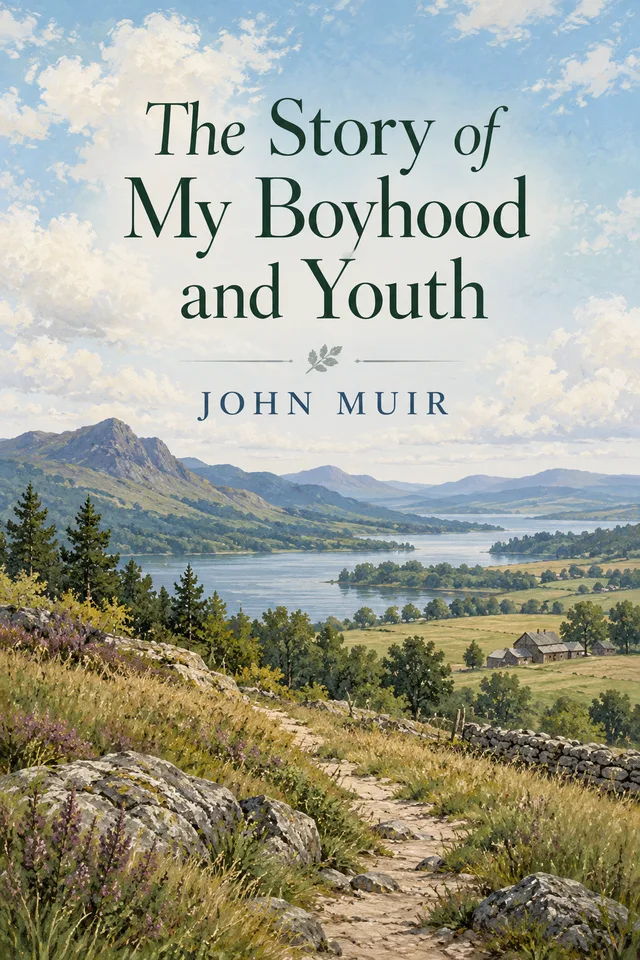
The Story of My Boyhood and Youth
English BooksWhale Edition by John Muir
John Muir recalls a Scottish childhood, hard work on a Wisconsin farm, and the curiosity that shaped his life.
- Preview
- A sample from the prepared text
- Formats
- Online reader, EPUB, PDF
- Access
- Library claim
Book introduction
The Story of My Boyhood and Youth
John Muir traces his early years from Dunbar in Scotland to a demanding family farm in Wisconsin and his first experiences of university life. Encounters with birds, plants, animals, machinery, and books reveal a mind continually learning from the world around it. Across eight chapters, the memoir connects the discipline of farm labor with the independence and wonder that would carry Muir into the wilderness.
BooksWhale edition
How this edition was prepared
This edition is based on a public domain text and has been prepared for digital reading by BooksWhale.
Public domain basis
Why this edition can be shared
Original English work by John Muir, who died in 1914. The source is the public-domain transcription from Project Gutenberg; modern editorial apparatus and illustrations are excluded.
Read preview
A sample from the prepared text
Preview selected from the prepared reader text.
Preview chapterI — A BOYHOOD IN SCOTLANDRead preview
Earliest Recollections—The “Dandy Doctor” Terror—Deeds of Daring—The Savagery of Boys—School and Fighting—Birds’-nesting.
When I was a boy in Scotland I was fond of everything that was wild, and all my life I’ve been growing fonder and fonder of wild places and wild creatures. Fortunately around my native town of Dunbar, by the stormy North Sea, there was no lack of wildness, though most of the land lay in smooth cultivation. With red-blooded playmates, wild as myself, I loved to wander in the fields to hear the birds sing, and along the seashore to gaze and wonder at the shells and seaweeds, eels and crabs in the pools among the rocks when the tide was low; and best of all to watch the waves in awful storms thundering on the black headlands and craggy ruins of the old Dunbar Castle when the sea and the sky, the waves and the clouds, were mingled together as one. We never thought of playing truant, but after I was five or six years old I ran away to the seashore or the fields almost every Saturday, and every day in the school vacations except Sundays, though solemnly warned that I must play at home in the garden and back yard, lest I should learn to think bad thoughts and say bad words. All in vain. In spite of the sure sore punishments that followed like shadows, the natural inherited wildness in our blood ran true on its glorious course as invincible and unstoppable as stars.
My earliest recollections of the country were gained on short walks with my grandfather when I was perhaps not over three years old. On one of these walks grandfather took me to Lord Lauderdale’s gardens, where I saw figs growing against a sunny wall and tasted some of them, and got as many apples to eat as I wished. On another memorable walk in a hay-field, when we sat down to rest on one of the haycocks I heard a sharp, prickly, stinging cry, and, jumping up eagerly, called grandfather’s attention to it. He said he heard only the wind, but I insisted on digging into the hay and turning it over until we discovered the source of the strange exciting sound,—a mother field mouse with half a dozen naked young hanging to her teats. This to me was a wonderful discovery. No hunter could have been more excited on discovering a bear and her cubs in a wilderness den.
I was sent to school before I had completed my third year. The first schoolday was doubtless full of wonders, but I am not able to recall any of them. I remember the servant washing my face and getting soap in my eyes, and mother hanging a little green bag with my first book in it around my neck so I would not lose it, and its blowing back in the sea-wind like a flag. But before I was sent to school my grandfather, as I was told, had taught me my letters from shop signs across the street. I can remember distinctly how proud I was when I had spelled my way through the little first book into the second, which seemed large and important, and so on to the third. Going from one book to another formed a grand triumphal advancement, the memories of which still stand out in clear relief.
The third book contained interesting stories as well as plain reading-and spelling-lessons. To me the best story of all was “Llewellyn’s Dog,” the first animal that comes to mind after the needle-voiced field mouse. It so deeply interested and touched me and some of my classmates that we read it over and over with aching hearts, both in and out of school and shed bitter tears over the brave faithful dog, Gelert, slain by his own master, who imagined that he had devoured his son because he came to him all bloody when the boy was lost, though he had saved the child’s life by killing a big wolf. We have to look far back to learn how great may be the capacity of a child’s heart for sorrow and sympathy with animals as well as with human friends and neighbors. This auld-lang-syne story stands out in the throng of old schoolday memories as clearly as if I had myself been one of that Welsh hunting-party—heard the bugles blowing, seen Gelert slain, joined in the search for the lost child, discovered it at last happy and smiling among the grass and bushes beside the dead, mangled wolf, and wept with Llewellyn over the sad fate of his noble, faithful dog friend.
Preview chapterII — A NEW WORLDPreview
Stories of America—Glorious News—Crossing the Atlantic—The New Home—A Baptism in Nature—New Birds—The Adventures of Watch—Scotch Correction—Marauding Indians.
Our grammar-school reader, called, I think, “Maccoulough’s Course of Reading,” contained a few natural-history sketches that excited me very much and left a deep impression, especially a fine description of the fish hawk and the bald eagle by the Scotch ornithologist Wilson, who had the good fortune to wander for years in the American woods while the country was yet mostly wild. I read his description over and over again, till I got the vivid picture he drew by heart,—the long-winged hawk circling over the heaving waves, every motion watched by the eagle perched on the top of a crag or dead tree; the fish hawk poising for a moment to take aim at a fish and plunging under the water; the eagle with kindling eye spreading his wings ready for instant flight in case the attack should prove successful; the hawk emerging with a struggling fish in his talons, and proud flight; the eagle launching himself in pursuit; the wonderful wing-work in the sky, the fish hawk, though encumbered with his prey, circling higher, higher, striving hard to keep above the robber eagle; the eagle at length soaring above him, compelling him with a cry of despair to drop his hard-won prey; then the eagle steadying himself for a moment to take aim, descending swift as a lightning-bolt, and seizing the falling fish before it reached the sea.
Not less exciting and memorable was Audubon’s wonderful story of the passenger pigeon, a beautiful bird flying in vast flocks that darkened the sky like clouds, countless millions assembling to rest and sleep and rear their young in certain forests, miles in length and breadth, fifty or a hundred nests on a single tree; the overloaded branches bending low and often breaking; the farmers gathering from far and near, beating down countless thousands of the young and old birds from their nests and roosts with long poles at night, and in the morning driving their bands of hogs, some of them brought from farms a hundred miles distant, to fatten on the dead and wounded covering the ground.
In another of our reading-lessons some of the American forests were described. The most interesting of the trees to us boys was the sugar maple, and soon after we had learned this sweet story we heard everybody talking about the discovery of gold in the same wonder-filled country.
One night, when David and I were at grandfather’s fireside solemnly learning our lessons as usual, my father came in with news, the most wonderful, most glorious, that wild boys ever heard. “Bairns,” he said, “you needna learn your lessons the nicht, for we’re gan to America the morn!” No more grammar, but boundless woods full of mysterious good things; trees full of sugar, growing in ground full of gold; hawks, eagles, pigeons, filling the sky; millions of birds’ nests, and no gamekeepers to stop us in all the wild, happy land. We were utterly, blindly glorious. After father left the room, grandfather gave David and me a gold coin apiece for a keepsake, and looked very serious, for he was about to be deserted in his lonely old age. And when we in fullness of young joy spoke of what we were going to do, of the wonderful birds and their nests that we should find, the sugar and gold, etc., and promised to send him a big box full of that tree sugar packed in gold from the glorious paradise over the sea, poor lonely grandfather, about to be forsaken, looked with downcast eyes on the floor and said in a low, trembling, troubled voice, “Ah, poor laddies, poor laddies, you’ll find something else ower the sea forbye gold and sugar, birds’ nests and freedom fra lessons and schools. You’ll find plenty hard, hard work.” And so we did. But nothing he could say could cloud our joy or abate the fire of youthful, hopeful, fearless adventure. Nor could we in the midst of such measureless excitement see or feel the shadows and sorrows of his darkening old age. To my schoolmates, met that night on the street, I shouted the glorious news, “I’m gan to Amaraka the morn!” None could believe it. I said, “Weel, just you see if I am at the skule the morn!”
Preview chapterIII — LIFE ON A WISCONSIN FARMPreview
Humanity in Oxen—Jack, the Pony—Learning to Ride—Nob and Nell—Snakes—Mosquitoes and their Kin—Fish and Fishing—Considering the Lilies—Learning to Swim—A Narrow Escape from Drowning and a Victory—Accidents to Animals.
Coming direct from school in Scotland while we were still hopefully ignorant and far from tame,—notwithstanding the unnatural profusion of teaching and thrashing lavished upon us,—getting acquainted with the animals about us was a never-failing source of wonder and delight. At first my father, like nearly all the backwoods settlers, bought a yoke of oxen to do the farm work, and as field after field was cleared, the number was gradually increased until we had five yoke. These wise, patient, plodding animals did all the ploughing, logging, hauling, and hard work of every sort for the first four or five years, and, never having seen oxen before, we looked at them with the same eager freshness of conception as we did at the wild animals. We worked with them, sympathized with them in their rest and toil and play, and thus learned to know them far better than we should had we been only trained scientific naturalists. We soon learned that each ox and cow and calf had individual character. Old white-faced Buck, one of the second yoke of oxen we owned, was a notably sagacious fellow. He seemed to reason sometimes almost like ourselves. In the fall we fed the cattle lots of pumpkins and had to split them open so that mouthfuls could be readily broken off. But Buck never waited for us to come to his help. The others, when they were hungry and impatient, tried to break through the hard rind with their teeth, but seldom with success if the pumpkin was full grown. Buck never wasted time in this mumbling, slavering way, but crushed them with his head. He went to the pile, picked out a good one, like a boy choosing an orange or apple, rolled it down on to the open ground, deliberately kneeled in front of it, placed his broad, flat brow on top of it, brought his weight hard down and crushed it, then quietly arose and went on with his meal in comfort. Some would call this “instinct,” as if so-called “blind instinct” must necessarily make an ox stand on its head to break pumpkins when its teeth got sore, or when nobody came with an axe to split them. Another fine ox showed his skill when hungry by opening all the fences that stood in his way to the corn-fields.
The humanity we found in them came partly through the expression of their eyes when tired, their tones of voice when hungry and calling for food, their patient plodding and pulling in hot weather, their long-drawn-out sighing breath when exhausted and suffering like ourselves, and their enjoyment of rest with the same grateful looks as ours. We recognized their kinship also by their yawning like ourselves when sleepy and evidently enjoying the same peculiar pleasure at the roots of their jaws; by the way they stretched themselves in the morning after a good rest; by learning languages,—Scotch, English, Irish, French, Dutch,—a smattering of each as required in the faithful service they so willingly, wisely rendered; by their intelligent, alert curiosity, manifested in listening to strange sounds; their love of play; the attachments they made; and their mourning, long continued, when a companion was killed.
When we went to Portage, our nearest town, about ten or twelve miles from the farm, it would oftentimes be late before we got back, and in the summer-time, in sultry, rainy weather, the clouds were full of sheet lightning which every minute or two would suddenly illumine the landscape, revealing all its features, the hills and valleys, meadows and trees, about as fully and clearly as the noonday sunshine; then as suddenly the glorious light would be quenched, making the darkness seem denser than before. On such nights the cattle had to find the way home without any help from us, but they never got off the track, for they followed it by scent like dogs. Once, father, returning late from Portage or Kingston, compelled Tom and Jerry, our first oxen, to leave the dim track, imagining they must be going wrong. At last they stopped and refused to go farther. Then father unhitched them from the wagon, took hold of Tom’s tail, and was thus led straight to the shanty. Next morning he set out to seek his wagon and found it on the brow of a steep hill above an impassable swamp. We learned less from the cows, because we did not enter so far into their lives, working with them, suffering heat and cold, hunger and thirst, and almost deadly weariness with them; but none with natural charity could fail to sympathize with them in their love for their calves, and to feel that it in no way differed from the divine mother-love of a woman in thoughtful, self-sacrificing care; for they would brave every danger, giving their lives for their offspring. Nor could we fail to sympathize with their awkward, blunt-nosed baby calves, with such beautiful, wondering eyes looking out on the world and slowly getting acquainted with things, all so strange to them, and awkwardly learning to use their legs, and play and fight.
Table of contents
Inside this edition
- 01I — A BOYHOOD IN SCOTLAND
- 02II — A NEW WORLD
- 03III — LIFE ON A WISCONSIN FARM
- 04IV — A PARADISE OF BIRDS
- 05V — YOUNG HUNTERS
- 06VI — THE PLOUGHBOY
- 07VII — KNOWLEDGE AND INVENTIONS
- 08VIII — THE WORLD AND THE UNIVERSITY
Language availability
Other languages
Additional language editions are not published yet. This section will link to other BooksWhale editions when they become available.
Request another language