English Edition
Literature
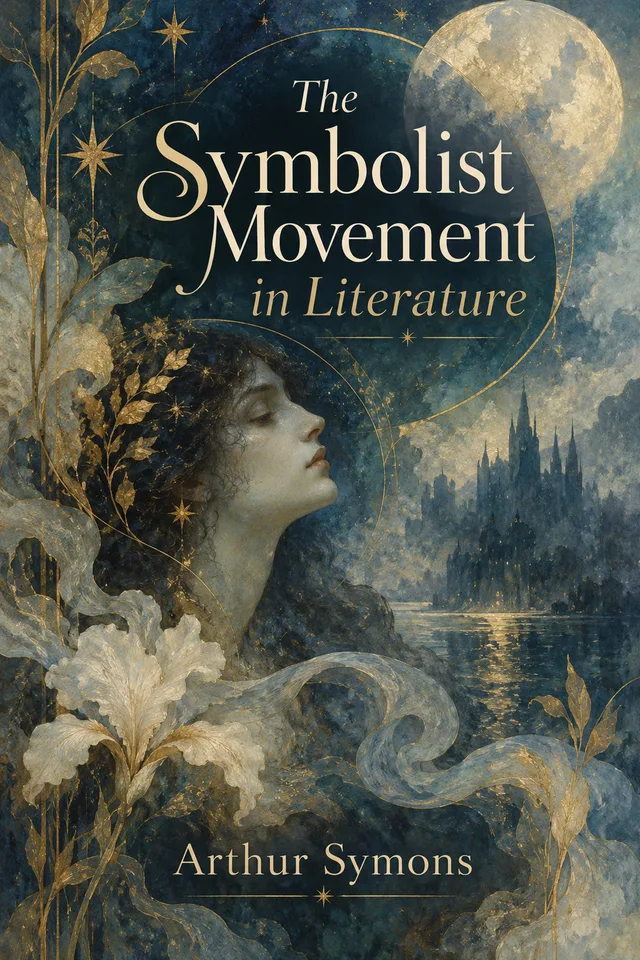
The Symbolist Movement in Literature
English BooksWhale Edition by Arthur Symons
Arthur Symons explores French literary modernity through essays on symbolism, poetic language, spiritual experience, and individual writers.
- Preview
- A sample from the prepared text
- Formats
- Online reader, EPUB, PDF
- Access
- Library claim
Book introduction
The Symbolist Movement in Literature
Arthur Symons studies a literary movement concerned with suggestion, inward experience, and meanings that resist direct statement. Essays on writers including Balzac, Baudelaire, Mallarmé, Verlaine, Rimbaud, Laforgue, and Maeterlinck place symbolism within a broader account of French literature. The critical essays of the expanded edition move between close characterisation, aesthetic argument, and reflection on the relationship between language, consciousness, and spiritual aspiration.
BooksWhale edition
How this edition was prepared
This edition is based on a public domain text and has been prepared for digital reading by BooksWhale.
Public domain basis
Why this edition can be shared
Arthur Symons died in 1945. This edition uses the public-domain English original, first published in 1899, from Project Gutenberg; later editorial notes and illustrations are excluded.
Read preview
A sample from the prepared text
Preview selected from the prepared reader text.
Preview chapterFull textRead preview
The Symbolist Movement in Literature
Preview chapterINTRODUCTIONPreview
"It is in and through Symbols that man, consciously or unconsciously, lives, works, and has his being: those ages, moreover, are accounted the noblest which can the best recognise symbolical worth, and prize it highest." Carlyle
Without symbolism there can be no literature; indeed, not even language. What are words themselves but symbols, almost as arbitrary as the letters which compose them, mere sounds of the voice to which we have agreed to give certain significations, as we have agreed to translate these sounds by those combinations of letters? Symbolism began with the first words uttered by the first man, as he named every living thing; or before them, in heaven, when God named the world into being. And we see, in these beginnings, precisely what Symbolism in literature really is: a form of expression, at the best but approximate, essentially but arbitrary, until it has obtained the force of a convention, for an unseen reality apprehended by the consciousness. It is sometimes permitted to us to hope that our convention is indeed the reflection rather than merely the sign of that unseen reality. We have done much if we have found a recognisable sign.
"A symbol," says Comte Goblet d'Alviella, in his book on The Migration of Symbols, "might be defined as a representation which does not aim at being a reproduction." Originally, as he points out, used by the Greeks to denote "the two halves of the tablet they divided between themselves as a pledge of hospitality," it came to be used of every sign, formula, or rite by which those initiated in any mystery made themselves secretly known to one another. Gradually the word extended its meaning, until it came to denote every conventional representation of idea by form, of the unseen by the visible. "In a Symbol," says Carlyle, "there is concealment and yet revelation: hence, therefore, by Silence and by Speech acting together, comes a double significance." And, in that fine chapter of Sartor Resartus, he goes further, vindicating for the word its full value: "In the Symbol proper, what we can call a Symbol, there is ever, more or less distinctly and directly, some embodiment and revelation of the Infinite; the Infinite is made to blend itself with the Finite, to stand visible, and as it were, attainable there."
It is in such a sense as this that the word Symbolism has been used to describe a movement which, during the last generation, has profoundly influenced the course of French literature. All such words, used of anything so living, variable, and irresponsible as literature, are, as symbols themselves must so often be, mere compromises, mere indications. Symbolism, as seen in the writers of our day, would have no value if it were not seen also, under one disguise or another, in every great imaginative writer. What distinguishes the Symbolism of our day from the Symbolism of the past; is that it has now become conscious of itself, in a sense in which it was unconscious even in Gérard de Nerval, to whom I trace the particular origin of the literature which I call Symbolist. The forces which mould the thought of men change, or men's resistance to them slackens; with the change of men's thought comes a change of literature, alike in its inmost essence and in its outward form: after the world has starved its soul long enough in the contemplation and the re-arrangement of material things, comes the turn of the soul; and with it comes the literature of which I write in this volume, a literature in which the visible world is no longer a reality, and the unseen world no longer a dream.
The great epoch in French literature which preceded this epoch was that of the offshoot of Romanticism which produced Baudelaire, Flaubert, the Goncourts, Taine, Zola, Leconte de Lisle. Taine was the philosopher both of what had gone before him and of what came immediately after; so that he seems to explain at once Flaubert and Zola. It was the age of Science, the age of material things; and words, with that facile elasticity which there is in them, did miracles in the exact representation of everything that visibly existed, exactly as it existed. Even Baudelaire, in whom the spirit is always an uneasy guest at the orgie of life, had a certain theory of Realism which tortures many of his poems into strange, metallic shapes, and fills them with imitative odours, and disturbs them with a too deliberate rhetoric of the flesh? Flaubert, the one impeccable novelist who has ever lived, was resolute to be the novelist of a world in which art, formal art, was the only escape from the burden of reality, and in which the soul was of use mainly as the agent of fine literature. The Goncourts caught at Impressionism to render the fugitive aspects of a world which existed only as a thing of flat spaces, and angles, and coloured movement, in which sun and shadow were the artists; as moods, no less flitting, were the artists of the merely receptive consciousnesses of men and women. Zola has tried to build in brick and mortar inside the covers of a book; he is quite sure that the soul is a nervous fluid, which he is quite sure some man of science is about to catch for us, as a man of science has bottled the air, a pretty, blue liquid. Leconte de Lisle turned the world to stone, but saw, beyond the world, only a pause from misery in a Nirvana never subtilised to the Eastern ecstasy. And, with all these writers, form aimed above all things at being precise, at saying rather than suggesting, at saying what they had to say so completely that nothing remained over, which it might be the business of the reader to divine. And so they have expressed, finally, a certain aspect of the world; and some of them have carried style to a point beyond which the style that says, rather than suggests, cannot go. The whole of that movement comes to a splendid funeral in M. de Heredia's sonnets, in which the literature of form says its last word, and dies.
Preview chapterBALZACPreview
The first man who has completely understood Balzac is Rodin, and it has taken Rodin ten years to realise his own conception. France has refused the statue in which a novelist is represented as a dreamer, to whom Paris is not so much Paris as Patmos: "the most Parisian of our novelists," Frenchmen assure you. It is more than a hundred years since Balzac was born: a hundred years is a long time in which to be misunderstood with admiration.
In choosing the name of the Human Comedy for a series of novels in which, as he says, there is at once "the history and the criticism of society, the analysis of its evils, and the discussion of its principles," Balzac proposed to do for the modern world what Dante, in his Divine Comedy, had done for the world of the Middle Ages. Condemned to write in prose, and finding his opportunity in that restriction, he created for himself a form which is perhaps the nearest equivalent for the epic or the poetic drama, and the only form in which, at all events, the epic is now possible. The world of Dante was materially simple compared with the world of the nineteenth century; the "visible world" had not yet begun to "exist," in its tyrannical modern sense; the complications of the soul interested only the Schoolmen, and were a part of theology; poetry could still represent an age and yet be poetry. But to-day poetry can no longer represent more than the soul of things; it had taken refuge from the terrible improvements of civilisation in a divine seclusion, where it sings, disregarding the many voices of the street. Prose comes offering its infinite capacity for detail; and it is by the infinity of its detail that the novel, as Balzac created it, has become the modern epic.
There had been great novels, indeed, before Balzac, but no great novelist; and the novels themselves are scarcely what we should to-day call by that name. The interminable Astrée and its companions form a link between the fabliaux and the novel, and from them developed the characteristic eighteenth-century conte, in narrative, letters, or dialogue, as we see it in Marivaux, Laclos, Crebillon fils, Crebillon's longer works, including Le Sopha, with their conventional paraphernalia of Eastern fable, are extremely tedious; but in two short pieces, La Nuit et le Moment and Le Hasard du Coin du Feu, he created a model of witty, naughty, deplorably natural comedy, which to this day is one of the most characteristic French forms of fiction. Properly, however, it is a form of the drama rather than of the novel. Laclos, in Les Liaisons Dangereuses, a masterpiece which scandalised the society that adored Crebillon, because its naked human truth left no room for sentimental excuses, comes much nearer to prefiguring the novel (as Stendhal, for instance, is afterward to conceive it), but still preserves the awkward traditional form of letters. Marivaux had indeed already seemed to suggest the novel of analysis, but in a style which has christened a whole manner of writing that precisely which is least suited to the writing of fiction. Voltaire's contes, La Religieuse of Diderot, are tracts or satires in which the story is only an excuse for the purpose. Rousseau, too, has his purpose, even in La Nouvelle Héloise, but it is a humanising purpose; and with that book the novel of passion comes into existence, and along with it the descriptive novel. Yet with Rousseau this result is an accident of genius; we cannot call him a novelist; and we find him abandoning the form he has found, for another, more closely personal, which suits him better. Restif de la Bretonne, who followed Rousseau at a distance, not altogether wisely, developed the form of half-imaginary autobiography in Monsieur Nicolas, a book of which the most significant part may be compared with Hazlitt's Liber Amoris. Morbid and even mawkish as it is, it has a certain uneasy, unwholesome humanity in its confessions, which may seem to have set a fashion only too scrupulously followed by modern French novelists. Meanwhile, the Abbé Prévost's one great story, Manon Lescaut, had brought for once a purely objective study, of an incomparable simplicity, into the midst of these analyses of difficult souls; and then we return to the confession, in the works of others not novelists: Benjamin Constant, Mme. de Staël, Chateaubriand, in Adolphe, Corinne, René. At once we are in the Romantic movement, a movement which begins lyrically among poets, and at first with a curious disregard of the more human part of humanity.
Table of contents
Inside this edition
- 01Full text
- 02INTRODUCTION
- 03BALZAC
- 04PROSPER MÉRIMÉE
- 05GÉRARD DE NERVAL
- 06THÉOPHILE GAUTIER
- 07GUSTAVE FLAUBERT
- 08CHARLES BAUDELAIRE
- 09EDMOND AND JULES DE GONCOURT
- 10VILLIERS DE L'ISLE-ADAM
- 11LÉON CLADEL
- 12A NOTE ON ZOLA'S METHOD
- 13STÉPHANE MALLARMÉ
- 14PAUL VERLAINE
- 15I. JORIS-KARL HUYSMANS
- 16II. THE LATER HUYSMANS
- 17ARTHUR RIMBAUD
- 18JULES LAFORGUE
- 19MAETERLINCK AS A MYSTIC
- 20CONCLUSION
Language availability
Other languages
Additional language editions are not published yet. This section will link to other BooksWhale editions when they become available.
Request another language