English Edition
Literature
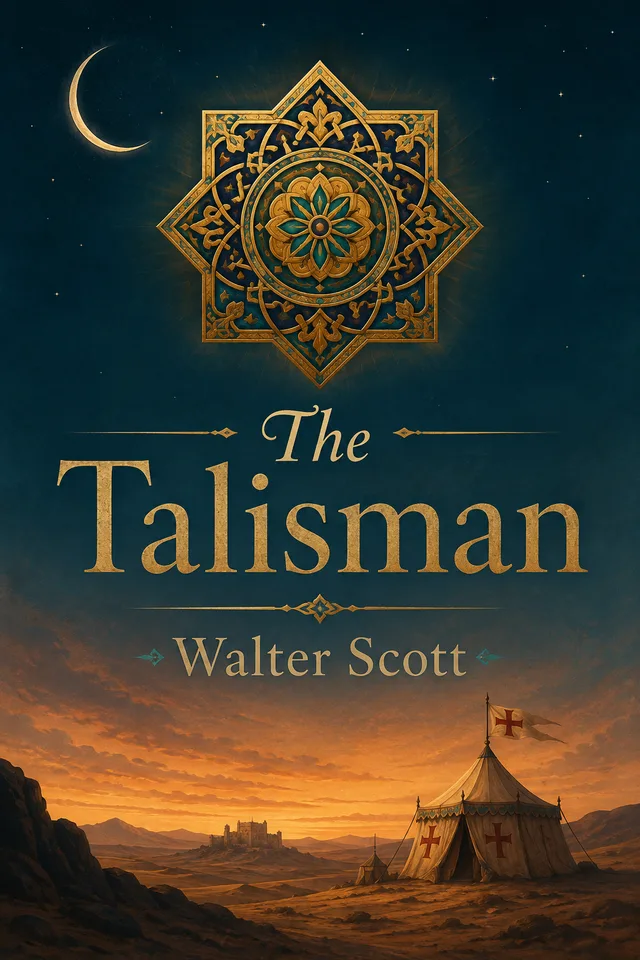
The Talisman
English BooksWhale Edition by Walter Scott
A Crusades romance featuring Richard the Lionheart, Saladin, chivalry, disguise, illness, and honor.
- Preview
- A sample from the prepared text
- Formats
- Online reader, EPUB, PDF
- Access
- Library claim
Book introduction
The Talisman
The Talisman sets Walter Scott’s historical imagination in the Third Crusade. Richard the Lionheart, Saladin, knights, physicians, political intrigue, and questions of honor shape a romance of conflict and mutual admiration across enemy lines.
BooksWhale edition
How this edition was prepared
This edition is based on a public domain text and has been prepared for digital reading by BooksWhale.
Public domain basis
Why this edition can be shared
Walter Scott died in 1832, and The Talisman was first published in 1825; these dates support the public-domain basis for the original English text.
Read preview
A sample from the prepared text
Preview selected from the prepared reader text.
Preview chapterFull textRead preview
The Talisman
Walter Scott
Preview chapterTHE TALISMANPreview
By Sir Walter Scott
Preview chapterINTRODUCTION TO THE TALISMAN.Preview
The “Betrothed” did not greatly please one or two friends, who thought that it did not well correspond to the general title of “The Crusaders.” They urged, therefore, that, without direct allusion to the manners of the Eastern tribes, and to the romantic conflicts of the period, the title of a “Tale of the Crusaders” would resemble the playbill, which is said to have announced the tragedy of Hamlet, the character of the Prince of Denmark being left out. On the other hand, I felt the difficulty of giving a vivid picture of a part of the world with which I was almost totally unacquainted, unless by early recollections of the Arabian Nights' Entertainments; and not only did I labour under the incapacity of ignorance--in which, as far as regards Eastern manners, I was as thickly wrapped as an Egyptian in his fog--but my contemporaries were, many of them, as much enlightened upon the subject as if they had been inhabitants of the favoured land of Goshen. The love of travelling had pervaded all ranks, and carried the subjects of Britain into all quarters of the world. Greece, so attractive by its remains of art, by its struggles for freedom against a Mohammedan tyrant, by its very name, where every fountain had its classical legend--Palestine, endeared to the imagination by yet more sacred remembrances--had been of late surveyed by British eyes, and described by recent travellers. Had I, therefore, attempted the difficult task of substituting manners of my own invention, instead of the genuine costume of the East, almost every traveller I met who had extended his route beyond what was anciently called “The Grand Tour,” had acquired a right, by ocular inspection, to chastise me for my presumption. Every member of the Travellers' Club who could pretend to have thrown his shoe over Edom was, by having done so, constituted my lawful critic and corrector. It occurred, therefore, that where the author of Anastasius, as well as he of Hadji Baba, had described the manners and vices of the Eastern nations, not only with fidelity, but with the humour of Le Sage and the ludicrous power of Fielding himself, one who was a perfect stranger to the subject must necessarily produce an unfavourable contrast. The Poet Laureate also, in the charming tale of “Thalaba,” had shown how extensive might be the researches of a person of acquirements and talent, by dint of investigation alone, into the ancient doctrines, history, and manners of the Eastern countries, in which we are probably to look for the cradle of mankind; Moore, in his “Lalla Rookh,” had successfully trod the same path; in which, too, Byron, joining ocular experience to extensive reading, had written some of his most attractive poems. In a word, the Eastern themes had been already so successfully handled by those who were acknowledged to be masters of their craft, that I was diffident of making the attempt.
These were powerful objections; nor did they lose force when they became the subject of anxious reflection, although they did not finally prevail. The arguments on the other side were, that though I had no hope of rivalling the contemporaries whom I have mentioned, yet it occurred to me as possible to acquit myself of the task I was engaged in without entering into competition with them.
The period relating more immediately to the Crusades which I at last fixed upon was that at which the warlike character of Richard I., wild and generous, a pattern of chivalry, with all its extravagant virtues, and its no less absurd errors, was opposed to that of Saladin, in which the Christian and English monarch showed all the cruelty and violence of an Eastern sultan, and Saladin, on the other hand, displayed the deep policy and prudence of a European sovereign, whilst each contended which should excel the other in the knightly qualities of bravery and generosity. This singular contrast afforded, as the author conceived, materials for a work of fiction possessing peculiar interest. One of the inferior characters introduced was a supposed relation of Richard Coeur de Lion--a violation of the truth of history which gave offence to Mr. Mills, the author of the “History of Chivalry and the Crusades,” who was not, it may be presumed, aware that romantic fiction naturally includes the power of such invention, which is indeed one of the requisites of the art.
Table of contents
Inside this edition
- 01Full text
- 02THE TALISMAN
- 03INTRODUCTION TO THE TALISMAN.
- 04APPENDIX TO INTRODUCTION.
- 05ELLIS'S SPECIMENS OF EARLY ENGLISH METRICEL ROMANCES.
- 06TALES OF THE CRUSADERS. TALE II.--THE TALISMAN.
- 07CHAPTER I.
- 08CHAPTER II.
- 09CHAPTER III.
- 10AHRIMAN.
- 11CHAPTER IV.
- 12CHAPTER V.
- 13CHAPTER VI.
- 14CHAPTER VII.
- 15CHAPTER VIII.
- 16CHAPTER IX.
- 17CHAPTER X.
- 18CHAPTER XI.
- 19CHAPTER XII.
- 20CHAPTER XIII.
- 21CHAPTER XIV.
- 22CHAPTER XV.
- 23CHAPTER XVI.
- 24CHAPTER XVII.
- 25CHAPTER XVIII.
- 26CHAPTER XIX.
- 27CHAPTER XX.
- 28CHAPTER XXI
- 29CHAPTER XXII.
- 30CHAPTER XXIII.
- 31CHAPTER XXIV
- 32CHAPTER XXV.
- 33CHAPTER XXVI.
- 34THE BLOODY VEST.
- 35THE BLOODY VEST.
- 36FYTTE SECOND.
- 37CHAPTER XXVII.
- 38CHAPTER XXVIII.
Language availability
Other languages
Additional language editions are not published yet. This section will link to other BooksWhale editions when they become available.
Request another language