English Edition
Literature
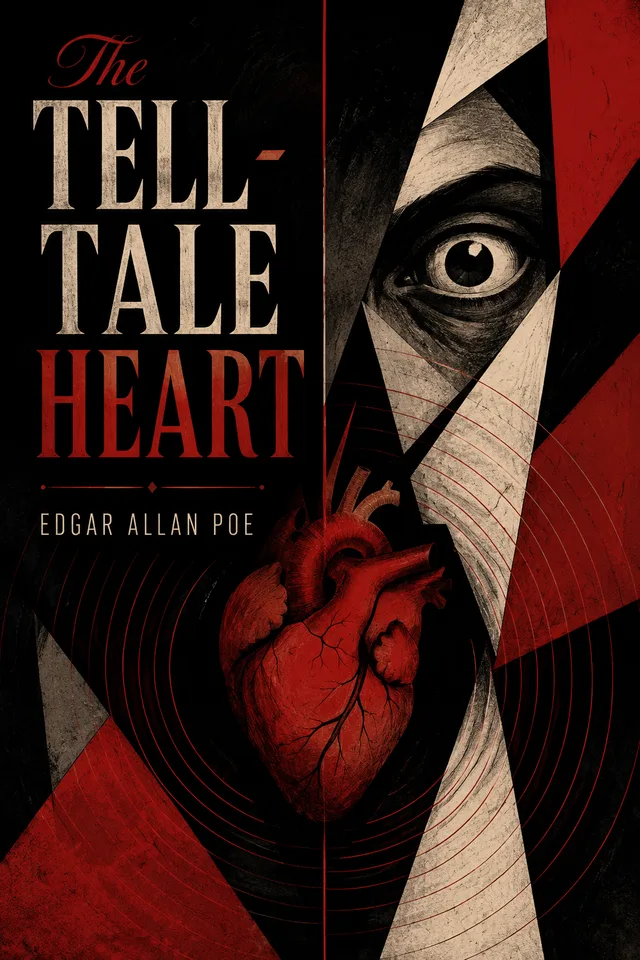
The Tell-Tale Heart
English BooksWhale Edition by Edgar Allan Poe
A tense psychological tale of obsession, murder, guilt, and an impossible heartbeat.
- Preview
- A sample from the prepared text
- Formats
- Online reader, EPUB, PDF
- Access
- Library claim
Book introduction
The Tell-Tale Heart
The Tell-Tale Heart compresses terror into a fierce first-person confession. Poe's narrator insists on sanity while revealing obsession, violence, and guilt with unforgettable intensity.
BooksWhale edition
How this edition was prepared
This edition is based on a public domain text and has been prepared for digital reading by BooksWhale.
Public domain basis
Why this edition can be shared
Edgar Allan Poe died in 1849, and The Tell-Tale Heart was first published in 1843. These dates support the public-domain basis for the English source text used in this edition.
Read preview
A sample from the prepared text
Preview selected from the prepared reader text.
Preview chapterFull textRead preview
The Tell-Tale Heart
Preview chapterTHE SPECTACLESPreview
Many years ago, it was the fashion to ridicule the idea of "love at first sight;" but those who think, not less than those who feel deeply, have always advocated its existence. Modern discoveries, indeed, in what may be termed ethical magnetism or magnetoesthetics, render it probable that the most natural, and, consequently, the truest and most intense of the human affections are those which arise in the heart as if by electric sympathy—in a word, that the brightest and most enduring of the psychal fetters are those which are riveted by a glance. The confession I am about to make will add another to the already almost innumerable instances of the truth of the position.
My story requires that I should be somewhat minute. I am still a very young man—not yet twenty-two years of age. My name, at present, is a very usual and rather plebeian one—Simpson. I say "at present;" for it is only lately that I have been so called—having legislatively adopted this surname within the last year in order to receive a large inheritance left me by a distant male relative, Adolphus Simpson, Esq. The bequest was conditioned upon my taking the name of the testator,—the family, not the Christian name; my Christian name is Napoleon Bonaparte—or, more properly, these are my first and middle appellations.
I assumed the name, Simpson, with some reluctance, as in my true patronym, Froissart, I felt a very pardonable pride—believing that I could trace a descent from the immortal author of the "Chronicles." While on the subject of names, by the bye, I may mention a singular coincidence of sound attending the names of some of my immediate predecessors. My father was a Monsieur Froissart, of Paris. His wife—my mother, whom he married at fifteen—was a Mademoiselle Croissart, eldest daughter of Croissart the banker, whose wife, again, being only sixteen when married, was the eldest daughter of one Victor Voissart. Monsieur Voissart, very singularly, had married a lady of similar name—a Mademoiselle Moissart. She, too, was quite a child when married; and her mother, also, Madame Moissart, was only fourteen when led to the altar. These early marriages are usual in France. Here, however, are Moissart, Voissart, Croissart, and Froissart, all in the direct line of descent. My own name, though, as I say, became Simpson, by act of Legislature, and with so much repugnance on my part, that, at one period, I actually hesitated about accepting the legacy with the useless and annoying proviso attached.
As to personal endowments, I am by no means deficient. On the contrary, I believe that I am well made, and possess what nine tenths of the world would call a handsome face. In height I am five feet eleven. My hair is black and curling. My nose is sufficiently good. My eyes are large and gray; and although, in fact they are weak a very inconvenient degree, still no defect in this regard would be suspected from their appearance. The weakness itself, however, has always much annoyed me, and I have resorted to every remedy—short of wearing glasses. Being youthful and good-looking, I naturally dislike these, and have resolutely refused to employ them. I know nothing, indeed, which so disfigures the countenance of a young person, or so impresses every feature with an air of demureness, if not altogether of sanctimoniousness and of age. An eyeglass, on the other hand, has a savor of downright foppery and affectation. I have hitherto managed as well as I could without either. But something too much of these merely personal details, which, after all, are of little importance. I will content myself with saying, in addition, that my temperament is sanguine, rash, ardent, enthusiastic—and that all my life I have been a devoted admirer of the women.
One night last winter I entered a box at the P-—Theatre, in company with a friend, Mr. Talbot. It was an opera night, and the bills presented a very rare attraction, so that the house was excessively crowded. We were in time, however, to obtain the front seats which had been reserved for us, and into which, with some little difficulty, we elbowed our way.
Preview chapterA TALE OF THE RAGGED MOUNTAINSPreview
During the fall of the year 1827, while residing near Charlottesville, Virginia, I casually made the acquaintance of Mr. Augustus Bedloe. This young gentleman was remarkable in every respect, and excited in me a profound interest and curiosity. I found it impossible to comprehend him either in his moral or his physical relations. Of his family I could obtain no satisfactory account. Whence he came, I never ascertained. Even about his age - although I call him a young gentleman - there was something which perplexed me in no little degree. He certainly seemed young - and he made a point of speaking about his youth - yet there were moments when I should have had little trouble in imagining him a hundred years of age. But in no regard was he more peculiar than in his personal appearance. He was singularly tall and thin. He stooped much. His limbs were exceedingly long and emaciated. His forehead was broad and low. His complexion was absolutely bloodless. His mouth was large and flexible and his teeth were more wildly uneven, although sound, than I had ever before seen teeth in a human head. The expression of his smile, however, was by no means unpleasing, as might be supposed; but it had no variation whatever. It was one of profound melancholy - of a phaseless and unceasing gloom. His eyes were abnormally large, and round like those of a cat. The pupils, too, upon any accession or diminution of light, underwent contraction or dilation, just such as is observed in the feline tribe. In moments of excitement the orbs grew bright to a degree almost inconceivable; seeming to emit luminous rays, not of a reflected but of an intrinsic lustre, as does a candle or the sun; yet their ordinary condition was so totally vapid, filmy, and dull, as to convey the idea of the eyes of a long-interred corpse.
These peculiarities of person appeared to cause him much annoyance, and he was continually alluding to them in a sort of half-explanatory, half-apologetic strain, which, when I first heard it, impressed me very painfully. I soon, however, grew accustomed to it, and my uneasiness wore off. It seemed to be his design rather to insinuate than directly to assert that, physically, he had not always been what he was - that a long series of neuralgic attacks had reduced him from a condition of more than usual personal beauty, to that which I saw. For many years past he had been attended by a physician, named Templeton - an old gentleman, perhaps seventy years of age - whom he had first encountered at Saratoga, and from whose attention, while there, he either received, or fancied that he received, great benefit. The result was that Bedloe, who was wealthy, had made an arrangement with Dr. Templeton, by which the latter, in consideration of a liberal annual allowance, had consented to devote his time and medical experience exclusively to the care of the invalid.
Doctor Templeton had been a traveller in his younger days, and at Paris had become a convert, in great measure, to the doctrines of Mesmer. It was altogether by means of magnetic remedies that he had succeeded in alleviating the acute pains of his patient; and this success had very naturally inspired the latter with a certain degree of confidence in the opinions from which the remedies had been educed. The Doctor, however, like all enthusiasts, had struggled hard to make a thorough convert of his pupil, and finally so far gained his point as to induce the sufferer to submit to numerous experiments. By a frequent repetition of these, a result had arisen, which of late days has become so common as to attract little or no attention, but which, at the period of which I write, had very rarely been known in America. I mean to say, that between Doctor Templeton and Bedloe there had grown up, little by little, a very distinct and strongly marked rapport, or magnetic relation. I am not prepared to assert, however, that this rapport extended beyond the limits of the simple sleep-producing power; but this power itself had attained great intensity. At the first attempt to induce the magnetic somnolency, the mesmerist entirely failed. In the fifth or sixth he succeeded very partially, and after long continued effort. Only at the twelfth was the triumph complete. After this the will of the patient succumbed rapidly to that of the physician, so that, when I first became acquainted with the two, sleep was brought about almost instantaneously by the mere volition of the operator, even when the invalid was unaware of his presence. It is only now, in the year 1845, when similar miracles are witnessed daily by thousands, that I dare venture to record this apparent impossibility as a matter of serious fact.
Table of contents
Inside this edition
- 01Full text
- 02THE SPECTACLES
- 03A TALE OF THE RAGGED MOUNTAINS
- 04THE PREMATURE BURIAL
- 05MESMERIC REVELATION
- 06THE OBLONG BOX
- 07THE TELL-TALE HEART
- 08THE ANGEL OF THE ODD
- 09THOU ART THE MAN
- 10THE LITERARY LIFE OF THINGUM BOB, ESQ.
- 11THE PURLOINED LETTER
- 12THE THOUSAND-AND-SECOND TALE OF SCHEHERAZADE
- 13SOME WORDS WITH A MUMMY
- 14THE POWER OF WORDS
- 15THE IMP OF THE PERVERSE
- 16THE SYSTEM OF DOCTOR TARR AND PROFESSOR FETHER
- 17THE FACTS IN THE CASE OF M. VALDEMAR
- 18THE SPHINX
- 19THE CASK OF AMONTILLADO
- 20THE DOMAIN OF ARNHEIM
- 21MELLONTA TAUTA
- 22HOP-FROG
- 23VON KEMPELEN AND HIS DISCOVERY
- 24X-ING A PARAGRAB
- 25LANDOR'S COTTAGE
- 26THE LIGHTHOUSE
Language availability
Other languages
Additional language editions are not published yet. This section will link to other BooksWhale editions when they become available.
Request another language