English Edition
Literature
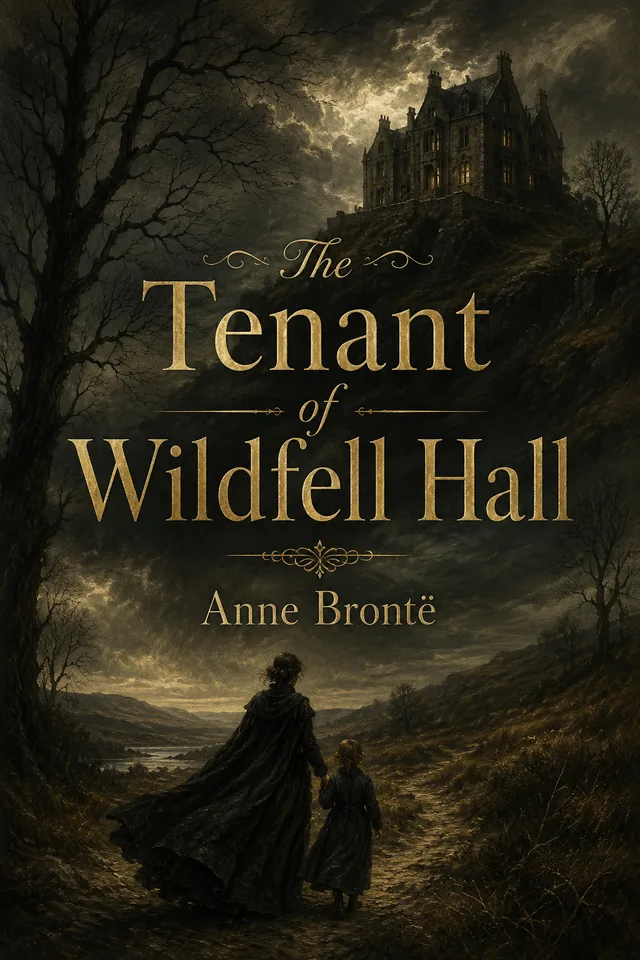
The Tenant of Wildfell Hall
English BooksWhale Edition by Anne Brontë
Anne Brontë's bold novel follows Helen Graham's escape from a destructive marriage and defense of moral freedom.
- Preview
- A sample from the prepared text
- Formats
- Online reader, EPUB, PDF
- Access
- Library claim
Book introduction
The Tenant of Wildfell Hall
The Tenant of Wildfell Hall centers on Helen Graham, whose mysterious arrival and hidden past expose alcoholism, coercion, and the limited rights of married women. Anne Brontë's novel is unusually direct in its treatment of domestic cruelty, conscience, motherhood, and female independence.
BooksWhale edition
How this edition was prepared
This edition is based on a public domain text and has been prepared for digital reading by BooksWhale.
Public domain basis
Why this edition can be shared
Anne Brontë died in 1849, and The Tenant of Wildfell Hall was first published in 1848. These dates support the public-domain basis for this English original-language edition.
Read preview
A sample from the prepared text
Preview selected from the prepared reader text.
Preview chapterFull textRead preview
The Tenant of Wildfell Hall
Preview chapterINTRODUCTIONPreview
Anne Brontë serves a twofold purpose in the study of what the Brontës wrote and were. In the first place, her gentle and delicate presence, her sad, short story, her hard life and early death, enter deeply into the poetry and tragedy that have always been entwined with the memory of the Brontës, as women and as writers; in the second, the books and poems that she wrote serve as matter of comparison by which to test the greatness of her two sisters. She is the measure of their genius—like them, yet not with them.
Many years after Anne’s death her brother-in-law protested against a supposed portrait of her, as giving a totally wrong impression of the “dear, gentle Anne Brontë.” “Dear” and “gentle” indeed she seems to have been through life, the youngest and prettiest of the sisters, with a delicate complexion, a slender neck, and small, pleasant features. Notwithstanding, she possessed in full the Brontë seriousness, the Brontë strength of will. When her father asked her at four years old what a little child like her wanted most, the tiny creature replied—if it were not a Brontë it would be incredible!—“Age and experience.” When the three children started their “Island Plays” together in 1827, Anne, who was then eight, chose Guernsey for her imaginary island, and peopled it with “Michael Sadler, Lord Bentinck, and Sir Henry Halford.” She and Emily were constant companions, and there is evidence that they shared a common world of fancy from very early days to mature womanhood. “The Gondal Chronicles” seem to have amused them for many years, and to have branched out into innumerable books, written in the “tiny writing” of which Mr. Clement Shorter has given us facsimiles. “I am now engaged in writing the fourth volume of Solala Vernon’s Life,” says Anne at twenty-one. And four years later Emily says, “The Gondals still flourish bright as ever. I am at present writing a work on the First War. Anne has been writing some articles on this and a book by Henry Sophona. We intend sticking firm by the rascals as long as they delight us, which I am glad to say they do at present.”
That the author of “Wildfell Hall” should ever have delighted in the Gondals, should ever have written the story of Solala Vernon or Henry Sophona, is pleasant to know. Then, for her too, as for her sisters, there was a moment when the power of “making out” could turn loneliness and disappointment into riches and content. For a time at least, and before a hard and degrading experience had broken the spring of her youth, and replaced the disinterested and spontaneous pleasure that is to be got from the life and play of imagination, by a sad sense of duty, and an inexorable consciousness of moral and religious mission, Anne Brontë wrote stories for her own amusement, and loved the “rascals” she created.
But already in 1841, when we first hear of the Gondals and Solala Vernon, the material for quite other books was in poor Anne’s mind. She was then teaching in the family at Thorpe Green, where Branwell joined her as tutor in 1843, and where, owing to events that are still a mystery, she seems to have passed through an ordeal that left her shattered in health and nerve, with nothing gained but those melancholy and repulsive memories that she was afterwards to embody in “Wildfell Hall.” She seems, indeed, to have been partly the victim of Branwell’s morbid imagination, the imagination of an opium-eater and a drunkard. That he was neither the conqueror nor the villain that he made his sisters believe, all the evidence that has been gathered since Mrs. Gaskell wrote goes to show. But poor Anne believed his account of himself, and no doubt saw enough evidence of vicious character in Branwell’s daily life to make the worst enormities credible. She seems to have passed the last months of her stay at Thorpe Green under a cloud of dread and miserable suspicion, and was thankful to escape from her situation in the summer of 1845. At the same moment Branwell was summarily dismissed from his tutorship, his employer, Mr. Robinson, writing a stern letter of complaint to Branwell’s father, concerned no doubt with the young man’s disorderly and intemperate habits. Mrs. Gaskell says: “The premature deaths of two at least of the sisters—all the great possibilities of their earthly lives snapped short—may be dated from Midsummer 1845.” The facts as we now know them hardly bear out so strong a judgment. There is nothing to show that Branwell’s conduct was responsible in any way for Emily’s illness and death, and Anne, in the contemporary fragment recovered by Mr. Shorter, gives a less tragic account of the matter. “During my stay (at Thorpe Green),” she writes on July 31, 1845, “I have had some very unpleasant and undreamt-of experience of human nature. . . . Branwell has . . . been a tutor at Thorpe Green, and had much tribulation and ill-health. . . . We hope he will be better and do better in future.” And at the end of the paper she says, sadly, forecasting the coming years, “I for my part cannot well be flatter or older in mind than I am now.” This is the language of disappointment and anxiety; but it hardly fits the tragic story that Mrs. Gaskell believed.
Preview chapterCHAPTER IPreview
You must go back with me to the autumn of 1827.
My father, as you know, was a sort of gentleman farmer in ——shire; and I, by his express desire, succeeded him in the same quiet occupation, not very willingly, for ambition urged me to higher aims, and self-conceit assured me that, in disregarding its voice, I was burying my talent in the earth, and hiding my light under a bushel. My mother had done her utmost to persuade me that I was capable of great achievements; but my father, who thought ambition was the surest road to ruin, and change but another word for destruction, would listen to no scheme for bettering either my own condition, or that of my fellow mortals. He assured me it was all rubbish, and exhorted me, with his dying breath, to continue in the good old way, to follow his steps, and those of his father before him, and let my highest ambition be to walk honestly through the world, looking neither to the right hand nor to the left, and to transmit the paternal acres to my children in, at least, as flourishing a condition as he left them to me.
“Well!—an honest and industrious farmer is one of the most useful members of society; and if I devote my talents to the cultivation of my farm, and the improvement of agriculture in general, I shall thereby benefit, not only my own immediate connections and dependants, but, in some degree, mankind at large:—hence I shall not have lived in vain.”
With such reflections as these I was endeavouring to console myself, as I plodded home from the fields, one cold, damp, cloudy evening towards the close of October. But the gleam of a bright red fire through the parlour window had more effect in cheering my spirits, and rebuking my thankless repinings, than all the sage reflections and good resolutions I had forced my mind to frame;—for I was young then, remember—only four-and-twenty—and had not acquired half the rule over my own spirit that I now possess—trifling as that may be.
However, that haven of bliss must not be entered till I had exchanged my miry boots for a clean pair of shoes, and my rough surtout for a respectable coat, and made myself generally presentable before decent society; for my mother, with all her kindness, was vastly particular on certain points.
In ascending to my room I was met upon the stairs by a smart, pretty girl of nineteen, with a tidy, dumpy figure, a round face, bright, blooming cheeks, glossy, clustering curls, and little merry brown eyes. I need not tell you this was my sister Rose. She is, I know, a comely matron still, and, doubtless, no less lovely—in _your_ eyes—than on the happy day you first beheld her. Nothing told me then that she, a few years hence, would be the wife of one entirely unknown to me as yet, but destined hereafter to become a closer friend than even herself, more intimate than that unmannerly lad of seventeen, by whom I was collared in the passage, on coming down, and well-nigh jerked off my equilibrium, and who, in correction for his impudence, received a resounding whack over the sconce, which, however, sustained no serious injury from the infliction; as, besides being more than commonly thick, it was protected by a redundant shock of short, reddish curls, that my mother called auburn.
On entering the parlour we found that honoured lady seated in her arm-chair at the fireside, working away at her knitting, according to her usual custom, when she had nothing else to do. She had swept the hearth, and made a bright blazing fire for our reception; the servant had just brought in the tea-tray; and Rose was producing the sugar-basin and tea-caddy from the cupboard in the black oak side-board, that shone like polished ebony, in the cheerful parlour twilight.
Table of contents
Inside this edition
- 01Full text
- 02INTRODUCTION
- 03CHAPTER I
- 04CHAPTER II
- 05CHAPTER III
- 06CHAPTER IV
- 07CHAPTER V
- 08CHAPTER VI
- 09CHAPTER VII
- 10CHAPTER VIII
- 11CHAPTER IX
- 12CHAPTER X
- 13CHAPTER XI
- 14CHAPTER XII
- 15CHAPTER XIII
- 16CHAPTER XIV
- 17CHAPTER XV
- 18CHAPTER XVI
- 19CHAPTER XVII
- 20CHAPTER XVIII
- 21CHAPTER XIX
- 22CHAPTER XX
- 23CHAPTER XXI
- 24CHAPTER XXII
- 25CHAPTER XXIII
- 26CHAPTER XXIV
- 27CHAPTER XXV
- 28CHAPTER XXVI
- 29CHAPTER XXVII
- 30CHAPTER XXVIII
- 31CHAPTER XXIX
- 32CHAPTER XXX
- 33CHAPTER XXXI
- 34CHAPTER XXXII
- 35CHAPTER XXXIII
- 36CHAPTER XXXIV
- 37CHAPTER XXXV
- 38CHAPTER XXXVI
- 39CHAPTER XXXVII
- 40CHAPTER XXXVIII
- 41CHAPTER XXXIX
- 42CHAPTER XL
- 43CHAPTER XLI
- 44CHAPTER XLII
- 45CHAPTER XLIII
- 46CHAPTER XLIV
- 47CHAPTER XLV
- 48CHAPTER XLVI
- 49CHAPTER XLVII
- 50CHAPTER XLVIII
- 51CHAPTER XLIX
- 52CHAPTER L
- 53CHAPTER LI
- 54CHAPTER LII
- 55CHAPTER LIII
Language availability
Other languages
Additional language editions are not published yet. This section will link to other BooksWhale editions when they become available.
Request another language