English Edition
Literature
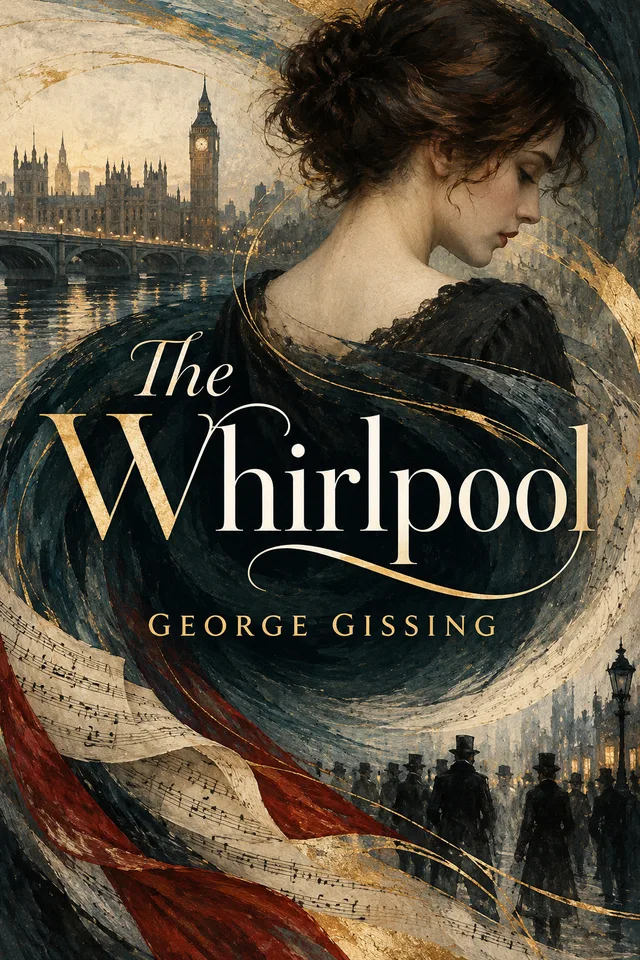
The Whirlpool
English BooksWhale Edition by George Gissing
London ambition, musical aspiration, and financial uncertainty draw a marriage into the restless pressures of late Victorian society.
- Preview
- A sample from the prepared text
- Formats
- Online reader, EPUB, PDF
- Access
- Library claim
Book introduction
The Whirlpool
George Gissing’s The Whirlpool follows Harvey Rolfe and Alma through a social world where money, artistic ambition, and reputation unsettle private life. Alma’s hopes as a musician meet the demands of marriage and the attractions of fashionable London. Organized in three parts, the novel examines the strain between independence and obligation, showing how financial speculation and social expectations reach into the household.
BooksWhale edition
How this edition was prepared
This edition is based on a public domain text and has been prepared for digital reading by BooksWhale.
Public domain basis
Why this edition can be shared
George Gissing died in 1903; the work was first published in 1897. This edition uses the public-domain English original from Project Gutenberg, without later notes, illustrations, or publisher material.
Read preview
A sample from the prepared text
Preview selected from the prepared reader text.
Preview chapterPart the FirstRead preview
Part the First
Preview chapterCHAPTER 1Preview
Harvey Rolfe was old enough to dine with deliberation, young and healthy enough to sauce with appetite the dishes he thoughtfully selected. You perceived in him the imperfect epicure. His club had no culinary fame; the dinner was merely tolerable; but Rolfe's unfinished palate flattered the second-rate cook. He knew nothing of vintages; it sufficed him to distinguish between Bordeaux and Burgundy; yet one saw him raise his glass and peer at the liquor with eye of connoisseur. All unaffectedly; for he was conscious of his shortcoming in the art of delicate living, and never vaunted his satisfactions. He had known the pasture of poverty, and the table as it is set by London landladies; to look back on these things was to congratulate himself that nowadays he dined.
Beyond the achievement of a vague personal distinction at the Metropolitan Club, he had done nothing to make himself a man of note, and it was doubtful whether more than two or three of the members really liked him or regarded him with genuine interest. His introduction to this circle he owed to an old friend, Hugh Carnaby, whose social position was much more clearly defined: Hugh Carnaby, the rambler, the sportsman, and now for a twelvemonth the son-in-law of Mrs. Ascott Larkfield. Through Carnaby people learnt as much of his friend's history as it concerned anyone to know: that Harvey Rolfe had begun with the study of medicine, had given it up in disgust, subsequently was 'in business', and withdrew from it on inheriting a competency. They were natives of the same county, and learnt their Latin together at the Grammar School of Greystone, the midland town which was missed by the steam highroad, and so preserves much of the beauty and tranquillity of days gone by. Rolfe seldom spoke of his own affairs, but in talking of travel he had been heard to mention that his father had engineered certain lines of foreign railway. It seemed that Harvey had no purpose in life, save that of enjoying himself. Obviously he read a good deal, and Carnaby credited him with profound historical knowledge; but he neither wrote nor threatened to do so. Something of cynicism appeared in his talk of public matters; politics amused him, and his social views lacked consistency, tending, however, to an indolent conservatism. Despite his convivial qualities, he had traits of the reserved, even of the unsociable, man: a slight awkwardness in bearing, a mute shyness with strangers, a hesitancy in ordinary talk, and occasional bluntness of assertion or contradiction, suggesting a contempt which possibly he did not intend. Hugh Carnaby declared that the true Rolfe only showed himself after a bottle of wine; maintained, moreover, that Harvey had vastly improved since he entered upon a substantial income. When Rolfe was five and twenty, Hugh being two years younger, they met after a long separation, and found each other intolerable; a decade later their meeting led to hearty friendship. Rolfe had become independent, and was tasting his freedom in a twelvemonth's travel. The men came face to face one day on the deck of a steamer at Port Said. Physically, Rolfe had changed so much that the other had a difficulty in recognising him; morally, the change was not less marked, as Carnaby very soon became aware. At thirty-seven this process of development was by no means arrested, but its slow and subtle working escaped observation unless it were that of Harvey Rolfe himself.
His guest this evening, in a quiet corner of the dining-room where he generally sat, was a man, ten years his junior, named Morphew: slim, narrow-shouldered, with sandy hair, and pale, delicate features of more sensibility than intelligence; restless, vivacious, talking incessantly in a low, rapid voice, with frequent nervous laughs which threw back his drooping head. A difference of costume—Rolfe wore morning dress, Morphew the suit of ceremony—accentuated the younger man's advantage in natural and acquired graces; otherwise, they presented the contrast of character and insignificance. Rolfe had a shaven chin, a weathered complexion, thick brown hair; the penumbra of middle-age had touched his countenance, softening here and there a line which told of temperament in excess. At this moment his manner inclined to a bluff jocularity, due in some measure to the bottle of wine before him, as also was the tinge of colour upon his cheek; he spoke briefly, but listened with smiling interest to his guest's continuous talk. This ran on the subject of the money-market, with which the young man boasted some practical acquaintance.
Preview chapterCHAPTER 2Preview
It was half past ten when Rolfe knocked at the door in Hamilton Terrace. He learnt from the servant that Mr. Carnaby was at home, and had company. In the room known as the library, four men sat smoking; their voices pealed into the hall as the door opened, and a boisterous welcome greeted the newcomer's appearance.
'Come to condole?' cried Hugh, striding forward with his man-of-the-wide-world air, and holding out his big hand. 'No doubt they're having a high old time at the club. Does it please them? Does it tickle them?'
'Why, naturally. There's the compensation, my boy—you contribute to the gaiety of your friends.'
Carnaby was a fair example of the well-bred, well-fed Englishman—tall, brawny, limber, not uncomely, with a red neck, a powerful jaw, and a keen eye. Something more of repose, of self-possession, and a slightly more intellectual brow, would have made him the best type of conquering, civilising Briton. He came of good family, but had small inheritance; his tongue told of age-long domination; his physique and carriage showed the horseman, the game-stalker, the nomad. Hugh had never bent over books since the day when he declined the university and got leave to join Colonel Bosworth's exploring party in the Caucasus. After a boyhood of straitened circumstances, he profited by a skilful stewardship which allowed him to hope for some seven hundred a year; his elder brother, Miles, a fine fellow, who went into the army, pinching himself to benefit Hugh and their sister Ruth. Miles was now Major Carnaby, active on the North-West Frontier. Ruth was wife of a missionary in some land of swamps; doomed by climate, but of spirit indomitable. It seemed strange that Hugh, at five and thirty, had done nothing particular. Perhaps his income explained it—too small for traditional purposes, just large enough to foster indolence. For Hugh had not even followed up his promise of becoming an explorer; he had merely rambled, mostly in pursuit of fowl or quadruped. When he married, all hope for him was at an end. The beautiful and brilliant daughter of a fashionable widow, her income a trifle more than Carnaby's own; devoted to the life of cities, wherein she shone; an enchantress whose spell would not easily be broken, before whom her husband bowed in delighted subservience—such a woman might flatter Hugh's pride, but could scarce be expected to draw out his latent energies and capabilities. This year, for the first time, he had visited no wild country; his journeying led only to Paris, to Vienna. In due season he shot his fifty brace on somebody's grouse-moor, but the sport did not exhilarate him.
An odd and improbable alliance, that between Hugh Carnaby and Harvey Rolfe. Yet in several ways they suited each other. Old-time memories had a little, not much, to do with it; more of the essence of the matter was their feeling of likeness in difference. Ten years ago Carnaby felt inclined to call his old school-fellow a 'cad'; Harvey saw nothing in Hugh but robust snobbishness. Nowadays they had the pleasant sense of understanding each other on most points, and the result was a good deal of honest mutual admiration. The one's physical vigour and adroitness, the other's active mind, liberal thoughts, studious habits, proved reciprocally attractive. Though in unlike ways, both were impressively modern. Of late it had seemed as if the man of open air, checked in his natural courses, thrown back upon his meditations, turned to the student, with hope of guidance in new paths, of counsel amid unfamiliar obstacles. To the observant Rolfe, his friend's position abounded in speculative interest. With the course of years, each had lost many a harsher characteristic, whilst the inner man matured. That their former relations were gradually being reversed, neither perhaps had consciously noted; but even in the jests which passed between them on Harvey's arrival this evening, it appeared plainly enough that Hugh Carnaby no longer felt the slightest inclination to regard his friend as an inferior.
Table of contents
Inside this edition
- 01Part the First
- 02CHAPTER 1
- 03CHAPTER 2
- 04CHAPTER 3
- 05CHAPTER 4
- 06CHAPTER 5
- 07CHAPTER 6
- 08CHAPTER 7
- 09CHAPTER 8
- 10CHAPTER 9
- 11CHAPTER 10
- 12CHAPTER 11
- 13CHAPTER 12
- 14Part the Second
- 15CHAPTER 1
- 16CHAPTER 2
- 17CHAPTER 3
- 18CHAPTER 4
- 19CHAPTER 5
- 20CHAPTER 6
- 21CHAPTER 7
- 22CHAPTER 8
- 23CHAPTER 9
- 24CHAPTER 10
- 25CHAPTER 11
- 26CHAPTER 12
- 27CHAPTER 13
- 28CHAPTER 14
- 29CHAPTER 15
- 30Part the Third
- 31CHAPTER 1
- 32CHAPTER 2
- 33CHAPTER 3
- 34CHAPTER 4
- 35CHAPTER 5
- 36CHAPTER 6
- 37CHAPTER 7
- 38CHAPTER 8
- 39CHAPTER 9
- 40CHAPTER 10
- 41CHAPTER 11
- 42CHAPTER 12
- 43CHAPTER 13
Language availability
Other languages
Additional language editions are not published yet. This section will link to other BooksWhale editions when they become available.
Request another language