English Edition
Literature
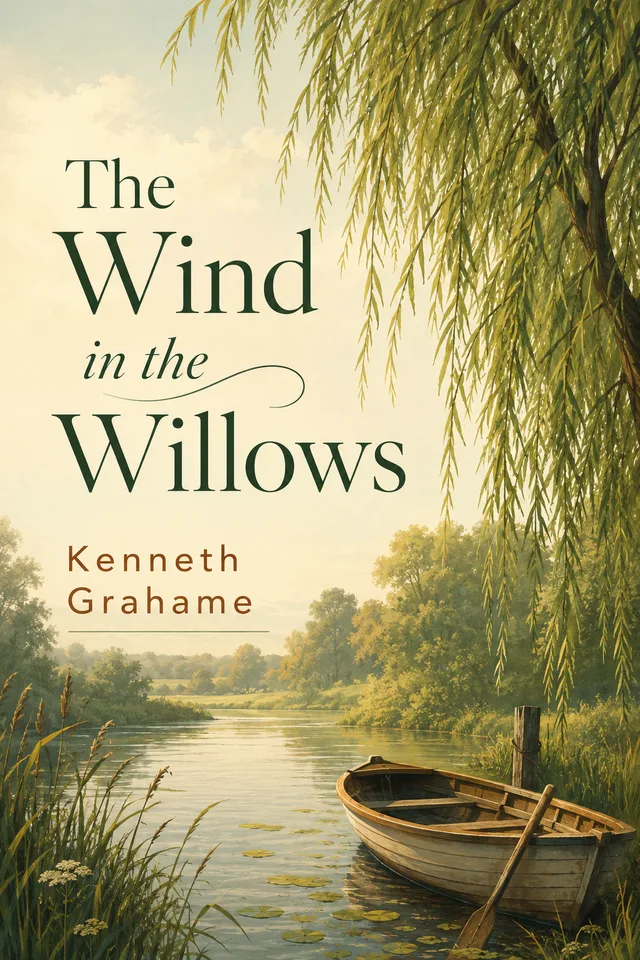
The Wind in the Willows
English BooksWhale Edition by Kenneth Grahame
A riverside classic where Mole, Rat, Badger, and Toad turn friendship, home, and mischief into lasting enchantment.
- Preview
- A sample from the prepared text
- Formats
- Online reader, EPUB, PDF
- Access
- Library claim
Book introduction
The Wind in the Willows
The Wind in the Willows follows Mole's first spring by the river, Rat's steady companionship, Badger's wisdom, and Mr. Toad's comic disasters with motorcars and vanity. Kenneth Grahame's pastoral fantasy blends adventure, humor, and a deep affection for home, seasons, and loyal friendship.
BooksWhale edition
How this edition was prepared
This edition is based on a public domain text and has been prepared for digital reading by BooksWhale.
Public domain basis
Why this edition can be shared
Kenneth Grahame died in 1932, and The Wind in the Willows was first published in 1908. These dates support the public-domain basis for this English original-language edition.
Read preview
A sample from the prepared text
Preview selected from the prepared reader text.
Preview chapterFull textRead preview
The Wind in the Willows
Preview chapterI. THE RIVER BANKPreview
The Mole had been working very hard all the morning, spring-cleaning his little home. First with brooms, then with dusters; then on ladders and steps and chairs, with a brush and a pail of whitewash; till he had dust in his throat and eyes, and splashes of whitewash all over his black fur, and an aching back and weary arms. Spring was moving in the air above and in the earth below and around him, penetrating even his dark and lowly little house with its spirit of divine discontent and longing. It was small wonder, then, that he suddenly flung down his brush on the floor, said “Bother!” and “O blow!” and also “Hang spring-cleaning!” and bolted out of the house without even waiting to put on his coat. Something up above was calling him imperiously, and he made for the steep little tunnel which answered in his case to the gravelled carriage-drive owned by animals whose residences are nearer to the sun and air. So he scraped and scratched and scrabbled and scrooged and then he scrooged again and scrabbled and scratched and scraped, working busily with his little paws and muttering to himself, “Up we go! Up we go!” till at last, pop! his snout came out into the sunlight, and he found himself rolling in the warm grass of a great meadow.
“This is fine!” he said to himself. “This is better than whitewashing!” The sunshine struck hot on his fur, soft breezes caressed his heated brow, and after the seclusion of the cellarage he had lived in so long the carol of happy birds fell on his dulled hearing almost like a shout. Jumping off all his four legs at once, in the joy of living and the delight of spring without its cleaning, he pursued his way across the meadow till he reached the hedge on the further side.
“Hold up!” said an elderly rabbit at the gap. “Sixpence for the privilege of passing by the private road!” He was bowled over in an instant by the impatient and contemptuous Mole, who trotted along the side of the hedge chaffing the other rabbits as they peeped hurriedly from their holes to see what the row was about. “Onion-sauce! Onion-sauce!” he remarked jeeringly, and was gone before they could think of a thoroughly satisfactory reply. Then they all started grumbling at each other. “How _stupid_ you are! Why didn’t you tell him——” “Well, why didn’t _you_ say——” “You might have reminded him——” and so on, in the usual way; but, of course, it was then much too late, as is always the case.
It all seemed too good to be true. Hither and thither through the meadows he rambled busily, along the hedgerows, across the copses, finding everywhere birds building, flowers budding, leaves thrusting—everything happy, and progressive, and occupied. And instead of having an uneasy conscience pricking him and whispering “whitewash!” he somehow could only feel how jolly it was to be the only idle dog among all these busy citizens. After all, the best part of a holiday is perhaps not so much to be resting yourself, as to see all the other fellows busy working.
He thought his happiness was complete when, as he meandered aimlessly along, suddenly he stood by the edge of a full-fed river. Never in his life had he seen a river before—this sleek, sinuous, full-bodied animal, chasing and chuckling, gripping things with a gurgle and leaving them with a laugh, to fling itself on fresh playmates that shook themselves free, and were caught and held again. All was a-shake and a-shiver—glints and gleams and sparkles, rustle and swirl, chatter and bubble. The Mole was bewitched, entranced, fascinated. By the side of the river he trotted as one trots, when very small, by the side of a man who holds one spell-bound by exciting stories; and when tired at last, he sat on the bank, while the river still chattered on to him, a babbling procession of the best stories in the world, sent from the heart of the earth to be told at last to the insatiable sea.
Preview chapterII. THE OPEN ROADPreview
“Ratty,” said the Mole suddenly, one bright summer morning, “if you please, I want to ask you a favour.”
The Rat was sitting on the river bank, singing a little song. He had just composed it himself, so he was very taken up with it, and would not pay proper attention to Mole or anything else. Since early morning he had been swimming in the river, in company with his friends the ducks. And when the ducks stood on their heads suddenly, as ducks will, he would dive down and tickle their necks, just under where their chins would be if ducks had chins, till they were forced to come to the surface again in a hurry, spluttering and angry and shaking their feathers at him, for it is impossible to say quite _all_ you feel when your head is under water. At last they implored him to go away and attend to his own affairs and leave them to mind theirs. So the Rat went away, and sat on the river bank in the sun, and made up a song about them, which he called
“DUCKS’ DITTY.”
All along the backwater, Through the rushes tall, Ducks are a-dabbling, Up tails all! Ducks’ tails, drakes’ tails, Yellow feet a-quiver, Yellow bills all out of sight Busy in the river!
Slushy green undergrowth Where the roach swim— Here we keep our larder, Cool and full and dim.
Everyone for what he likes! _We_ like to be Heads down, tails up, Dabbling free!
High in the blue above Swifts whirl and call— _We_ are down a-dabbling Uptails all!
“I don’t know that I think so _very_ much of that little song, Rat,” observed the Mole cautiously. He was no poet himself and didn’t care who knew it; and he had a candid nature.
“Nor don’t the ducks neither,” replied the Rat cheerfully. “They say, ‘_Why_ can’t fellows be allowed to do what they like _when_ they like and _as_ they like, instead of other fellows sitting on banks and watching them all the time and making remarks and poetry and things about them? What _nonsense_ it all is!’ That’s what the ducks say.”
“So it is, so it is,” said the Mole, with great heartiness.
“No, it isn’t!” cried the Rat indignantly.
“Well then, it isn’t, it isn’t,” replied the Mole soothingly. “But what I wanted to ask you was, won’t you take me to call on Mr. Toad? I’ve heard so much about him, and I do so want to make his acquaintance.”
“Why, certainly,” said the good-natured Rat, jumping to his feet and dismissing poetry from his mind for the day. “Get the boat out, and we’ll paddle up there at once. It’s never the wrong time to call on Toad. Early or late he’s always the same fellow. Always good-tempered, always glad to see you, always sorry when you go!”
“He must be a very nice animal,” observed the Mole, as he got into the boat and took the sculls, while the Rat settled himself comfortably in the stern.
“He is indeed the best of animals,” replied Rat. “So simple, so good-natured, and so affectionate. Perhaps he’s not very clever—we can’t all be geniuses; and it may be that he is both boastful and conceited. But he has got some great qualities, has Toady.”
Rounding a bend in the river, they came in sight of a handsome, dignified old house of mellowed red brick, with well-kept lawns reaching down to the water’s edge.
“There’s Toad Hall,” said the Rat; “and that creek on the left, where the notice-board says, ‘Private. No landing allowed,’ leads to his boat-house, where we’ll leave the boat. The stables are over there to the right. That’s the banqueting-hall you’re looking at now—very old, that is. Toad is rather rich, you know, and this is really one of the nicest houses in these parts, though we never admit as much to Toad.”
Table of contents
Inside this edition
- 01Full text
- 02I. THE RIVER BANK
- 03II. THE OPEN ROAD
- 04III. THE WILD WOOD
- 05IV. MR. BADGER
- 06V. DULCE DOMUM
- 07VI. MR. TOAD
- 08VII. THE PIPER AT THE GATES OF DAWN
- 09VIII. TOAD’S ADVENTURES
- 10IX. WAYFARERS ALL
- 11X. THE FURTHER ADVENTURES OF TOAD
- 12XI. “LIKE SUMMER TEMPESTS CAME HIS TEARS”
- 13XII. THE RETURN OF ULYSSES
Language availability
Other languages
Additional language editions are not published yet. This section will link to other BooksWhale editions when they become available.
Request another language