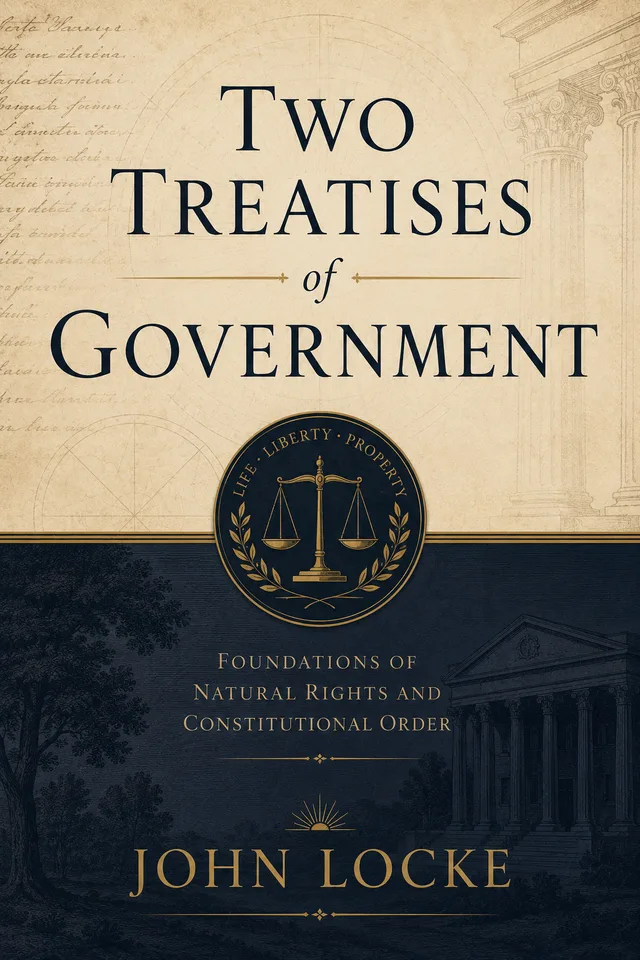
English Edition
Politics
Two Treatises of Government
English BooksWhale Edition by John Locke
Locke’s foundational defense of natural rights, consent, property, resistance, and limited government.
- Preview
- A sample from the prepared text
- Formats
- Online reader, EPUB, PDF
- Access
- Library claim
Book introduction
Two Treatises of Government
Two Treatises of Government argues against absolute monarchy and develops Locke’s theory of natural rights, property, political consent, legislative power, and the right of resistance. It remains a central text for readers studying liberal political thought, constitutional government, revolution, and modern ideas of citizenship.
BooksWhale edition
How this edition was prepared
This edition is based on a public domain text and has been prepared for digital reading by BooksWhale.
Public domain basis
Why this edition can be shared
John Locke died in 1704, and Two Treatises of Government was first published in 1689. These dates support the public-domain basis for the English source text used in this edition.
Read preview
A sample from the prepared text
Preview selected from the prepared reader text.
Preview chapterFull textRead preview
Two Treatises of Government
John Locke
Preview chapterBOOK I — OF GOVERNMENTPreview
BOOK I — OF GOVERNMENT
Preview chapterChap. I.Preview
§. 1. Slavery is so vile and miserable an estate of man, and so directly opposite to the generous temper and courage of our nation; that it is hardly to be conceived, that an Englishman, much less a gentleman, should plead for it. And truly I should have taken Sir Robert Filmer ’s Patriarcha, as any other treatise, which would persuade all men, that they are slaves, and ought to be so, for such another exercise of wit, as was his who writ the encomium of Nero; rather than for a serious discourse meant in earnest, had not the gravity of the title and epistle, the picture in the front of the book, and the applause that followed it, required me to believe, that the
§. 2. If any one think I take too much liberty in speaking so freely of a man, who is the great champion of absolute power, and the idol of those who worship it; I beseech him to make this small allowance for once, to one, who, even after the reading of Sir Robert ’s book, cannot but think himself, as the laws allow him, a freeman: and I know no fault it is to do so, unless any one better skilled in the fate of it, than I, should have it revealed to him, that this treatise, which has lain dormant so long, was, when it appeared in the world, to carry, by strength of its arguments, all liberty out of it; and that That all government is absolute monarchy. And the ground he builds on, is this, That no man is born free.
§. 3. In this last age a generation of men has sprung up amongst us, that would flatter princes with an opinion, that they have a divine right to absolute power, let the laws by which they are constituted, and are to govern, and the conditions under which they enter upon their authority, be what they will, and their engagements to observe them never so well ratified by solemn oaths and promises. To make way for this doctrine, they have denied mankind a right to natural freedom; whereby they have not only, as much as in them lies, exposed all subjects to the utmost misery of tyranny and oppression, but have also unsettled the titles, and shaken the thrones of princes: (for they too, by these mens system, except only one, are all born slaves, and by divine right are subjects to Adam ’s right heir;) as if they had designed to make war upon all government, and subvert the very foundations of human society, to serve their present turn.
§. 4. However we must believe them upon their own bare words, when they tell us, we Robert Filmer seems to condemn the novelty of the contrary opinion, Patr. p. 3. yet I believe it will be hard for him to find any other age, or country of the world, but this, which has asserted monarchy to be jure divino. And he confesses, Patr. p. 4. That Heyward, Blackwood, Barclay, and others, that have bravely vindicated the right of kings in most points, never thought of this, but with one consent admitted the natural liberty and equality of mankind.
§. 5. By whom this doctrine came at first to be broached, and brought in fashion amongst us, and what sad effects it gave rise to, I leave to historians to relate, or to the memory of those, who were contemporaries with Sibthorp and Manwering, to recollect. My business at present is only to consider what Sir Robert Filmer, who is allowed to have carried this argument farthest, and is supposed to have brought it to perfection, has said in it; French was at court, has learned, and runs away with this short system of politics, viz. Men are not born free, and therefore could never have the liberty to choose either governors, or forms of government. Princes have their power absolute, and by divine right; for slaves could never have a right to compact or consent. Adam was an absolute monarch, and so are all princes ever since.
Table of contents
Inside this edition
- 01Full text
- 02BOOK I — OF GOVERNMENT
- 03Chap. I.
- 04CHAP. II. Of Paternal and Regal Power.
- 05CHAP. III. Of Adam’ s Title to Sovereignty by Creation.
- 06CHAP. IV. Of Adam’ s Title to Sovereignty by Donation, Gen. i. 28.
- 07CHAP. V. Of Adam’ s Title to Sovereignty by the Subjection of Eve.
- 08CHAP. VI. Of Adam’ s Title to Sovereignty by Fatherhood.
- 09CHAP. VII. Of Fatherhood and Property considered together as Fountains of Sovereignty.
- 10CHAP. VIII. Of the Conveyance of Adam’ s sovereign Monarchical Power.
- 11CHAP. IX. Of Monarchy, by Inheritance from Adam.
- 12CHAP. X. Of the Heir to Adam’ s Monarchical Power.
- 13CHAP. XI. Who HEIR?
- 14BOOK II — OF CIVIL-GOVERNMENT
- 15Chap. I.
- 16CHAP. II. Of the State of Nature.
- 17CHAP. III. Of the State of War.
- 18CHAP. IV. Of SLAVERY.
- 19CHAP. V. Of PROPERTY.
- 20CHAP. VI. Of Paternal Power.
- 21CHAP. VII. Of Political or Civil Society.
- 22CHAP. VIII. Of the Beginning of Political Societies.
- 23CHAP. IX. Of the Ends of Political Society and Government.
- 24CHAP. X. Of the Forms of a Common-wealth.
- 25CHAP. XI. Of the Extent of the Legislative Power.
- 26CHAP. XII. Of the Legislative, Executive, and Federative Power of the Common-wealth.
- 27CHAP. XIII. Of the Subordination of the Powers of the Common-wealth.
- 28CHAP. XIV. Of PREROGATIVE.
- 29CHAP. XV. Of Paternal, Political, and Despotical Power, considered together.
- 30CHAP. XVI. Of CONQUEST.
- 31CHAP. XVII. Of USURPATION.
- 32CHAP. XVIII. Of TYRANNY.
- 33CHAP. XIX. Of the Dissolution of Government.
Language availability
Other languages
Additional language editions are not published yet. This section will link to other BooksWhale editions when they become available.
Request another language