English Edition
Literature
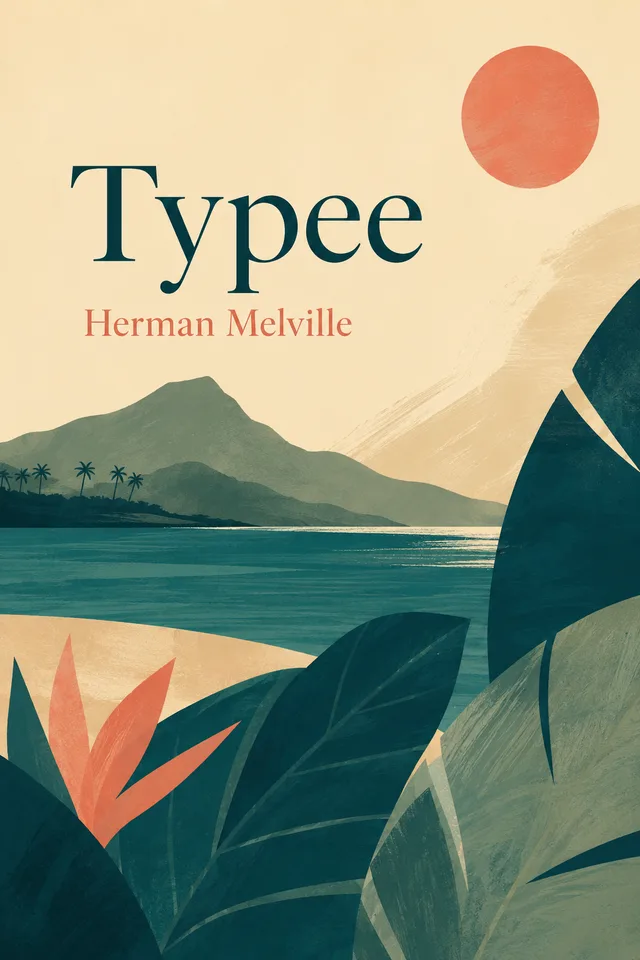
Typee
English BooksWhale Edition by Herman Melville
Melville’s South Seas narrative of escape, captivity, cultural encounter, desire, fear, and colonial imagination.
- Preview
- A sample from the prepared text
- Formats
- Online reader, EPUB, PDF
- Access
- Library claim
Book introduction
Typee
Typee draws on Herman Melville’s early experience in the Marquesas, turning a sailor’s flight from a whaling ship into a vivid narrative of island life, captivity, curiosity, and unease. The book mixes adventure, ethnographic observation, romance, and critique of missionary and colonial assumptions, revealing Melville before Moby-Dick in a lush Pacific setting.
BooksWhale edition
How this edition was prepared
This edition is based on a public domain text and has been prepared for digital reading by BooksWhale.
Public domain basis
Why this edition can be shared
Herman Melville died in 1891, and Typee was first published in 1846. These dates support the public-domain basis for this English original edition.
Read preview
A sample from the prepared text
Preview selected from the prepared reader text.
Preview chapterFull textRead preview
Typee
TYPEE A ROMANCE OF THE SOUTH SEAS By Herman Melville PREFACE More than three years have elapsed since the occurrence of the events recorded in this volume. The interval, with the exception of the last few months, has been chiefly spent by the author tossing about on the wide ocean. Sailors are the only class of men who now-a-days see anything like stirring adventure; and many things which to fire-side people appear strange and romantic, to them seem as common-place as a jacket out at elbows. Yet, notwithstanding the familiarity of sailors with all sorts of curious adventure, the incidents recorded in the following pages have often served, when ‘spun as a yarn,’ not only to relieve the weariness of many a night-watch at sea, but to excite the warmest sympathies of the author’s shipmates. He has been, therefore, led to think that his story could scarcely fail to interest those who are less familiar than the sailor with a life of adventure.
In his account of the singular and interesting people among whom he was thrown, it will be observed that he chiefly treats of their more obvious peculiarities; and, in describing their customs, refrains in most cases from entering into explanations concerning their origin and purposes.
As writers of travels among barbarous communities are generally very diffuse on these subjects, he deems it right to advert to what may be considered a culpable omission. No one can be more sensible than the author of his deficiencies in this and many other respects; but when the very peculiar circumstances in which he was placed are understood, he feels assured that all these omissions will be excused.
In very many published narratives no little degree of attention is bestowed upon dates; but as the author lost all knowledge of the days of the week, during the occurrence of the scenes herein related, he hopes that the reader will charitably pass over his shortcomings in this particular.
In the Polynesian words used in this volume,--except in those cases where the spelling has been previously determined by others,--that form of orthography has been employed, which might be supposed most easily to convey their sound to a stranger. In several works descriptive of the islands in the Pacific, many of the most beautiful combinations of vocal sounds have been altogether lost to the ear of the reader by an over-attention to the ordinary rules of spelling.
There are a few passages in the ensuing chapters which may be thought to bear rather hard upon a reverend order of men, the account of whose proceedings in different quarters of the globe--transmitted to us through their own hands--very generally, and often very deservedly, receives high commendation. Such passages will be found, however, to be based upon facts admitting of no contradiction, and which have come immediately under the writer’s cognizance. The conclusions deduced from these facts are unavoidable, and in stating them the author has been influenced by no feeling of animosity, either to the individuals themselves, or to that glorious cause which has not always been served by the proceedings of some of its advocates.
The great interest with which the important events lately occurring at the Sandwich, Marquesas, and Society Islands, have been regarded in America and England, and indeed throughout the world, will, he trusts, justify a few otherwise unwarrantable digressions.
There are some things related in the narrative which will be sure to appear strange, or perhaps entirely incomprehensible, to the reader;
but they cannot appear more so to him than they did to the author at the time. He has stated such matters just as they occurred, and leaves every one to form his own opinion concerning them; trusting that his anxious desire to speak the unvarnished truth will gain for him the confidence of his readers. 1846.
INTRODUCTION TO THE EDITION OF 1892 By Arthur Stedman Of the trinity of American authors whose births made the year 1819 a notable one in our literary history,--Lowell, Whitman, and Melville,--it is interesting to observe that the two latter were both descended, on the fathers’ and mothers’ sides respectively, from have families of British New England and Dutch New York extraction. Whitman and Van Velsor, Melville and Gansevoort, were the several combinations which produced these men; and it is easy to trace in the life and character of each author the qualities derived from his joint ancestry. Here, however, the resemblance ceases, for Whitman’s forebears, while worthy country people of good descent, were not prominent in public or private life. Melville, on the other hand, was of distinctly patrician birth, his paternal and maternal grandfathers having been leading characters in the Revolutionary War; their descendants still maintaining a dignified
Preview chapterbook, Melville met with more than the usual hardships of a sailor-boy’sPreview
first venture. It does not seem difficult in ‘Redburn’ to separate the author’s actual experiences from those invented by him, this being the case in some of his other writings.
A good part of the succeeding three years, from 1837 to 1840, was occupied with school-teaching. While so engaged at Greenbush, now East Albany, N.Y., he received the munificent salary of ‘six dollars a quarter and board.’ He taught for one term at Pittsfield, Mass., ‘boarding around’ with the families of his pupils, in true American fashion, and easily suppressing, on one memorable occasion, the efforts of his larger scholars to inaugurate a rebellion by physical force.
I fancy that it was the reading of Richard Henry Dana’s ‘Two Years Before the Mast’ which revived the spirit of adventure in Melville’s breast. That book was published in 1840, and was at once talked of everywhere. Melville must have read it at the time, mindful of his own experience as a sailor. At any rate, he once more signed a ship’s articles, and on January 1, 1841, sailed from New Bedford harbour in the whaler Acushnet, bound for the Pacific Ocean and the sperm fishery.
He has left very little direct information as to the events of this eighteen months’ cruise, although his whaling romance, ‘Moby Dick; or, the Whale,’ probably gives many pictures of life on board the Acushnet.
In the present volume he confines himself to a general account of the captain’s bad treatment of the crew, and of his non-fulfilment of agreements. Under these considerations, Melville decided to abandon the vessel on reaching the Marquesas Islands; and the narrative of ‘Typee’
begins at this point. However, he always recognised the immense influence the voyage had had upon his career, and in regard to its results has said in ‘Moby Dick,’-- ‘If I shall ever deserve any real repute in that small but high hushed world which I might not be unreasonably ambitious of; if hereafter I shall do anything that on the whole a man might rather have done than to have left undone... then here I prospectively ascribe all the honour and the glory to whaling; for a whale-ship was my Yale College and my Harvard.’
The record, then, of Melville’s escape from the Dolly, otherwise the Acushnet, the sojourn of his companion Toby and himself in the Typee Valley on the island of Nukuheva, Toby’s mysterious disappearance, and Melville’s own escape, is fully given in the succeeding pages; and rash indeed would he be who would enter into a descriptive contest with these inimitable pictures of aboriginal life in the ‘Happy Valley.’ So great an interest has always centred in the character of Toby, whose actual existence has been questioned, that I am glad to be able to declare him an authentic personage, by name Richard T. Greene. He was enabled to discover himself again to Mr. Melville through the publication of the present volume, and their acquaintance was renewed, lasting for quite a long period. I have seen his portrait,--a rare old daguerrotype,--and some of his letters to our author. One of his children was named for the
latter, but Mr. Melville lost trace of him in recent years.
With the author’s rescue from what Dr. T. M. Coan has styled his ‘anxious paradise,’ ‘Typee’ ends, and its sequel, ‘Omoo,’ begins. Here, again, it seems wisest to leave the remaining adventures in the South Seas to the reader’s own discovery, simply stating that, after a sojourn at the Society Islands, Melville shipped for Honolulu. There he remained for four months, employed as a clerk. He joined the crew of the American frigate United States, which reached Boston, stopping on the way at one of the Peruvian ports, in October of 1844. Once more was a narrative of his experiences to be preserved in ‘White Jacket; or, the World in a Man-of-War.’ Thus, of Melville’s four most important books, three, ‘Typee,’ ‘Omoo,’ and ‘White-Jacket,’ are directly auto biographical, and ‘Moby Dick’ is partially so; while the less important ‘Redburn’ is between the two classes in this respect. Melville’s other prose works,
Preview chapterletter is dated June 1, 1851.Preview
‘Since you have been here I have been building some shanties of houses (connected with the old one), and likewise some shanties of chapters and essays. I have been ploughing and sowing and raising and printing and praying, and now begin to come out upon a less bristling time, and to enjoy the calm prospect of things from a fair piazza at the north of the old farmhouse here. Not entirely yet, though, am I without something to be urgent with. The ‘Whale’ is only half through the press; for, wearied with the long delays of the printers, and disgusted with the heat and dust of the Babylonish brick-kiln of New York, I came back to the country to feel the grass, and end the book reclining on it, if I may.’
Mr. Hawthorne, who was then living in the red cottage at Lenox, had a week at Arrow Head with his daughter Una the previous spring. It is recorded that the friends ‘spent most of the time in the barn, bathing in the early spring sunshine, which streamed through the open doors, and talking philosophy.’ According to Mr. J. E. A. Smith’s volume on the Berkshire Hills, these gentlemen, both reserved in nature, though near neighbours and often in the same company, were inclined to be shy of each other, partly, perhaps, through the knowledge that Melville had written a very appreciative review of ‘Mosses from an Old Manse’ for the New York Literary World, edited by their mutual friends, the Duyckincks.
‘But one day,’ writes Mr. Smith, ‘it chanced that when they were out on a picnic excursion, the two were compelled by a thundershower to take shelter in a narrow recess of the rocks of Monument Mountain. Two hours of this enforced intercourse settled the matter. They learned so much of each other’s character,... that the most intimate friendship for the future was inevitable.’ A passage in Hawthorne’s ‘Wonder Book’
is noteworthy as describing the number of literary neighbours in Berkshire:-- ‘For my part, I wish I had Pegasus here at this moment,’ said the student. ‘I would mount him forthwith, and gallop about the country within a circumference of a few miles, making literary calls on my brother authors. Dr. Dewey would be within ray reach, at the foot of the Taconic. In Stockbridge, yonder, is Mr. James [G. P. R. James], conspicuous to all the world on his mountain-pile of history and romance. Longfellow, I believe, is not yet at the Oxbow, else the winged horse would neigh at him. But here in Lenox I should find our most truthful novelist [Miss Sedgwick], who has made the scenery and life of Berkshire all her own. On the hither side of Pittsfield sits Herman Melville, shaping out the gigantic conception of his ‘White Whale,’
while the gigantic shadow of Greylock looms upon him from his study window. Another bound of my flying steed would bring me to the door of Holmes, whom I mention last, because Pegasus would certainly unseat me the next minute, and claim the poet as his rider.’
While at Pittsfield, Mr. Melville was induced to enter the lecture field. From 1857 to 1860 he filled many engagements in the lyceums, chiefly speaking of his adventures in the South Seas. He lectured in cities as widely apart as Montreal, Chicago, Baltimore, and San Francisco, sailing to the last-named place in 1860, by way of Cape Horn, on the Meteor, commanded, by his younger brother, Captain Thomas Melville, afterward governor of the ‘Sailor’s Snug Harbor’ at Staten Island, N.Y. Besides his voyage to San Francisco, he had, in 1849 and 1856, visited England, the Continent, and the Holy Land, partly to superintend the publication of English editions of his works, and partly for recreation.
A pronounced feature of Melville’s character was his unwillingness to speak of himself, his adventures, or his writings in conversation. He was, however, able to overcome this reluctance on the lecture platform.
Table of contents
Inside this edition
- 01Full text
- 02book, Melville met with more than the usual hardships of a sailor-boy’s
- 03letter is dated June 1, 1851.
- 04letter reads:--
- 05book has no equal as a picture of life aboard a sailing man-of-war, the
- 06CHAPTER ONE
- 07CHAPTER TWO
- 08CHAPTER THREE
- 09CHAPTER FOUR
- 10CHAPTER FIVE
- 11CHAPTER SIX
- 12CHAPTER SEVEN
- 13CHAPTER EIGHT
- 14CHAPTER NINE
- 15CHAPTER TEN
- 16CHAPTER ELEVEN
- 17CHAPTER TWELVE
- 18chapter, Kory-Kory commenced the functions of the post assigned him.
- 19CHAPTER THIRTEEN
- 20CHAPTER FOURTEEN
- 21CHAPTER FIFTEEN
- 22CHAPTER SIXTEEN
- 23CHAPTER SEVENTEEN
- 24CHAPTER EIGHTEEN
- 25CHAPTER NINETEEN
- 26CHAPTER TWENTY
- 27CHAPTER TWENTY-ONE
- 28CHAPTER TWENTY-TWO
- 29CHAPTER TWENTY-THREE
- 30CHAPTER TWENTY-FOUR
- 31CHAPTER TWENTY-FIVE
- 32CHAPTER TWENTY-SIX
- 33CHAPTER TWENTY-SEVEN
- 34CHAPTER TWENTY-EIGHT
- 35CHAPTER TWENTY-NINE
- 36CHAPTER THIRTY
- 37CHAPTER THIRTY-ONE
- 38CHAPTER THIRTY-TWO
- 39CHAPTER THIRTY-THREE
- 40CHAPTER THIRTY-FOUR
Language availability
Other languages
Additional language editions are not published yet. This section will link to other BooksWhale editions when they become available.
Request another language