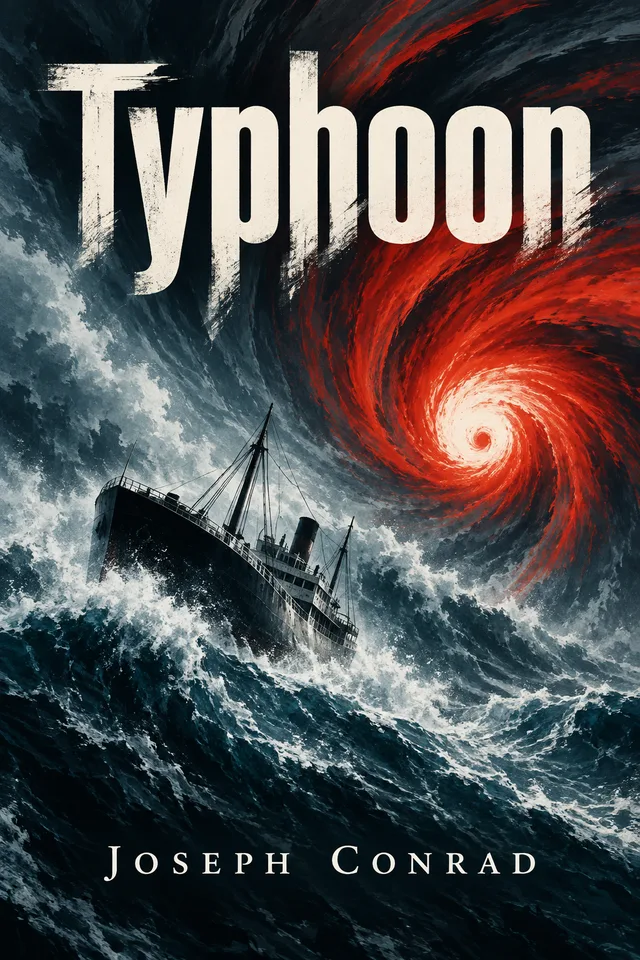
English Edition
Literature
Typhoon
English BooksWhale Edition by Joseph Conrad
A compact sea tale of command, storm, endurance, and unsentimental seamanship.
- Preview
- A sample from the prepared text
- Formats
- Online reader, EPUB, PDF
- Access
- Library claim
Book introduction
Typhoon
Typhoon follows Captain MacWhirr and the Nan-Shan through a violent storm that tests discipline, language, judgment, and survival. This edition suits readers of Conrad, maritime adventure, and classic sea fiction.
BooksWhale edition
How this edition was prepared
This edition is based on a public domain text and has been prepared for digital reading by BooksWhale.
Public domain basis
Why this edition can be shared
Joseph Conrad died in 1924, and Typhoon was first published in 1902. These dates support the public-domain basis for this original English edition.
Read preview
A sample from the prepared text
Preview selected from the prepared reader text.
Preview chapterFull textRead preview
Typhoon
Joseph Conrad
Preview chapterAUTHOR'S NOTEPreview
The main characteristic of this volume consists in this, that all the
stories composing it belong not only to the same period but have been
written one after another in the order in which they appear in the book.
The period is that which follows on my connection with Blackwood's
Magazine. I had just finished writing “The End of the Tether” and was
casting about for some subject which could be developed in a shorter
form than the tales in the volume of “Youth” when the instance of a
steamship full of returning coolies from Singapore to some port in
northern China occurred to my recollection. Years before I had heard
it being talked about in the East as a recent occurrence. It was for us
merely one subject of conversation amongst many others of the kind. Men
earning their bread in any very specialized occupation will talk shop,
not only because it is the most vital interest of their lives but also
because they have not much knowledge of other subjects. They have never
had the time to get acquainted with them. Life, for most of us, is not
so much a hard as an exacting taskmaster.
I never met anybody personally concerned in this affair, the interest of
which for us was, of course, not the bad weather but the extraordinary
complication brought into the ship's life at a moment of exceptional
stress by the human element below her deck. Neither was the story itself
ever enlarged upon in my hearing. In that company each of us could
imagine easily what the whole thing was like. The financial difficulty
of it, presenting also a human problem, was solved by a mind much too
simple to be perplexed by anything in the world except men's idle talk
for which it was not adapted.
From the first the mere anecdote, the mere statement I might say, that
such a thing had happened on the high seas, appeared to me a sufficient
subject for meditation. Yet it was but a bit of a sea yarn after all. I
felt that to bring out its deeper significance which was quite apparent
to me, something other, something more was required; a leading motive
that would harmonize all these violent noises, and a point of view that
would put all that elemental fury into its proper place.
What was needed of course was Captain MacWhirr. Directly I perceived him
I could see that he was the man for the situation. I don't mean to
say that I ever saw Captain MacWhirr in the flesh, or had ever come in
contact with his literal mind and his dauntless temperament. MacWhirr is
not an acquaintance of a few hours, or a few weeks, or a few months. He
is the product of twenty years of life. My own life. Conscious invention
had little to do with him. If it is true that Captain MacWhirr never
walked and breathed on this earth (which I find for my part extremely
difficult to believe) I can also assure my readers that he is perfectly
authentic. I may venture to assert the same of every aspect of the
story, while I confess that the particular typhoon of the tale was not a
typhoon of my actual experience.
At its first appearance “Typhoon,” the story, was classed by some
critics as a deliberately intended storm-piece. Others picked out
MacWhirr, in whom they perceived a definite symbolic intention. Neither
was exclusively my intention. Both the typhoon and Captain MacWhirr
presented themselves to me as the necessities of the deep conviction
with which I approached the subject of the story. It was their
opportunity. It was also my opportunity; and it would be vain to
discourse about what I made of it in a handful of pages, since the pages
themselves are here, between the covers of this volume, to speak for
themselves.
Preview chapterIPreview
Captain MacWhirr, of the steamer Nan-Shan, had a physiognomy that, in
the order of material appearances, was the exact counterpart of his
mind: it presented no marked characteristics of firmness or stupidity;
it had no pronounced characteristics whatever; it was simply ordinary,
irresponsive, and unruffled.
The only thing his aspect might have been said to suggest, at times, was
bashfulness; because he would sit, in business offices ashore, sunburnt
and smiling faintly, with downcast eyes. When he raised them, they were
perceived to be direct in their glance and of blue colour. His hair was
fair and extremely fine, clasping from temple to temple the bald dome
of his skull in a clamp as of fluffy silk. The hair of his face, on the
contrary, carroty and flaming, resembled a growth of copper wire clipped
short to the line of the lip; while, no matter how close he shaved,
fiery metallic gleams passed, when he moved his head, over the
surface of his cheeks. He was rather below the medium height, a bit
round-shouldered, and so sturdy of limb that his clothes always looked a
shade too tight for his arms and legs. As if unable to grasp what is due
to the difference of latitudes, he wore a brown bowler hat, a complete
suit of a brownish hue, and clumsy black boots. These harbour togs gave
to his thick figure an air of stiff and uncouth smartness. A thin silver
watch chain looped his waistcoat, and he never left his ship for the
shore without clutching in his powerful, hairy fist an elegant umbrella
of the very best quality, but generally unrolled. Young Jukes, the chief
mate, attending his commander to the gangway, would sometimes venture
to say, with the greatest gentleness, “Allow me, sir”--and possessing
himself of the umbrella deferentially, would elevate the ferule, shake
the folds, twirl a neat furl in a jiffy, and hand it back; going through
the performance with a face of such portentous gravity, that Mr. Solomon
Rout, the chief engineer, smoking his morning cigar over the skylight,
would turn away his head in order to hide a smile. “Oh! aye! The blessed
gamp. . . . Thank 'ee, Jukes, thank 'ee,” would mutter Captain MacWhirr,
heartily, without looking up.
Having just enough imagination to carry him through each successive day,
and no more, he was tranquilly sure of himself; and from the very same
cause he was not in the least conceited. It is your imaginative superior
who is touchy, overbearing, and difficult to please; but every ship
Captain MacWhirr commanded was the floating abode of harmony and peace.
It was, in truth, as impossible for him to take a flight of fancy as
it would be for a watchmaker to put together a chronometer with nothing
except a two-pound hammer and a whip-saw in the way of tools. Yet the
uninteresting lives of men so entirely given to the actuality of the
bare existence have their mysterious side. It was impossible in Captain
MacWhirr's case, for instance, to understand what under heaven could
have induced that perfectly satisfactory son of a petty grocer in
Belfast to run away to sea. And yet he had done that very thing at the
age of fifteen. It was enough, when you thought it over, to give you the
idea of an immense, potent, and invisible hand thrust into the ant-heap
of the earth, laying hold of shoulders, knocking heads together, and
setting the unconscious faces of the multitude towards inconceivable
goals and in undreamt-of directions.
His father never really forgave him for this undutiful stupidity. “We
could have got on without him,” he used to say later on, “but there's
the business. And he an only son, too!” His mother wept very much after
his disappearance. As it had never occurred to him to leave word behind,
he was mourned over for dead till, after eight months, his first letter
Table of contents
Inside this edition
- 01Full text
- 02AUTHOR'S NOTE
- 03I
- 04II
- 05III
- 06IV
- 07V
- 08VI
Language availability
Other languages
Additional language editions are not published yet. This section will link to other BooksWhale editions when they become available.
Request another language