English Edition
Science
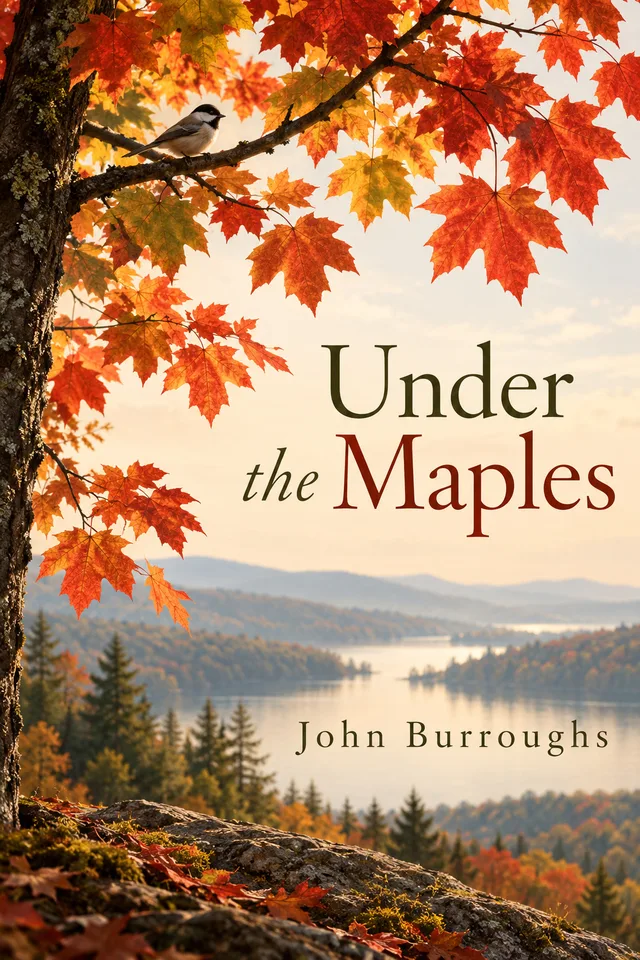
Under the Maples
English BooksWhale Edition by John Burroughs
John Burroughs observes falling leaves, birds, animals, and changing landscapes while reflecting on science and the pleasures of attentive looking.
- Preview
- A sample from the prepared text
- Formats
- Online reader, EPUB, PDF
- Access
- Library claim
Book introduction
Under the Maples
The twelve essays of Under the Maples move from autumn foliage and the flight of birds to Roosevelt’s Pine Knot retreat, California landscapes, and questions of evolution. John Burroughs joins close observation to reflective argument, testing what natural history can reveal about life and human perception. The collection preserves the essays and their internal sections, including the sequences of shorter nature notes.
BooksWhale edition
How this edition was prepared
This edition is based on a public domain text and has been prepared for digital reading by BooksWhale.
Public domain basis
Why this edition can be shared
John Burroughs died in 1921; the work was first published in 1921. This edition uses the public-domain English original from Project Gutenberg, without later notes, illustrations, or publisher material.
Read preview
A sample from the prepared text
Preview selected from the prepared reader text.
Preview chapterI — THE FALLING LEAVESRead preview
The time of the falling of leaves has come again. Once more in our morning walk we tread upon carpets of gold and crimson, of brown and bronze, woven by the winds or the rains out of these delicate textures while we slept.
How beautifully the leaves grow old! How full of light and color are their last days! There are exceptions, of course. The leaves of most of the fruit-trees fade and wither and fall ingloriously. They bequeath their heritage of color to their fruit. Upon it they lavish the hues which other trees lavish upon their leaves. The pear-tree is often an exception. I have seen pear orchards in October painting a hillside in hues of mingled bronze and gold. And well may the pear-tree do this, it is so chary of color upon its fruit.
But in October what a feast to the eye our woods and groves present! The whole body of the air seems enriched by their calm, slow radiance. They are giving back the light they have been absorbing from the sun all summer.
The carpet of the newly fallen leaves looks so clean and delicate when it first covers the paths and the highways that one almost hesitates to walk upon it. Was it the gallant Raleigh who threw down his cloak for Queen Elizabeth to walk upon? See what a robe the maples have thrown down for you and me to walk upon! How one hesitates to soil it! The summer robes of the groves and the forests—more than robes, a vital part of themselves, the myriad living nets with which they have captured, and through which they have absorbed, the energy of the solar rays. What a change when the leaves are gone, and what a change when they come again! A naked tree may be a dead tree. The dry, inert bark, the rough, wirelike twigs change but little from summer to winter. When the leaves come, what a transformation, what mobility, what sensitiveness, what expression! Ten thousand delicate veined hands reaching forth and waving a greeting to the air and light, making a union and compact with them, like a wedding ceremony. How young the old trees suddenly become! what suppleness and grace invest their branches! The leaves are a touch of immortal youth. As the cambium layer beneath the bark is the girdle of perennial youth, so the leaves are the facial expression of the same quality. The leaves have their day and die, but the last leaf that comes to the branch is as young as the first. The leaves and the blossom and the fruit of the tree come and go, yet they age not; under the magic touch of spring the miracle is repeated over and over.
The maples perhaps undergo the most complete transformation of all the forest trees. Their leaves fairly become luminous, as if they glowed with inward light. In October a maple-tree before your window lights up your room like a great lamp. Even on cloudy days its presence helps to dispel the gloom. The elm, the oak, the beech, possess in a much less degree that quality of luminosity, though certain species of oak at times are rich in shades of red and bronze. The leaves of the trees just named for the most part turn brown before they fall. The great leaves of the sycamore assume a rich tan-color like fine leather.
The spider weaves a net out of her own vitals with which to capture her prey, but the net is not a part of herself as the leaf is a part of the tree. The spider repairs her damaged net, but the tree never repairs its leaves. It may put forth new leaves, but it never essays to patch up the old ones. Every tree has such a superabundance of leaves that a few more or less or a few torn and bruised ones do not seem to matter. When the leaf surface is seriously curtailed, as it often is by some insect pest, or some form of leaf-blight, or by the ravages of a hail-storm, the growth of the tree and the maturing of its fruit is seriously checked. To denude a tree of its foliage three years in succession usually proves fatal. The vitality of the tree declines year by year till death ensues.
Preview chapterII — THE PLEASURES OF A NATURALISTPreview
II — THE PLEASURES OF A NATURALIST
Preview chapterIPreview
How closely every crack and corner of nature is packed with life, especially in our northern temperate zone! I was impressed with this fact when during several June days I was occupied with road-mending on the farm where I was born. To open up the loosely piled and decaying laminated rocks was to open up a little biological and zoölogical museum, so many of our smaller forms of life harbored there. From chipmunks to ants and spiders, animal life flourished. We disturbed the chipmunks in their den a foot and a half or more beneath the loosely piled rocks. There were two of them in a soft, warm nest of dry, shredded maple-leaves. They did not wait to be turned out of doors, but when they heard the racket overhead bolted precipitately. Two living together surprised me, as heretofore I had never known but one in a den. Near them a milk snake had stowed himself away in a crevice, and in the little earthquake which we set up got badly crushed. Two little red-bellied snakes about one foot long had also found harbor there.
The ants rushed about in great consternation when their eggs were suddenly exposed. In fact, there was live natural history under every stone about us. Some children brought me pieces of stone, which they picked up close by, which sheltered a variety of cocoon-building spiders. One small, dark-striped spider was carrying about its ball of eggs, the size of a large pea, attached to the hind part of its body. This became detached, when she seized it eagerly and bore it about held between her legs. Another fragment of stone, the size of one's hand, sheltered the chrysalis of some species of butterfly which was attached to it at its tail. It was surprising to see this enshrouded creature, blind and deaf, wriggle and thrash about as if threatening us with its wrath for invading its sanctuary. One would about as soon expect to see an egg protest.
Thus the naturalist finds his pleasures everywhere. Every solitude to him is peopled. Every morning or evening walk yields him a harvest to eye or ear.
The born naturalist is one of the most lucky men in the world. Winter or summer, rain or shine, at home or abroad, walking or riding, his pleasures are always near at hand. The great book of nature is open before him and he has only to turn the leaves.
A friend sitting on my porch in a hickory rocking-chair the other day was annoyed by one of our small solitary wasps that seemed to want to occupy the chair. It held a small worm in its legs. She would "shoo" it away, only to see it back in a few seconds. I assured her that it did not want to sting her, but that its nest was somewhere in the chair. And, sure enough, as soon as she quieted down, it entered a small opening in the end of one of the chair arms, and deposited its worm, and presently was back with another, and then a third and a fourth; and before the day was done it came with little pellets of mud and sealed up the opening.
Table of contents
Inside this edition
- 01I — THE FALLING LEAVES
- 02II — THE PLEASURES OF A NATURALIST
- 03I
- 04II
- 05III
- 06IV
- 07V
- 08VI
- 09VII
- 10VIII
- 11IX
- 12X
- 13XI
- 14XII
- 15III — THE FLIGHT OF BIRDS
- 16IV — BIRD INTIMACIES
- 17V — A MIDSUMMER IDYL
- 18VI — NEAR VIEWS OF WILD LIFE
- 19VII — WITH ROOSEVELT AT PINE KNOT
- 20VIII — A STRENUOUS HOLIDAY
- 21IX — UNDER GENIAL SKIES
- 22I. A SUN-BLESSED LAND
- 23II. LAWN BIRDS
- 24III. SILKEN CHAMBERS
- 25IV. THE DESERT NOTE
- 26V. SEA-DOGS
- 27X — A SHEAF OF NATURE NOTES
- 28I. NATURE'S WIRELESS
- 29II. MAETERLINCK ON THE BEE
- 30III. ODD OR EVEN
- 31IV. WHY AND HOW
- 32V. AN INSOLUBLE PROBLEM
- 33VI. A LIVE WORLD
- 34VII. DARWINISM AND THE WAR
- 35VIII. THE ROBIN
- 36IX. THE WEASEL
- 37X. MISINTERPRETING NATURE
- 38XI. NATURAL SCULPTURE
- 39XI — RUMINATIONS
- 40I. MAN A PART OF NATURE
- 41II. MARCUS AURELIUS ON DEATH
- 42III. THE INTERPRETER OF NATURE
- 43IV. ORIGINAL SOURCES
- 44V. THE COSMIC HARMONY
- 45VI. COSMIC RHYTHMS
- 46VII. THE BEGINNINGS OF LIFE
- 47VIII. SPENDTHRIFT NATURE
- 48XII — NEW GLEANINGS IN FIELD AND WOOD
- 49I. SUNRISE
- 50II. NATURE'S METHODS
- 51III. HEADS AND TAILS
- 52IV. AN UNSAVORY SUBJECT
- 53V. CHANCE IN ANIMAL LIFE
- 54VI. MOSQUITOES AND FLEAS
- 55VII. THE CHANGE OF CLIMATE IN SOUTHERN CALIFORNIA
- 56VIII. ALL-SEEING NATURE
Language availability
Other languages
Additional language editions are not published yet. This section will link to other BooksWhale editions when they become available.
Request another language