English Edition
Literature
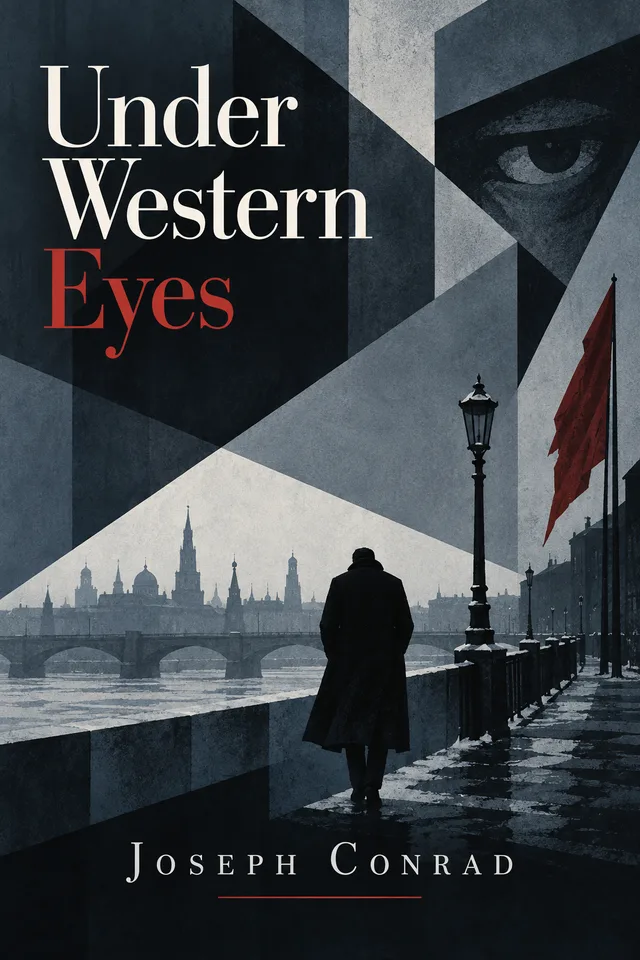
Under Western Eyes
English BooksWhale Edition by Joseph Conrad
A political novel of betrayal, exile, revolution, surveillance, and moral pressure.
- Preview
- A sample from the prepared text
- Formats
- Online reader, EPUB, PDF
- Access
- Library claim
Book introduction
Under Western Eyes
Under Western Eyes follows Razumov after a revolutionary assassination forces him into a world of confession, espionage, and exile. Conrad examines Russian radicalism, European judgment, guilt, and the lonely consequences of political violence.
BooksWhale edition
How this edition was prepared
This edition is based on a public domain text and has been prepared for digital reading by BooksWhale.
Public domain basis
Why this edition can be shared
Joseph Conrad died in 1924; the work was first published in 1911. These dates support the public-domain basis for this edition.
Read preview
A sample from the prepared text
Preview selected from the prepared reader text.
Preview chapterFull textRead preview
Under Western Eyes
Joseph Conrad
Preview chapterPART FIRSTPreview
To begin with I wish to disclaim the possession of those high gifts of imagination and expression which would have enabled my pen to create for the reader the personality of the man who called himself, after the Russian custom, Cyril son of Isidor--Kirylo Sidorovitch--Razumov.
If I have ever had these gifts in any sort of living form they have been smothered out of existence a long time ago under a wilderness of words. Words, as is well known, are the great foes of reality. I have been for many years a teacher of languages. It is an occupation which at length becomes fatal to whatever share of imagination, observation, and insight an ordinary person may be heir to. To a teacher of languages there comes a time when the world is but a place of many words and man appears a mere talking animal not much more wonderful than a parrot.
This being so, I could not have observed Mr. Razumov or guessed at his reality by the force of insight, much less have imagined him as he was. Even to invent the mere bald facts of his life would have been utterly beyond my powers. But I think that without this declaration the readers of these pages will be able to detect in the story the marks of documentary evidence. And that is perfectly correct. It is based on a document; all I have brought to it is my knowledge of the Russian language, which is sufficient for what is attempted here. The document, of course, is something in the nature of a journal, a diary, yet not exactly that in its actual form. For instance, most of it was not written up from day to day, though all the entries are dated. Some of these entries cover months of time and extend over dozens of pages. All the earlier part is a retrospect, in a narrative form, relating to an event which took place about a year before.
I must mention that I have lived for a long time in Geneva. A whole quarter of that town, on account of many Russians residing there, is called La Petite Russie--Little Russia. I had a rather extensive connexion in Little Russia at that time. Yet I confess that I have no comprehension of the Russian character. The illogicality of their attitude, the arbitrariness of their conclusions, the frequency of the exceptional, should present no difficulty to a student of many grammars; but there must be something else in the way, some special human trait--one of those subtle differences that are beyond the ken of mere professors. What must remain striking to a teacher of languages is the Russians’ extraordinary love of words. They gather them up; they cherish them, but they don’t hoard them in their breasts; on the contrary, they are always ready to pour them out by the hour or by the night with an enthusiasm, a sweeping abundance, with such an aptness of application sometimes that, as in the case of very accomplished parrots, one can’t defend oneself from the suspicion that they really understand what they say.
There is a generosity in their ardour of speech which removes it as far as possible from common loquacity; and it is ever too disconnected to be classed as eloquence.... But I must apologize for this digression.
It would be idle to inquire why Mr. Razumov has left this record behind him. It is inconceivable that he should have wished any human eye to see it. A mysterious impulse of human nature comes into play here. Putting aside Samuel Pepys, who has forced in this way the door of immortality, innumerable people, criminals, saints, philosophers, young girls, statesmen, and simple imbeciles, have kept self-revealing records from vanity no doubt, but also from other more inscrutable motives. There must be a wonderful soothing power in mere words since so many men have used them for self-communion. Being myself a quiet individual I take it that what all men are really after is some form or perhaps only some formula of peace. Certainly they are crying loud enough for it at the present day. What sort of peace Kirylo Sidorovitch Razumov expected to find in the writing up of his record it passeth my understanding to guess.
Preview chapterIPreview
The origin of Mr. Razumov’s record is connected with an event characteristic of modern Russia in the actual fact: the assassination of a prominent statesman--and still more characteristic of the moral corruption of an oppressed society where the noblest aspirations of humanity, the desire of freedom, an ardent patriotism, the love of justice, the sense of pity, and even the fidelity of simple minds are prostituted to the lusts of hate and fear, the inseparable companions of an uneasy despotism.
The fact alluded to above is the successful attempt on the life of Mr. de P---, the President of the notorious Repressive Commission of some years ago, the Minister of State invested with extraordinary powers. The newspapers made noise enough about that fanatical, narrow-chested figure in gold-laced uniform, with a face of crumpled parchment, insipid, bespectacled eyes, and the cross of the Order of St. Procopius hung under the skinny throat. For a time, it may be remembered, not a month passed without his portrait appearing in some one of the illustrated papers of Europe. He served the monarchy by imprisoning, exiling, or sending to the gallows men and women, young and old, with an equable, unwearied industry. In his mystic acceptance of the principle of autocracy he was bent on extirpating from the land every vestige of anything that resembled freedom in public institutions; and in his ruthless persecution of the rising generation he seemed to aim at the destruction of the very hope of liberty itself.
It is said that this execrated personality had not enough imagination to be aware of the hate he inspired. It is hardly credible; but it is a fact that he took very few precautions for his safety. In the preamble of a certain famous State paper he had declared once that “the thought of liberty has never existed in the Act of the Creator. From the multitude of men’s counsel nothing could come but revolt and disorder; and revolt and disorder in a world created for obedience and stability is sin. It was not Reason but Authority which expressed the Divine Intention. God was the Autocrat of the Universe....” It may be that the man who made this declaration believed that heaven itself was bound to protect him in his remorseless defence of Autocracy on this earth.
No doubt the vigilance of the police saved him many times; but, as a matter of fact, when his appointed fate overtook him, the competent authorities could not have given him any warning. They had no knowledge of any conspiracy against the Minister’s life, had no hint of any plot through their usual channels of information, had seen no signs, were aware of no suspicious movements or dangerous persons.
Mr. de P--was being driven towards the railway station in a two-horse uncovered sleigh with footman and coachman on the box. Snow had been falling all night, making the roadway, uncleared as yet at this early hour, very heavy for the horses. It was still falling thickly. But the sleigh must have been observed and marked down. As it drew over to the left before taking a turn, the footman noticed a peasant walking slowly on the edge of the pavement with his hands in the pockets of his sheepskin coat and his shoulders hunched up to his ears under the falling snow. On being overtaken this peasant suddenly faced about and swung his arm. In an instant there was a terrible shock, a detonation muffled in the multitude of snowflakes; both horses lay dead and mangled on the ground and the coachman, with a shrill cry, had fallen off the box mortally wounded. The footman (who survived) had no time to see the face of the man in the sheepskin coat. After throwing the bomb this last got away, but it is supposed that, seeing a lot of people surging up on all sides of him in the falling snow, and all running towards the scene of the explosion, he thought it safer to turn back with them.
Table of contents
Inside this edition
- 01Full text
- 02PART FIRST
- 03I
- 04In all his life Razumov was allowed only once to come into personal
- 05I don’t see why you....”
- 06in his pocket.
- 07II
- 08into a snowdrift and was up to his knees before he stopped.
- 09issue.
- 10In the carriage--it was a small brougham on sleigh runners--Razumov
- 11It’s incredible....”
- 12It was impossible to detect any sign of emotion on his face.
- 13It was only on the stage that the unusual was outwardly acknowledged.
- 14If Haldin had not turned up the police would have been already here
- 15III
- 16insinuated quietly Councillor Mikulin.
- 17PART SECOND
- 18I
- 19It was as if she had been prepared for me by some mysterious
- 20it, but in French... “their mouvements d’ame.”
- 21I heard a rustle of paper somewhere. It came from her muff. She had the
- 22I released her long emaciated hand, shook my head negatively, and sat
- 23I was very much shocked by this piece of ingenuity.
- 24I understood now the poor woman’s whispered allusion to Judas.
- 25II
- 26III
- 27I took her offered hand.
- 28I gave neither. I was irresistibly impelled to say--
- 29I looked at her calm face and her animated eyes.
- 30I bowed my head.
- 31into the ante-room, closing the door behind us carefully.
- 32I wondered if she were not deluding herself with some impossible hope.
- 33It was not that, however.
- 34IV
- 35I inquired after the health of her mother.
- 36I smiled approvingly, and she added an unexpected remark--
- 37I broke the silence by beginning a question on that point--
- 38I was astonished. “Eggs, did you say?”
- 39It was a moment before I heard her voice.
- 40I waited a little before I observed thoughtfully--
- 41I understood the point very well. For the same reason she checked what
- 42in a lower, significant tone--
- 43I heard him clear gratingly his parched throat, and became all
- 44I listened to his unsteady footfalls by my side for the space of several strides.
- 45I felt my arm seized above the elbow, and next instant found myself
- 46I spoke with some asperity.
- 47I rose from my chair at once, and he followed my example, without haste, a little heavily.
- 48I had not stayed with him to be offended.
- 49I did not look round even.
- 50I had to think for a moment before I saw what he was referring to.
- 51PART THIRD
- 52I
- 53I perceived that he had fascinated her by an assumption of mysterious
- 54In the doorway, his black-coated bulk blocking the view, Peter
- 55Ivanovitch boomed in a hearty tone with something boastful in it.
- 56II
- 57It’s possible that later on I may...”
- 58Ivanovitch?”
- 59III
- 60instance, think that I am not the right sort?”
- 61impossible to guess what she had in her mind. Razumov muttered--
- 62It was she who was animated.
- 63if cautious, manner of speaking.
- 64It was the white-haired woman conspirator who was the first to break the silence.
- 65In these last words there was neither pride nor sadness. The bitterness
- 66IV
- 67it. The suspicions of my correspondent were aroused....”
- 68PART FOUR
- 69I
- 70II
- 71I did not venture to break the silence which fell between us. I looked
- 72into her eyes, glistening through the veil.
- 73It was perfectly right that she should think of me, but what could I do
- 74in my ignorance of Mr. Razumov’s quarters.
- 75I led her straight to the lift then. At the top floor the attendant
- 76III
- 77I demurred on account of the late hour. “You know mother likes you so
- 78In the end Miss Haldin went on, appealingly--
- 79in remorse?”
- 80IV
- 81It was nearly a fortnight after her mother’s funeral that I saw Natalia
- 82I rose, a little shakily.
- 83in his guarded voice. “And so I leave you two to have a talk together.”
- 84I offered to show it to her, and she at once volunteered to call on me
- 85intelligent. He has ideas.... He talks well, too.”
- 86I was truly astonished.
Language availability
Other languages
Additional language editions are not published yet. This section will link to other BooksWhale editions when they become available.
Request another language