English Edition
Education
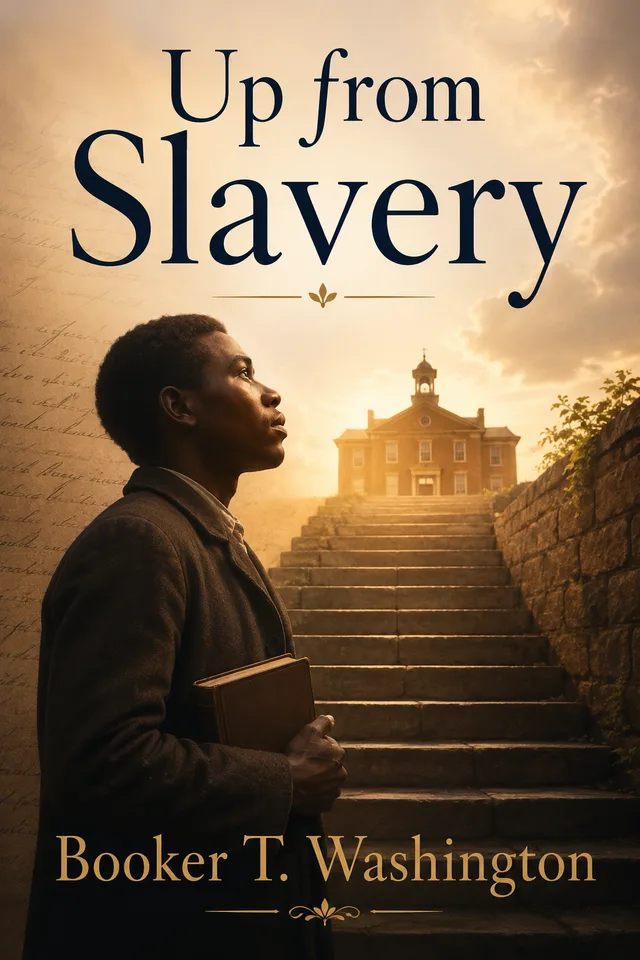
Up from Slavery
English BooksWhale Edition by Booker T. Washington
Washington’s autobiography of emancipation, schooling, Tuskegee, self-help, race, and public leadership.
- Preview
- A sample from the prepared text
- Formats
- Online reader, EPUB, PDF
- Access
- Library claim
Book introduction
Up from Slavery
Up from Slavery traces Booker T. Washington’s movement from enslavement and poverty to education, institution-building, and national influence. The book is a key document in African American history, the history of education, post-Reconstruction politics, and debates over labor, dignity, accommodation, and advancement.
BooksWhale edition
How this edition was prepared
This edition is based on a public domain text and has been prepared for digital reading by BooksWhale.
Public domain basis
Why this edition can be shared
Booker T. Washington died in 1915, and Up from Slavery was first published in 1901. These dates support the public-domain basis for this English original edition.
Read preview
A sample from the prepared text
Preview selected from the prepared reader text.
Preview chapterFull textRead preview
Up from Slavery
Booker T. Washington
Preview chapterUP FROM SLAVERY:Preview
UP FROM SLAVERY:
Preview chapterPrefacePreview
This volume is the outgrowth of a series of articles, dealing with
incidents in my life, which were published consecutively in the
Outlook. While they were appearing in that magazine I was constantly
surprised at the number of requests which came to me from all parts of
the country, asking that the articles be permanently preserved in book
form. I am most grateful to the Outlook for permission to gratify these
requests.
I have tried to tell a simple, straightforward story, with no attempt
at embellishment. My regret is that what I have attempted to do has
been done so imperfectly. The greater part of my time and strength is
required for the executive work connected with the Tuskegee Normal and
Industrial Institute, and in securing the money necessary for the
support of the institution. Much of what I have said has been written
on board trains, or at hotels or railroad stations while I have been
waiting for trains, or during the moments that I could spare from my
work while at Tuskegee. Without the painstaking and generous assistance
of Mr. Max Bennett Thrasher I could not have succeeded in any
satisfactory degree.
chapter in the history of the Negro, and in the history of the
knottiest problem we have ever faced. It not only makes “a carpenter of
a man; it makes a man of a carpenter.” In one sense, therefore, it is
of greater value than any other institution for the training of men and
women that we have, from Cambridge to Palo Alto. It is almost the only
one of which it may be said that it points the way to a new epoch in a
large area of our national life.
To work out the plan on paper, or at a distance—that is one thing. For
a white man to work it out—that too, is an easy thing. For a coloured
man to work it out in the South, where, in its constructive period, he
was necessarily misunderstood by his own people as well as by the
whites, and where he had to adjust it at every step to the strained
race relations—that is so very different and more difficult a thing
that the man who did it put the country under lasting obligations to
him.
It was not and is not a mere educational task. Anybody could teach boys
trades and give them an elementary education. Such tasks have been done
since the beginning of civilization. But this task had to be done with
the rawest of raw material, done within the civilization of the
dominant race, and so done as not to run across race lines and social
lines that are the strongest forces in the community. It had to be done
for the benefit of the whole community. It had to be done, moreover,
without local help, in the face of the direst poverty, done by begging,
and done in spite of the ignorance of one race and the prejudice of the
other.
No man living had a harder task, and a task that called for more wisdom
to do it right. The true measure of Mr. Washington’s success is, then,
not his teaching the pupils of Tuskegee, nor even gaining the support
of philanthropic persons at a distance, but this—that every Southern
white man of character and of wisdom has been won to a cordial
recognition of the value of the work, even men who held and still hold
to the conviction that a mere book education for the Southern blacks
under present conditions is a positive evil. This is a demonstration of
the efficiency of the Hampton-Tuskegee idea that stands like the
demonstration of the value of democratic institutions themselves—a
demonstration made so clear in spite of the greatest odds that it is no
longer open to argument.
Consider the change that has come in twenty years in the discussion of
Table of contents
Inside this edition
- 01Full text
- 02UP FROM SLAVERY:
- 03Preface
- 04UP FROM SLAVERY
- 05Chapter I.
- 06Chapter II.
- 07Chapter III.
- 08Chapter IV.
- 09Chapter V.
- 10Chapter VI.
- 11Chapter VII.
- 12Chapter VIII.
- 13Chapter IX.
- 14Chapter X.
- 15Chapter XI.
- 16Chapter XII.
- 17Booker T. Washington, Principal.
- 18Chapter XIII.
- 19Booker, has already mastered the brick-maker’s trade at Tuskegee.
- 20Chapter XIV.
- 21Booker T. Washington, Esq.:
- 22Chapter XV.
- 23Booker Washington arose. It was, of course, just the moment for him.
- 24Chapter XVI.
- 25Booker Taliaferro is my next oldest child. Young as he is, he has
- 26Booker.
- 27Chapter XVII.
- 28Booker T. Washington, the foremost educator among the coloured people
Language availability
Other languages
Additional language editions are not published yet. This section will link to other BooksWhale editions when they become available.
Request another language