English Edition
Literature
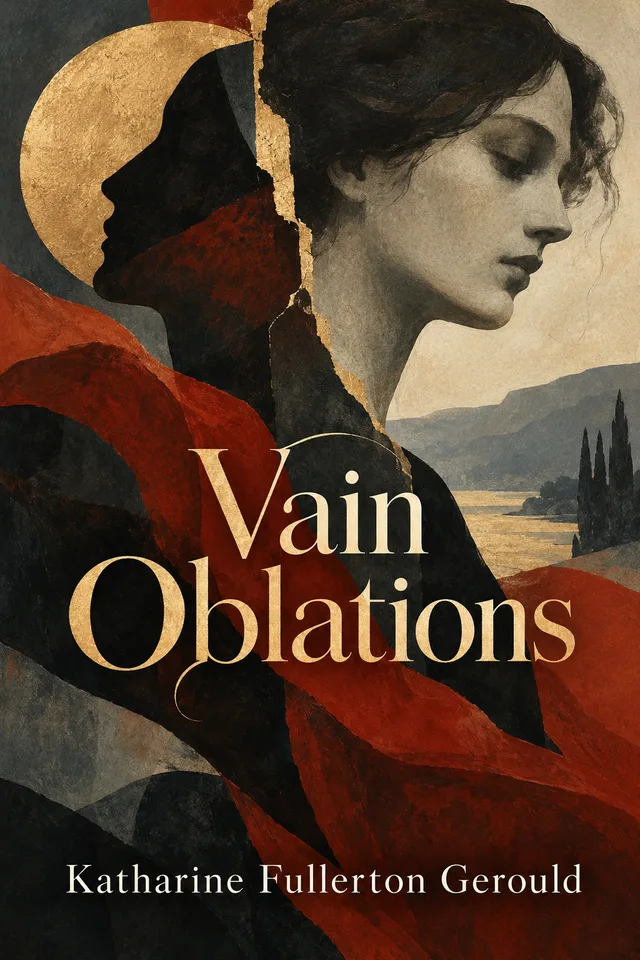
Vain Oblations
English BooksWhale Edition by Katharine Fullerton Gerould
Seven stories examine divided loyalties, troubling sacrifices, and the distance between respectable appearances and private moral choices.
- Preview
- A sample from the prepared text
- Formats
- Online reader, EPUB, PDF
- Access
- Library claim
Book introduction
Vain Oblations
Katharine Fullerton Gerould’s collection brings together seven stories, including Vain Oblations, The Mango-Seed, The Wine of Violence, The Tortoise, and The Case of Paramore. Characters confront obligations whose costs cannot easily be measured, and narrators struggle to interpret acts of loyalty or cruelty. The stories connect psychological observation with questions of responsibility, social convention, memory, and the limits of sympathetic understanding.
BooksWhale edition
How this edition was prepared
This edition is based on a public domain text and has been prepared for digital reading by BooksWhale.
Public domain basis
Why this edition can be shared
Katharine Fullerton Gerould died in 1944. This edition uses the public-domain English original, first published in 1914, from Project Gutenberg; later editorial notes and illustrations are excluded.
Read preview
A sample from the prepared text
Preview selected from the prepared reader text.
Preview chapterFull textRead preview
Vain Oblations
Preview chapterVAIN OBLATIONSPreview
As I was with Saxe during the four most desperate weeks of his life, I think I may say that I knew him better than any one else. Those were also the four most articulate weeks, for they were a period of terrible inaction, spent on the decks of ocean steamships. Saxe was not much given to talking, but there was nothing else to do. No book that has ever been written could have held his attention for two minutes. I was with him, for that matter, off and on, until the end. What I have to tell I got partly from my own observation, partly from a good little woman at the Mission, partly from Saxe’s letters, largely from his own lips, and partly from natives. But if I recorded it as it came, unassimilated, unchronologized—one fact often limping into camp six months after its own result—the story would be as unintelligible as the quipus of the Incas. It has taken me three years of steady staring to see the thing whole. I know more about it now—including Saxe—than Saxe ever knew. In point of fact, one of the most significant pieces of evidence did not come in until after his death. (I wish it clearly understood, by the way, that Saxe did not commit suicide.) But, more than that, I have been thinking for three years about Mary Bradford. I could tell you as much about what she suffered—the subtlety and the brutality of her ordeal—as if she were one of my own heroines. God forbid that I should ever think of Mary Bradford as “material”: that I should analyze her, or dramatize her, or look at her with the artist’s squint. If I tell her story, it is because I think it right that we should know what things can be. For the most part, we keep to our own continents: the cruel nations are the insensitive nations, and the squeamish races are kind. But Mary Bradford was the finest flower of New England; ten home-keeping generations only lay between her and the Quest of 1620. It is chronic hyperæsthesia simply to be New English; and the pure-bred New Englander had best stick to the euphemisms, the approximations, the reticences, of his own extraordinary villages. But Mary Bradford encountered all the physical realities of life in their crudest form, alone, in the obscene heart of Africa, with black faces thrust always between her and the sky. Some cynic may put in his belittling word to the effect that the New Englander has always counted physical suffering less than spiritual discomfort. The mental torture was not lacking in Mary Bradford’s case. For over a year, the temptation to suicide must have been like a terrible thirst, death—any death—luring her like a rippling spring. I told Saxe one night in mid-Atlantic, to comfort him, that she would of course have killed herself if she saw no chance of escape.
Saxe laughed dryly. “That’s the most damnable thing about it,” he said. “Mary would think it mortal sin to kill herself. She would stick on as long as God chose to keep the breath in her body.”
“Sin?” I queried rather stupidly.
“Yes, sin,” he answered. “You don’t know anything about it: you were brought up in Europe.”
“But Saxe,” I cried, “rather than—” I did not finish.
“You don’t know anything about New England,” he said. “Damn your books! Missionaries face everything, and there’s more than one kind of martyrdom. I hope she’s dead. I rather think she is.”
His voice was uneven, but with a meaningless unevenness like a boy’s that is changing. There was no emotion in it. A week more of monotonous ploughing of the waves would just have broken him, I think; but he pulled himself together when he touched the soil of Africa. Something in him went out to meet the curse that hung low over the land in the tropic afternoon; and encountering the Antagonist, his eyes grew sane again. But with sanity came the reticence of battle. All that I know of Saxe’s and Mary Bradford’s early lives, I learned in those four weeks. I have made out some things about her, since then, that probably Saxe never knew. As I said, I have been thinking about Mary Bradford for three years, and it is no secret that to contemplate is, in the end, to know. The stigmata received by certain saints are, I take it, irrefutable proof of this. I do not pretend to carry upon me Mary Bradford’s wounds; I do not even canonize her in my heart. But I seriously believe that she had, on the whole, the most bitter single experience ever undergone by woman; and much of the extraordinary horror of the adventure came from the very exquisiteness of the victim. I have often wondered if the Greek and Italian literatures that she knew so well offered her any mitigating memory of a woman more luckless than she. Except Jocasta, I positively cannot think of one; and Jocasta never lived. All of us have dreams of a market where we could sell our old lamps for new. How must not Mary Bradford have longed to change her humanities against mere foothold on the soil of America or Europe! But my preface is too long.
Preview chapterTHE MANGO-SEEDPreview
The two young men looked at each other rather helplessly. Then “Marty” Martin drew a few ragged words over his helplessness. “I’m sorry, Peter—really, awfully. I’ll be back in an hour. And do buck up. But you have bucked up, you really have. You look ever so much better than you did when we went to lunch. And I’ll be back. Oh, you can depend on me.” He drifted off through the door. His muscles were tense with haste, but he fingered chairs and tables as he went—as if trying to put clogs of decency on feet indecorously winged. Even so, he was soon out of sight, and Peter Wayne was alone.
“There’s no point in saying it isn’t rum, because it is,” he murmured to himself. “And here,” he added, looking about. There was no moral support in those crimson walls, those great pier-glasses, those insignificant writing-tables with red-shaded electric lights, those uncomfortable tapestried armchairs. It wasn’t the setting to help you through a crisis. He was in the quietest corner of the most essentially respectable hotel in New York. There were plenty of them—scores—that were incidentally respectable; but at the St. Justin respectability had been cherished through years for its own sake, as more important than the register, the cuisine, or the unimpeachable location that no metropolitan progress could render inconvenient. As a very young bachelor with virtually no family ties, he was not familiar with the St. Justin. It wasn’t a place where you would expect to get the kind of thing his kind of human being wanted. He couldn’t, for example, have induced Marty to lunch there. They had lunched at Plon’s. It was a hotel where you might be perfectly sure your grandparents had stopped. It was natural that his mother should have selected it for their meeting, as she hadn’t been in America for well over twenty years. But there was less backing than he had expected, somehow.
Sitting uncomfortably in one of the corners by a writing-table (his back to the window so that the familiar streets shouldn’t lure him too much to flight), he took the privilege of the consciously crucial moment. He reviewed his life. It was so very short, after all, that it was easily reviewed. He was only a few months out of the university, and he was just twenty-two. The insoluble was there to the point of being either romantic or absurd, he didn’t know which. He had what so many young people long for in vain, a mystery. He had amused himself occasionally with monstrous hypotheses. But what real account could he give of himself? What account, that is, of the sort that Marty Martin and his like had by heart before they could spell? The most that he knew about his parents—except that they were alive and in the tropics—was that they banked in Honolulu and had some natural hold or other on Marty Martin’s uncle. Marty Martin’s uncle had picked out Peter’s school and his college for him, and was telegraphed for when Peter had appendicitis. That was as near the parental relation as anything he had known from experience. Lonely? Well, any fellow was lonely when the other fellows all went trooping home for holidays; but loneliness he had always frankly diagnosed as three-quarters pride. The fellows were always glad to get back to school or college, he noticed. In any case, he had stopped thinking about it much—his plight. That saved his dignity. What he sat now vaguely dreading was the immense, the cataclysmic downfall of his dignity. He tried to put the facts to himself so simply that they should be as reassuring as a primer. Ollendorf, he had once complained to a teacher, would take the zest out of a murder, the sense out of a scandal. Tragedy was a verbal matter. Put a crime into any foreign language, and it sounded like a laundry list. He would try, as it were, to find the French for his situation.
Table of contents
Inside this edition
- 01Full text
- 02VAIN OBLATIONS
- 03THE MANGO-SEED
- 04THE WINE OF VIOLENCE
- 05ON THE STAIRCASE
- 06THE TORTOISE
- 07THE DIVIDED KINGDOM
- 08THE CASE OF PARAMORE
Language availability
Other languages
Additional language editions are not published yet. This section will link to other BooksWhale editions when they become available.
Request another language