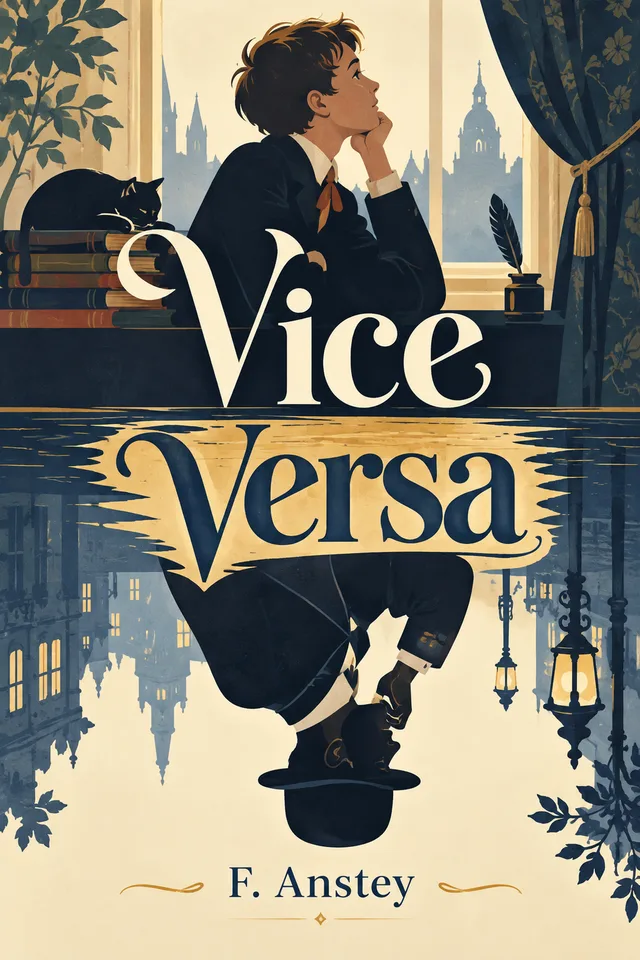
English Edition
Literature
Vice Versa
English BooksWhale Edition by F. Anstey
A lively Victorian comic fantasy about a father and son who exchange bodies.
- Preview
- A sample from the prepared text
- Formats
- Online reader, EPUB, PDF
- Access
- Library claim
Book introduction
Vice Versa
Vice Versa turns a magical accident into a sharp comedy of school life, family authority, and social embarrassment. F. Anstey’s popular fantasy remains one of the classic English body-swap stories and a durable work of Victorian humor.
BooksWhale edition
How this edition was prepared
This edition is based on a public domain text and has been prepared for digital reading by BooksWhale.
Public domain basis
Why this edition can be shared
F. Anstey died in 1934, and Vice Versa was first published in 1882, supporting the public-domain basis for this English original edition.
Read preview
A sample from the prepared text
Preview selected from the prepared reader text.
Preview chapterFull textRead preview
Vice Versa
F. Anstey
There is an old story of a punctiliously polite Greek, who, while performing the funeral of an infant daughter, felt bound to make his excuses to the spectators for "bringing out such a ridiculously small corpse to so large a crowd."
The Author, although he trusts that the present production has more vitality than the Greek gentleman's child, still feels that in these days of philosophical fiction, metaphysical romance, and novels with a purpose, some apology may perhaps be needed for a tale which has the unambitious and frivolous aim of mere amusement.
However, he ventures to leave the tale to be its own apology, merely contenting himself with the entreaty that his little fish may be spared the rebuke that it is not a whale.
In submitting it with all possible respect to the Public, he conceives that no form of words he could devise would appeal so simply and powerfully to their feelings as that which he has ventured to adopt from a certain Anglo-Portuguese Phrase-Book of deserved popularity.
Like the compilers of that work, he--"expects then who the little book, for the care what he wrote him and her typographical corrections, will commend itself to the--_British Paterfamilias_--at which he dedicates him particularly."
Preview chapter1. _Black Monday_Preview
"In England, where boys go to boarding schools, if the holidays were not long there would be no opportunity for cultivating the domestic affections."--_Letter of Lord Campbell's, 1835_.
On a certain Monday evening late in January, 1881, Paul Bultitude, Esq. (of Mincing Lane, Colonial Produce Merchant), was sitting alone in his dining-room at Westbourne Terrace after dinner.
The room was a long and lofty one, furnished in the stern uncompromising style of the Mahogany Age, now supplanted by the later fashions of decoration which, in their outset original and artistic, seem fairly on the way to become as meaningless and conventional.
Here were no skilfully contrasted shades of grey or green, no dado, no distemper on the walls; the woodwork was grained and varnished after the manner of the Philistines, the walls papered in dark crimson, with heavy curtains of the same colour, and the sideboard, dinner-waggon, and row of stiff chairs were all carved in the same massive and expensive style of ugliness. The pictures were those familiar presentments of dirty rabbits, fat white horses, bloated goddesses, and misshapen boors, by masters who, if younger than they assume to be, must have been quite old enough to know better.
Mr. Bultitude was a tall and portly person, of a somewhat pompous and overbearing demeanour; not much over fifty, but looking considerably older. He had a high shining head, from which the hair had mostly departed, what little still remained being of a grizzled auburn, prominent pale blue eyes with heavy eyelids and fierce, bushy whitey-brown eyebrows. His general expression suggested a conviction of his own extreme importance, but, in spite of this, his big underlip drooped rather weakly and his double chin slightly receded, giving a judge of character reason for suspecting that a certain obstinate positiveness observable in Mr. Bultitude's manner might possibly be due less to the possession of an unusually strong will than to the circumstance that, by some fortunate chance, that will had hitherto never met with serious opposition.
The room, with all its aesthetic shortcomings, was comfortable enough, and Mr. Bultitude's attitude--he was lying back in a well-wadded leather arm-chair, with a glass of claret at his elbow and his feet stretched out towards the ruddy blaze of the fire--seemed at first sight to imply that happy after-dinner condition of perfect satisfaction with oneself and things in general, which is the natural outcome of a good cook, a good conscience, and a good digestion.
At first sight; because his face did not confirm the impression--there was a latent uneasiness in it, an air of suppressed irritation, as if he expected and even dreaded to be disturbed at any moment, and yet was powerless to resent the intrusion as he would like to do.
At the slightest sound in the hall outside he would half rise in his chair and glance at the door with a mixture of alarm and resignation, and as often as the steps died away and the door remained closed, he would sink back and resettle himself with a shrug of evident relief.
Habitual novel readers on reading thus far will, I am afraid, prepare themselves for the arrival of a faithful cashier with news of irretrievable ruin, or a mysterious and cynical stranger threatening disclosures of a disgraceful nature.
But all such anticipations must at once be ruthlessly dispelled. Mr. Bultitude, although he was certainly a merchant, was a fairly successful one--in direct defiance of the laws of fiction, where any connection with commerce seems to lead naturally to failure in one of the three volumes.
He was an elderly gentleman, too, of irreproachable character and antecedents; no Damocles' sword of exposure was swinging over his bald but blameless head; he had no disasters to fear and no indiscretions to conceal. He had not been intended for melodrama, with which, indeed, he would not have considered it a respectable thing to be connected.
Preview chapter2. _A Grand Transformation Scene_Preview
"Magnaque numinibus vota exaudita malignis."
Paul Bultitude put on his glasses to examine the stone more carefully, for it was some time since he had last seen or thought about it. Then he looked up and said once more, "What use would a thing like this be to you?"
Dick would have considered it a very valuable prize indeed; he could have exhibited it to admiring friends--during lessons, of course, when it would prove a most agreeable distraction; he could have played with and fingered it incessantly, invented astonishing legends of its powers and virtues; and, at last, when he had grown tired of it, have bartered it for any more desirable article that might take his fancy. All these advantages were present to his mind in a vague shifting form, but he could not find either courage or words to explain them.
Consequently he only said awkwardly, "Oh, I don't know, I should like it."
"Well, any way," said Paul, "you certainly won't have it. It's worth keeping, whatever it is, as the only thing your uncle Marmaduke was ever known to give to anybody."
Marmaduke Paradine, his brother-in-law, was not a connection of whom he had much reason to feel particularly proud. One of those persons endowed with what are known as "insinuating manners and address," he had, after some futile attempts to enter the army, been sent out to Bombay as agent for a Manchester firm, and in that capacity had contrived to be mixed up in some more than shady transactions with rival exporters and native dealers up the country, which led to an unceremonious dismissal by his employers.
He had brought home the stone from India as a propitiatory token of remembrance, more portable and less expensive than the lacquered cabinets, brasses, stuffs and carved work which are expected from friends at such a distance, and he had been received with pardon and started once more, until certain other proceedings of his, shadier still, had obliged Paul to forbid him the house at Westbourne Terrace.
Since then little had been heard of him, and the reports which reached Mr. Bultitude of his disreputable relative's connection with the promotion of a series of companies of the kind affected by the widow and curate, and exposed in money articles and law courts, gave him no desire to renew his acquaintance.
"Isn't it a talisman, though?" said Dick, rather unfortunately for any hopes he might have of persuading his father to entrust him with the coveted treasure.
"I'm sure I can't tell you," yawned Paul, "how do you mean?"
"I don't know, only Uncle Duke once said something about it. Barbara heard him tell mamma. I say, perhaps it's like the one in Scott, and cures people of things, though I don't think it's that sort of talisman either, because I tried it once on my chilblains, and it wasn't a bit of good. If you would only let me have it, perhaps I might find out, you know."
"You might," said his father drily, apparently not much influenced by this inducement, "but you won't have the chance. If it has a secret, I will find it out for myself" (he little knew how literally he was to be taken at his word), "and, by the way, there's your cab--at last."
There was a sound of wheels outside, and, as Dick heard them, he grew desperate in his extremity; a wish he had long secretly cherished unspoken, without ever hoping for courage to give it words, rose to his lips now; he got up and moved timidly towards his father.
"Father," he said, "there's something I want to say to you so much before I go. Do let me ask you now."
"Well, what is it?" said Paul. "Make haste, you haven't much time."
"It's this. I want you to--to let me leave Grimstone's at the end of the term."
Table of contents
Inside this edition
- 01Full text
- 021. _Black Monday_
- 032. _A Grand Transformation Scene_
- 043. _In the Toils_
- 054. _A Minnow amongst Tritons_
- 065. _Disgrace_
- 076. _Learning and Accomplishments_
- 087. _Cutting the Knot_
- 098. _Unbending the Bow_
- 109. _A Letter from Home_
- 1110. _The Complete Letter-Writer_
- 1211. _A Day of Rest_
- 1312. _Against Time_
- 1413. _A Respite_
- 1514. _An Error of Judgment_
- 1615. _The Rubicon_
- 1716. _Hard Pressed_
- 1817. _A Perfidious Ally_
- 1918. _Run to Earth_
- 2019. _The Reckoning_
Language availability
Other languages
Additional language editions are not published yet. This section will link to other BooksWhale editions when they become available.
Request another language