English Edition
Science
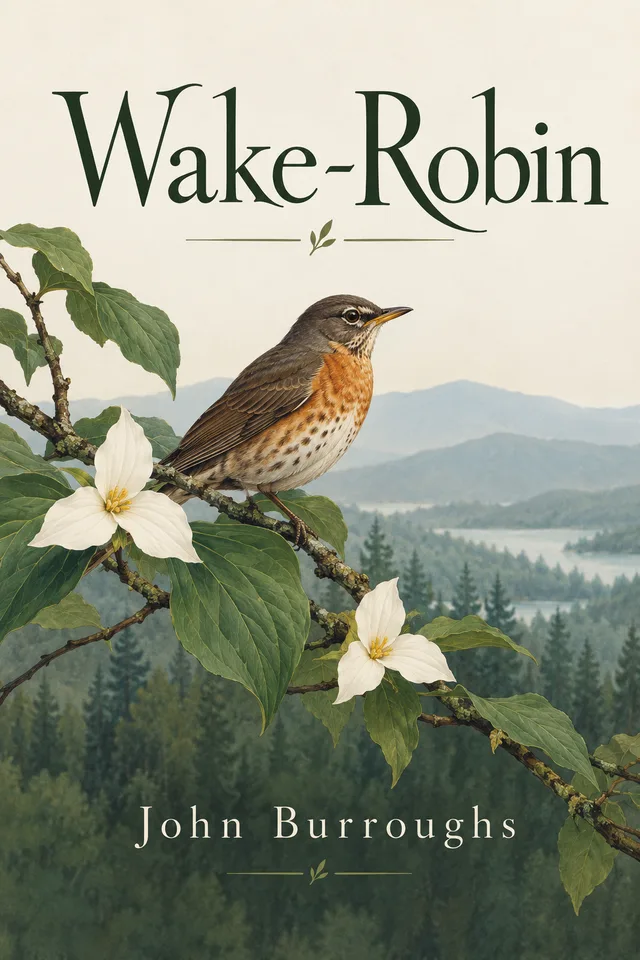
Wake-Robin
English BooksWhale Edition by John Burroughs
Birdsong, woodland walks, nesting habits, and seasonal change shape John Burroughs’s first collection of American nature essays.
- Preview
- A sample from the prepared text
- Formats
- Online reader, EPUB, PDF
- Access
- Library claim
Book introduction
Wake-Robin
John Burroughs invites readers into woods, fields, and mountain country through attentive observations of birds and their surroundings. Essays on returning migrants, hemlock forests, the Adirondacks, nests, and the bluebird combine natural history with personal reflection. The collection values patient looking and listening, showing how repeated encounters with familiar landscapes can deepen an understanding of both animal life and the seasons.
BooksWhale edition
How this edition was prepared
This edition is based on a public domain text and has been prepared for digital reading by BooksWhale.
Public domain basis
Why this edition can be shared
John Burroughs died in 1921; this work was first published in 1871. This edition uses the public-domain English original from Project Gutenberg, excluding later editorial additions.
Read preview
A sample from the prepared text
Preview selected from the prepared reader text.
Preview chapterPREFACE TO FIRST EDITIONRead preview
This is mainly a book about the Birds, or more properly an invitation to the study of Ornithology, and the purpose of the author will be carried out in proportion as it awakens and stimulates the interest of the reader in this branch of Natural History.
Though written less in the spirit of exact science than with the freedom of love and old acquaintance, yet I have in no instance taken liberties with facts, or allowed my imagination to influence me to the extent of giving a false impression or a wrong coloring. I have reaped my harvest more in the woods than in the study; what I offer, in fact, is a careful and conscientious record of actual observations and experiences, and is true as it stands written, every word of it. But what has interested me most in Ornithology is the pursuit, the chase, the discovery; that part of it which is akin to hunting, fishing, and wild sports, and which I could carry with me in my eye and ear wherever I went.
I cannot answer with much confidence the poet's inquiry,—
"Hast thou named all the birds without a gun?"
but I have done what I could to bring home the "river and sky" with the sparrow I heard "singing at dawn on the alder bough." In other words, I have tried to present a live bird,—a bird in the woods or the fields,—with the atmosphere and associations of the place, and not merely a stuffed and labeled specimen.
A more specific title for the volume would have suited me better; but not being able to satisfy myself in this direction, I cast about for a word thoroughly in the atmosphere and spirit of the book, which I hope I have found in "Wake-Robin," the common name of the white Trillium, which blooms in all our woods, and which marks the arrival of all the birds.
Preview chapterINTRODUCTION TO RIVERSIDE EDITIONPreview
In coming before the public with a newly made edition of my writings, what can I say to my reader at this stage of our acquaintance that will lead to a better understanding between us? Probably nothing. We understand each other very well already. I have offered myself as his guide to certain matters out of doors, and to a few matters indoor, and he has accepted me upon my own terms, and has, on the whole been better pleased with me than I had any reason to expect. For this I am duly grateful; why say more? Yet now that I am upon my feet, so as to speak, and palaver is the order, I will keep on a few minutes longer.
It is now nearly a quarter of a century since my first book, "Wake-Robin," was published. I have lived nearly as many years in the world as I had lived when I wrote its principal chapters. Other volumes have followed, and still others. When asked how many there are, I often have to stop and count them up. I suppose the mother of a large family does not have to count up her children to say how many there are. She sees their faces all before her. It is said of certain savage tribes who cannot count above five, and yet who own flocks and herds, that every native knows when he has got all his own cattle, not by counting, but by remembering each one individually.
The savage is with his herds daily; the mother has the love of her children constantly in her heart; but when one's book goes forth from him, in a sense it never returns. It is like the fruit detached from the bough. And yet to sit down and talk of one's books as a father might talk of his sons, who had left his roof and gone forth to make their own way in the world, is not an easy matter. The author's relation to his book is a little more direct and personal, after all, more a matter of will and choice, than a father's relation to his child. The book does not change, and, whatever it fortunes, it remains to the end what its author made it. The son is an evolution out of a long line of ancestry, and one's responsibility of this or that trait is often very slight; but the book is an actual transcript of his mind, and is wise or foolish according as he made it so. Hence I trust my reader will pardon me if I shrink from any discussion of the merits or demerits of these intellectual children of mine, or indulge in any very confidential remarks with regard to them.
I cannot bring myself to think of my books as "works," because so little "work" has gone to the making of them. It has all been play. I have gone a-fishing, or camping, or canoeing, and new literary material has been the result. My corn has grown while I loitered or slept. The writing of the book was only a second and finer enjoyment of my holiday in the fields or woods. Not till the writing did it really seem to strike in and become part of me.
A friend of mine, now an old man, who spent his youth in the woods of northern Ohio, and who has written many books, says, "I never thought of writing a book, till my self-exile, and then only to reproduce my old-time life to myself." The writing probably cured or alleviated a sort of homesickness. Such is a great measure has been my own case. My first book, "Wake-Robin," was written while I was a government clerk in Washington. It enabled me to live over again the days I had passed with the birds and in the scenes of my youth. I wrote the book sitting at a desk in front of an iron wall. I was the keeper of a vault in which many millions of bank-notes were stored. During my long periods of leisure I took refuge in my pen. How my mind reacted from the iron wall in front of me, and sought solace in memories of the birds and of summer fields and woods! Most of the chapters of "Winter Sunshine" were written at the same desk. The sunshine there referred to is of a richer quality than is found in New York or New England.
Preview chapterI — THE RETURN OF THE BIRDSPreview
Spring in our northern climate may fairly be said to extend from the middle of March to the middle of June. At least, the vernal tide continues to rise until the latter date, and it is not till after the summer solstice that the shoots and twigs begin to harden and turn to wood, or the grass to lose any of its freshness and succulency.
It is this period that marks the return of the birds,—one or two of the more hardy or half-domesticated species, like the song sparrow and the bluebird, usually arriving in March, while the rarer and more brilliant wood-birds bring up the procession in June. But each stage of the advancing season gives prominence to the certain species, as to certain flowers. The dandelion tells me when to look for the swallow, the dogtooth violet when to expect the wood-thrush, and when I have found the wake-robin in bloom I know the season is fairly inaugurated. With me this flower is associated, not merely with the awakening of Robin, for he has been awake for some weeks, but with the universal awakening and rehabilitation of nature.
Yet the coming and going of the birds is more or less a mystery and a surprise. We go out in the morning, and no thrush or vireo is to be heard; we go out again, and every tree and grove is musical; yet again, and all is silent. Who saw them come? Who saw them depart?
This pert little winter wren, for instance, darting in and out the fence, diving under the rubbish here and coming up yards away,—how does he manage with those little circular wings to compass degrees and zones, and arrive always in the nick of time? Last August I saw him in the remotest wilds of the Adirondacks, impatient and inquisitive as usual; a few weeks later, on the Potomac, I was greeted by the same hardy little busybody. Does he travel by easy stages from bush to bush and from wood to wood? or has that compact little body force and courage to brave the night and the upper air, and so achieve leagues at one pull?
And yonder bluebird with the earth tinge on his breast and the sky tinge on his back,—did he come down out of the heaven on that bright March morning when he told us so softly and plaintively that, if we pleased, spring had come? Indeed, there is nothing in the return of the birds more curious and suggestive than in the first appearance, or rumors of the appearance, of this little blue-coat. The bird at first seems a mere wandering voice in the air: one hears its call or carol on some bright March morning, but is uncertain of its source or direction; it falls like a drop of rain when no cloud is visible; one looks and listens, but to no purpose. The weather changes, perhaps a cold snap with snow comes on, and it may be a week before I hear the not again, and this time or the next perchance see this bird sitting on a stake in the fence lifting his wing as he calls cheerily to his mate. Its notes now become daily more frequent; the birds multiply, and, flitting from point to point, call and warble more confidently and gleefully. Their boldness increases till one sees them hovering with a saucy, inquiring air about barns and out-buildings, peeping into dove-cotes and stable windows, inspecting knotholes and pump-trees, intent only on a place to nest. They wage war against robins and wrens, pick quarrels with swallows, and seem to deliberate for days over the policy of taking forcible possession of one of the mud-houses of the latter. But as the season advances they drift more into the background. Schemes of conquest which they at first seemed bent upon are abandoned, and the settle down very quietly in their old quarters in remote stumpy fields.
Table of contents
Inside this edition
- 01PREFACE TO FIRST EDITION
- 02INTRODUCTION TO RIVERSIDE EDITION
- 03I — THE RETURN OF THE BIRDS
- 04II — IN THE HEMLOCKS
- 05III — THE ADIRONDACKS
- 06IV — BIRDS'-NESTS
- 07V — SPRING AT THE CAPITAL WITH AN EYE TO THE BIRDS
- 08VI — BIRCH BROWSINGS
- 09VII — THE BLUEBIRD
- 10VIII — THE INVITATION
Language availability
Other languages
Additional language editions are not published yet. This section will link to other BooksWhale editions when they become available.
Request another language