English Edition
Literature
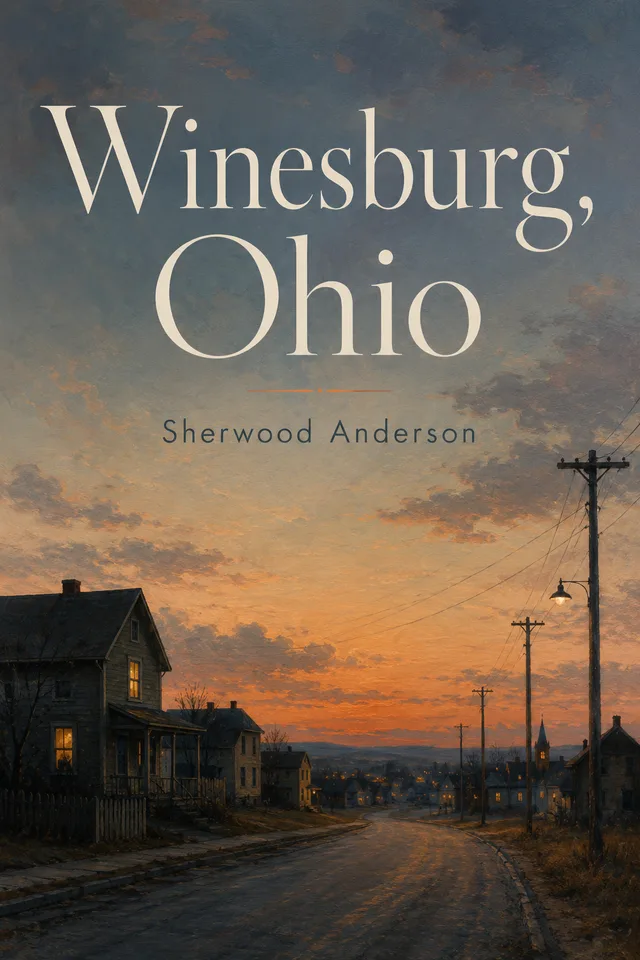
Winesburg, Ohio
English BooksWhale Edition by Sherwood Anderson
A linked portrait of small-town lives, private loneliness, frustrated desire, and the young writer who listens.
- Preview
- A sample from the prepared text
- Formats
- Online reader, EPUB, PDF
- Access
- Library claim
Book introduction
Winesburg, Ohio
Winesburg, Ohio gathers interlinked stories around George Willard and the residents of a Midwestern town. Sherwood Anderson turns quiet encounters, failed love, religious anxiety, aging, work, and hidden longing into one of the defining modern short-story cycles in American literature.
BooksWhale edition
How this edition was prepared
This edition is based on a public domain text and has been prepared for digital reading by BooksWhale.
Public domain basis
Why this edition can be shared
Sherwood Anderson died in 1941, and Winesburg, Ohio was first published in 1919. These dates support the public-domain basis for the English source text used in this edition.
Read preview
A sample from the prepared text
Preview selected from the prepared reader text.
Preview chapterFull textRead preview
Winesburg, Ohio
Preview chapterTHE BOOK OF THE GROTESQUEPreview
HANDS, concerning Wing Biddlebaum
PAPER PILLS, concerning Doctor Reefy
MOTHER, concerning Elizabeth Willard
THE PHILOSOPHER, concerning Doctor Parcival
NOBODY KNOWS, concerning Louise Trunnion
GODLINESS (Parts I), concerning Jesse Bentley
GODLINESS (Parts II), concerning Jesse Bentley
SURRENDER (Part III), concerning Louise Bentley
TERROR (Part IV), concerning David Hardy
A MAN OF IDEAS, concerning Joe Welling
ADVENTURE, concerning Alice Hindman
RESPECTABILITY, concerning Wash Williams
THE THINKER, concerning Seth Richmond
TANDY, concerning Tandy Hard
THE STRENGTH OF GOD, concerning the Reverend Curtis Hartman
THE TEACHER, concerning Kate Swift
LONELINESS, concerning Enoch Robinson
AN AWAKENING, concerning Belle Carpenter
“QUEER,” concerning Elmer Cowley
THE UNTOLD LIE, concerning Ray Pearson
DRINK, concerning Tom Foster
DEATH, concerning Doctor Reefy and Elizabeth Willard
SOPHISTICATION, concerning Helen White
DEPARTURE, concerning George Willard
Preview chapterINTRODUCTIONPreview
by Irving Howe
I must have been no more than fifteen or sixteen years old when I first
chanced upon Winesburg, Ohio. Gripped by these stories and sketches of
Sherwood Anderson’s small-town “grotesques,” I felt that he was opening
for me new depths of experience, touching upon half-buried truths which
nothing in my young life had prepared me for. A New York City boy who
never saw the crops grow or spent time in the small towns that lay
sprinkled across America, I found myself overwhelmed by the scenes of
wasted life, wasted love—was this the “real” America?—that Anderson
sketched in Winesburg. In those days only one other book seemed to
offer so powerful a revelation, and that was Thomas Hardy’s Jude the
Obscure.
Several years later, as I was about to go overseas as a soldier, I
spent my last week-end pass on a somewhat quixotic journey to Clyde,
Ohio, the town upon which Winesburg was partly modeled. Clyde looked, I
suppose, not very different from most other American towns, and the few
of its residents I tried to engage in talk about Anderson seemed quite
uninterested. This indifference would not have surprised him; it
certainly should not surprise anyone who reads his book.
Once freed from the army, I started to write literary criticism, and in
1951 I published a critical biography of Anderson. It came shortly
after Lionel Trilling’s influential essay attacking Anderson, an attack
from which Anderson’s reputation would never quite recover. Trilling
charged Anderson with indulging a vaporous sentimentalism, a kind of
vague emotional meandering in stories that lacked social or spiritual
solidity. There was a certain cogency in Trilling’s attack, at least
with regard to Anderson’s inferior work, most of which he wrote after
Winesburg, Ohio. In my book I tried, somewhat awkwardly, to bring
together the kinds of judgment Trilling had made with my still keen
affection for the best of Anderson’s writings. By then, I had read
writers more complex, perhaps more distinguished than Anderson, but his
muted stories kept a firm place in my memories, and the book I wrote
might be seen as a gesture of thanks for the light—a glow of darkness,
you might say—that he had brought to me.
Decades passed. I no longer read Anderson, perhaps fearing I might have
to surrender an admiration of youth. (There are some writers one should
never return to.) But now, in the fullness of age, when asked to say a
few introductory words about Anderson and his work, I have again fallen
under the spell of Winesburg, Ohio, again responded to the half-spoken
desires, the flickers of longing that spot its pages. Naturally, I now
have some changes of response: a few of the stories no longer haunt me
as once they did, but the long story “Godliness,” which years ago I
considered a failure, I now see as a quaintly effective account of the
way religious fanaticism and material acquisitiveness can become
intertwined in American experience.
Sherwood Anderson was born in Ohio in 1876. His childhood and youth in
Clyde, a town with perhaps three thousand souls, were scarred by bouts
of poverty, but he also knew some of the pleasures of pre-industrial
American society. The country was then experiencing what he would later
call “a sudden and almost universal turning of men from the old
handicrafts towards our modern life of machines.” There were still
people in Clyde who remembered the frontier, and like America itself,
the town lived by a mixture of diluted Calvinism and a strong belief in
“progress,” Young Sherwood, known as “Jobby”—the boy always ready to
work—showed the kind of entrepreneurial spirit that Clyde respected:
folks expected him to become a “go-getter,” And for a time he did.
Moving to Chicago in his early twenties, he worked in an advertising
agency where he proved adept at turning out copy. “I create nothing, I
Table of contents
Inside this edition
- 01Full text
- 02THE BOOK OF THE GROTESQUE
- 03INTRODUCTION
- 04book about extreme states of being, the collapse of men and women who
- 05EMMA SMITH ANDERSON,
- 06THE TALES AND THE PERSONS
- 07THE BOOK OF THE GROTESQUE
- 08book had one central thought that is very strange and has always
- 09HANDS
- 10PAPER PILLS
- 11MOTHER
- 12THE PHILOSOPHER
- 13NOBODY KNOWS
- 14GODLINESS
- 15A TALE IN FOUR PARTS
- 16PART ONE
- 17GODLINESS
- 18PART TWO
- 19SURRENDER
- 20PART THREE
- 21TERROR
- 22PART FOUR
- 23A MAN OF IDEAS
- 24ADVENTURE
- 25book and, letting it lie open before her, spent hours dreaming
- 26RESPECTABILITY
- 27THE THINKER
- 28TANDY
- 29THE STRENGTH OF GOD
- 30THE TEACHER
- 31book she wanted him to read and had been alone with her for an hour.
- 32book. It was then the thing happened that confused and puzzled the boy.
- 33LONELINESS
- 34AN AWAKENING
- 35“QUEER”
- 36THE UNTOLD LIE
- 37DRINK
- 38DEATH
- 39SOPHISTICATION
- 40DEPARTURE
Language availability
Other languages
Additional language editions are not published yet. This section will link to other BooksWhale editions when they become available.
Request another language