inglés Edición
Literatura
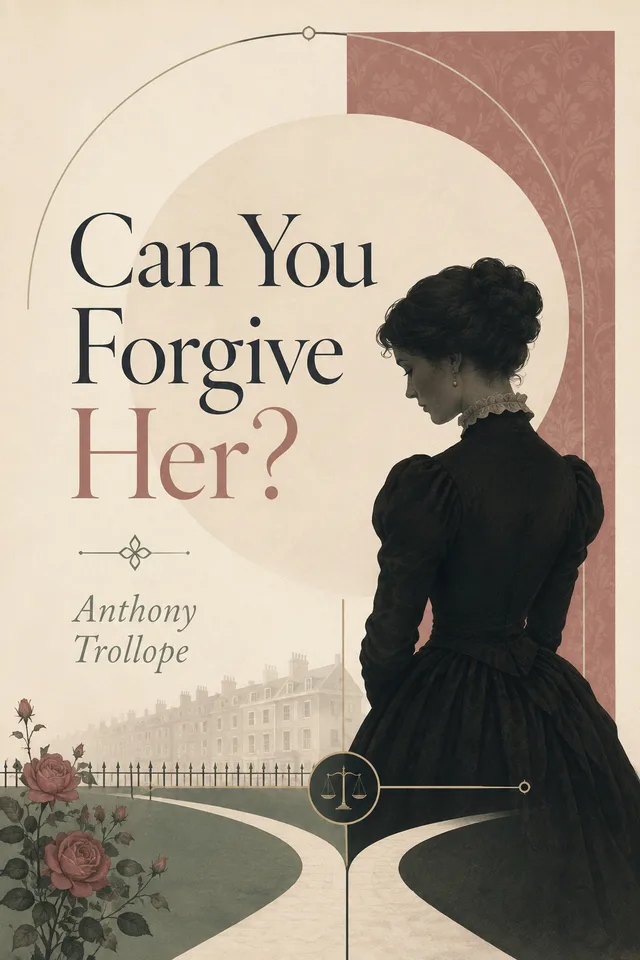
Can You Forgive Her?
Edición BooksWhale en inglés de Anthony Trollope
The opening Palliser novel, rich in courtship, politics, money, and difficult choices.
- Vista previa
- Muestra del texto preparado
- Formatos
- Lector online, EPUB, PDF
- Acceso
- Claim de Biblioteca
Introducción del libro
Can You Forgive Her?
Can You Forgive Her? begins Trollope’s Palliser sequence with Alice Vavasor’s uncertain engagement, family pressure, and political ambition around her. It is a generous Victorian social novel about love, independence, duty, and the costs of choosing badly.
Edición BooksWhale
Cómo se preparó esta edición
Esta edición se basa en un texto de dominio público y fue preparada por BooksWhale para lectura digital.
Base de dominio público
Por qué puede compartirse
Anthony Trollope died in 1882, and Can You Forgive Her? was first published in 1864; these dates support the public-domain basis for this original-language English edition.
Leer vista previa
Muestra del texto preparado
Vista previa seleccionada del texto preparado.
Capítulo de vista previaFull textLeer vista previa
Can You Forgive Her?
Anthony Trollope
Capítulo de vista previaCHAPTER I.Vista previa
Mr. Vavasor and His Daughter.
Whether or no, she, whom you are to forgive, if you can, did or did not belong to the Upper Ten Thousand of this our English world, I am not prepared to say with any strength of affirmation. By blood she was connected with big people,--distantly connected with some very big people indeed, people who belonged to the Upper Ten Hundred if there be any such division; but of these very big relations she had known and seen little, and they had cared as little for her. Her grandfather, Squire Vavasor of Vavasor Hall, in Westmoreland, was a country gentleman, possessing some thousand a year at the outside, and he therefore never came up to London, and had no ambition to have himself numbered as one in any exclusive set. A hot-headed, ignorant, honest old gentleman, he lived ever at Vavasor Hall, declaring to any who would listen to him, that the country was going to the mischief, and congratulating himself that at any rate, in his county, parliamentary reform had been powerless to alter the old political arrangements. Alice Vavasor, whose offence against the world I am to tell you, and if possible to excuse, was the daughter of his younger son; and as her father, John Vavasor, had done nothing to raise the family name to eminence, Alice could not lay claim to any high position from her birth as a Vavasor. John Vavasor had come up to London early in life as a barrister, and had failed. He had failed at least in attaining either much wealth or much repute, though he had succeeded in earning, or perhaps I might better say, in obtaining, a livelihood. He had married a lady somewhat older than himself, who was in possession of four hundred a year, and who was related to those big people to whom I have alluded. Who these were and the special nature of the relationship, I shall be called upon to explain hereafter, but at present it will suffice to say that Alice Macleod gave great offence to all her friends by her marriage. She did not, however, give them much time for the indulgence of their anger. Having given birth to a daughter within twelve months of her marriage, she died, leaving in abeyance that question as to whether the fault of her marriage should or should not be pardoned by her family.
When a man marries an heiress for her money, if that money be within her own control, as was the case with Miss Macleod's fortune, it is generally well for the speculating lover that the lady's friends should quarrel with him and with her. She is thereby driven to throw herself entirely into the gentleman's arms, and he thus becomes possessed of the wife and the money without the abominable nuisance of stringent settlements. But the Macleods, though they quarrelled with Alice, did not quarrel with her _à l'outrance_. They snubbed herself and her chosen husband; but they did not so far separate themselves from her and her affairs as to give up the charge of her possessions. Her four hundred a year was settled very closely on herself and on her children, without even a life interest having been given to Mr. Vavasor, and therefore when she died the mother's fortune became the property of the little baby. But, under these circumstances, the big people did not refuse to interest themselves to some extent on behalf of the father. I do not suppose that any actual agreement or compact was made between Mr. Vavasor and the Macleods; but it came to be understood between them that if he made no demand upon them for his daughter's money, and allowed them to have charge of her education, they would do something for him. He was a practising barrister, though his practice had never amounted to much; and a practising barrister is always supposed to be capable of filling any situation which may come his way. Two years after his wife's death Mr. Vavasor was appointed assistant commissioner in some office which had to do with insolvents, and which was abolished three years after his appointment. It was at first thought that he would keep his eight hundred a year for life and be required to do nothing for it; but a wretched cheeseparing Whig government, as John Vavasor called it when describing the circumstances of the arrangement to his father, down in Westmoreland, would not permit this; it gave him the option of taking four hundred a year for doing nothing, or of keeping his whole income and attending three days a week for three hours a day during term time, at a miserable dingy little office near Chancery Lane, where his duty would consist in signing his name to accounts which he never read, and at which he was never supposed even to look. He had sulkily elected to keep the money, and this signing had been now for nearly twenty years the business of his life. Of course he considered himself to be a very hardly-used man. One Lord Chancellor after another he petitioned, begging that he might be relieved from the cruelty of his position, and allowed to take his salary without doing anything in return for it. The amount of work which he did perform was certainly a minimum of labour. Term time, as terms were counted in Mr. Vavasor's office, hardly comprised half the year, and the hours of weekly attendance did not do more than make one day's work a week for a working man; but Mr. Vavasor had been appointed an assistant commissioner, and with every Lord Chancellor he argued that all Westminster Hall, and Lincoln's Inn to boot, had no right to call upon him to degrade himself by signing his name to accounts. In answer to every memorial he was offered the alternative of freedom with half his income; and so the thing went on.
Capítulo de vista previaCHAPTER II.Vista previa
Lady Macleod.
I cannot say that the house in Queen Anne Street was a pleasant house. I am now speaking of the material house, made up of the walls and furniture, and not of any pleasantness or unpleasantness supplied by the inmates. It was a small house on the south side of the street, squeezed in between two large mansions which seemed to crush it, and by which its fair proportion of doorstep and area was in truth curtailed. The stairs were narrow; the dining-room was dark, and possessed none of those appearances of plenteous hospitality which a dining-room should have. But all this would have been as nothing if the drawing-room had been pretty as it is the bounden duty of all drawing-rooms to be. But Alice Vavasor's drawing-room was not pretty. Her father had had the care of furnishing the house, and he had intrusted the duty to a tradesman who had chosen green paper, a green carpet, green curtains, and green damask chairs. There was a green damask sofa, and two green arm-chairs opposite to each other at the two sides of the fireplace. The room was altogether green, and was not enticing. In shape it was nearly square, the very small back room on the same floor not having been, as is usual, added to it. This had been fitted up as a "study" for Mr. Vavasor, and was very rarely used for any purpose.
Most of us know when we enter a drawing-room whether it is a pretty room or no; but how few of us know how to make a drawing-room pretty! There has come up in London in these latter days a form of room so monstrously ugly that I will venture to say that no other people on earth but Londoners would put up with it. Londoners, as a rule, take their houses as they can get them, looking only to situation, size, and price. What Grecian, what Roman, what Turk, what Italian would endure, or would ever have endured, to use a room with a monstrous cantle in the form of a parallelogram cut sheerly out of one corner of it? This is the shape of room we have now adopted,--or rather which the builders have adopted for us,--in order to throw the whole first floor into one apartment which may be presumed to have noble dimensions,--with such drawback from it as the necessities of the staircase may require. A sharp unadorned corner projects itself into these would-be noble dimensions, and as ugly a form of chamber is produced as any upon which the eye can look. I would say more on the subject if I dared to do so here, but I am bound now to confine myself to Miss Vavasor's room. The monstrous deformity of which I have spoken was not known when that house in Queen Anne Street was built. There is to be found no such abomination of shape in the buildings of our ancestors,--not even in the days of George the Second. But yet the drawing-room of which I speak was ugly, and Alice knew that it was so. She knew that it was ugly, and she would greatly have liked to banish the green sofa, to have re-papered the wall, and to have hung up curtains with a dash of pink through them. With the green carpet she would have been contented. But her father was an extravagant man; and from the day on which she had come of age she had determined that it was her special duty to avoid extravagance.
"It's the ugliest room I ever saw in my life," her father once said to her.
"It is not very pretty," Alice replied.
"I'll go halves with you in the expense of redoing it," said Mr. Vavasor.
"Wouldn't that be extravagant, papa? The things have not been here quite four years yet."
Índice
Dentro de esta edición
- 01Full text
- 02CHAPTER I.
- 03CHAPTER II.
- 04CHAPTER III.
- 05DEAREST ALICE,
- 06J. G.
- 07part should ever bring them again together. But she had pardoned him
- 08CHAPTER IV.
- 09CHAPTER V.
- 10CHAPTER VI.
- 11CHAPTER VII.
- 12CHAPTER VIII.
- 13CHAPTER IX.
- 14CHAPTER X.
- 15DEAREST JOHN,--
- 16ALICE VAVASOR.
- 17CHAPTER XI.
- 18CHAPTER XII.
- 19chapter,--or rather a portion of it, for with the reserve common to
- 20CHAPTER XIII.
- 21CHAPTER XIV.
- 22DEAREST ALICE,
- 23KATE VAVASOR.
- 24CHAPTER XV.
- 25CHAPTER XVI.
- 26CHAPTER XVII.
- 27part of the run Sir William stuck to the hounds in spite of his
- 28CHAPTER XVIII.
- 29MY DEAR MISS VAVASOR,
- 30MARGARET M. MIDLOTHIAN.
- 31DEAR COUSIN,
- 32G. PALLISER.
- 33CHAPTER XIX.
- 34CHAPTER XX.
- 35CHAPTER XXI.
- 36CHAPTER XXII.
- 37CHAPTER XXIII.
- 38CHAPTER XXIV.
- 39CHAPTER XXV.
- 40CHAPTER XXVI.
- 41CHAPTER XXVII.
- 42part of the refectory wall was falling; so he looked at that, and
- 43CHAPTER XXVIII.
- 44CHAPTER XXIX.
- 45CHAPTER XXX.
- 46DEAR ALICE,
- 47GEORGE VAVASOR.
- 48CHAPTER XXXI.
- 49CHAPTER XXXII.
- 50MY DEAR GEORGE,
- 51ALICE VAVASOR.
- 52CHAPTER XXXIII.
- 53part of a husband's unmarried female relations would not be forgiven
- 54CHAPTER XXXIV.
- 55part of the town and live on my income as best we may. I shall go
- 56CHAPTER XXXV.
- 57CHAPTER XXXVI.
- 58CHAPTER XXXVII.
- 59CHAPTER XXXVIII.
- 60CHAPTER XXXIX.
- 61CHAPTER XL.
- 62part must be regarded simply as done in kindness to Mrs. Greenow. She
- 63VOLUME II.
- 64CHAPTER XLI.
- 65ARABELLA GREENOW.
- 66part as she had been wont to do in other times.
- 67CHAPTER XLII.
- 68CHAPTER XLIII.
- 69CHAPTER XLIV.
- 70CHAPTER XLV.
- 71CHAPTER XLVI.
- 72part; but I think that it was natural. It was not that she had any
- 73CHAPTER XLVII.
- 74CHAPTER XLVIII.
- 75CHAPTER XLIX.
- 76CHAPTER L.
- 77CHAPTER LI.
- 78CHAPTER LII.
- 79CHAPTER LIII.
- 80CHAPTER LIV.
- 81DEAREST KATE,
- 82ALICE VAVASOR.
- 83CHAPTER LV.
- 84CHAPTER LVI.
- 85CHAPTER LVII.
- 86CHAPTER LVIII.
- 87CHAPTER LIX.
- 88CHAPTER LX.
- 89DEAR ALICE,
- 90GEORGE VAVASOR.
- 91CHAPTER LXI.
- 92CHAPTER LXII.
- 93"I!"
- 94book away. And when I told him that he might have another wife and a
- 95CHAPTER LXIII.
- 96CHAPTER LXIV.
- 97CHAPTER LXV.
- 98CHAPTER LXVI.
- 99CHAPTER LXVII.
- 100CHAPTER LXVIII.
- 101CHAPTER LXIX.
- 102CHAPTER LXX.
- 103part of his tour abroad. When he first reached Lucerne there was no
- 104CHAPTER LXXI.
- 105CHAPTER LXXII.
- 106CHAPTER LXXIII.
- 107OMNIUM.
- 108CHAPTER LXXIV.
- 109CHAPTER LXXV.
- 110CHAPTER LXXVI.
- 111part, when we remember Burgo's own programme for the following day.
- 112CHAPTER LXXVII.
- 113DEAR LADY MACLEOD,--
- 114CHAPTER LXXVIII.
- 115CHAPTER LXXIX.
- 116CHAPTER LXXX.
Disponibilidad de idiomas
Otros idiomas
Aún no hay otras ediciones lingüísticas publicadas. Esta sección enlazará las disponibles.
Solicitar otro idioma