inglés Edición
Literatura
Erewhon Revisited
Edición BooksWhale en inglés de Samuel Butler
A return to Erewhon reveals a religion built around a misunderstood escape, turning personal discovery into institutional satire.
- Vista previa
- Muestra del texto preparado
- Formatos
- Lector online, EPUB, PDF
- Acceso
- Claim de Biblioteca
Introducción del libro
Erewhon Revisited
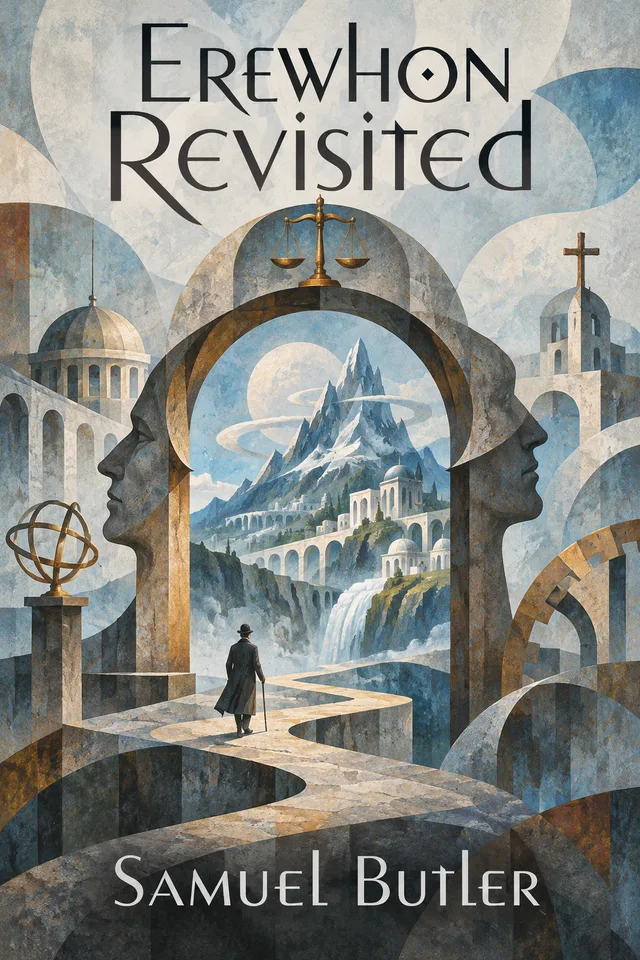
Samuel Butler returns to the imagined country of Erewhon twenty years after its first discovery. Higgs learns that his departure by balloon has become the foundation of a powerful religious system. Encounters with its guardians expose the distance between experience, doctrine, and institutional self-interest. This English sequel develops its own narrative of mistaken identity, family relationships, and the uses of belief.
Edición BooksWhale
Cómo se preparó esta edición
Esta edición se basa en un texto de dominio público y fue preparada por BooksWhale para lectura digital.
Base de dominio público
Por qué puede compartirse
Samuel Butler died in 1902, and this work was first published in 1901. This edition uses the public-domain original English text from Project Gutenberg, without later editorial notes or illustrations.
Leer vista previa
Muestra del texto preparado
Vista previa seleccionada del texto preparado.
Capítulo de vista previaFull textLeer vista previa
Erewhon Revisited
Samuel Butler
Capítulo de vista previaPrefaceVista previa
I forget when, but not very long after I had published “Erewhon” in 1872, it occurred to me to ask myself what course events in Erewhon would probably take after Mr. Higgs, as I suppose I may now call him, had made his escape in the balloon with Arowhena. Given a people in the conditions supposed to exist in Erewhon, and given the apparently miraculous ascent of a remarkable stranger into the heavens with an earthly bride—what would be the effect on the people generally?
There was no use in trying to solve this problem before, say, twenty years should have given time for Erewhonian developments to assume something like permanent shape, and in 1892 I was too busy with books now published to be able to attend to Erewhon. It was not till the early winter of 1900, i.e. as nearly as may be thirty years after the date of Higgs’s escape, that I found time to deal with the question above stated, and to answer it, according to my lights, in the book which I now lay before the public.
I have concluded, I believe rightly, that the events described in Chapter XXIV. of “Erewhon” would give rise to such a cataclysmic change in the old Erewhonian opinions as would result in the development of a new religion. Now the development of all new religions follows much the same general course. In all cases the times are more or less out of joint—older faiths are losing their hold upon the masses. At such times, let a personality appear, strong in itself, and made to seem still stronger by association with some supposed transcendent miracle, and it will be easy to raise a Lo here! that will attract many followers. If there be a single great, and apparently well-authenticated, miracle, others will accrete round it; then, in all religions that have so originated, there will follow temples, priests, rites, sincere believers, and unscrupulous exploiters of public credulity. To chronicle the events that followed Higgs’s balloon ascent without shewing that they were much as they have been under like conditions in other places, would be to hold the mirror up to something very wide of nature.
Analogy, however, between courses of events is one thing—historic parallelisms abound; analogy between the main actors in events is a very different one, and one, moreover, of which few examples can be found. The development of the new ideas in Erewhon is a familiar one, but there is no more likeness between Higgs and the founder of any other religion, than there is between Jesus Christ and Mahomet. He is a typical middle-class Englishman, deeply tainted with priggishness in his earlier years, but in great part freed from it by the sweet uses of adversity.
If I may be allowed for a moment to speak about myself, I would say that I have never ceased to profess myself a member of the more advanced wing of the English Broad Church. What those who belong to this wing believe, I believe. What they reject, I reject. No two people think absolutely alike on any subject, but when I converse with advanced Broad Churchmen I find myself in substantial harmony with them. I believe—and should be very sorry if I did not believe—that, mutatis mutandis, such men will find the advice given on pp. 277-281 and 287-291 of this book much what, under the supposed circumstances, they would themselves give.
Lastly, I should express my great obligations to Mr. R. A. Streatfeild of the British Museum, who, in the absence from England of my friend Mr. H. Festing Jones, has kindly supervised the corrections of my book as it passed through the press.
SAMUEL BUTLER. May 1, 1901.
Capítulo de vista previaCHAPTER I: UPS AND DOWNS OF FORTUNE—MY FATHER STARTS FOR EREWHONVista previa
Before telling the story of my father’s second visit to the remarkable country which he discovered now some thirty years since, I should perhaps say a few words about his career between the publication of his book in 1872, and his death in the early summer of 1891. I shall thus touch briefly on the causes that occasioned his failure to maintain that hold on the public which he had apparently secured at first.
His book, as the reader may perhaps know, was published anonymously, and my poor father used to ascribe the acclamation with which it was received, to the fact that no one knew who it might not have been written by. Omne ignotum pro magnifico, and during its month of anonymity the book was a frequent topic of appreciative comment in good literary circles. Almost coincidently with the discovery that he was a mere nobody, people began to feel that their admiration had been too hastily bestowed, and before long opinion turned all the more seriously against him for this very reason. The subscription, to which the Lord Mayor had at first given his cordial support, was curtly announced as closed before it had been opened a week; it had met with so little success that I will not specify the amount eventually handed over, not without protest, to my father; small, however, as it was, he narrowly escaped being prosecuted for trying to obtain money under false pretences.
The Geographical Society, which had for a few days received him with open arms, was among the first to turn upon him—not, so far as I can ascertain, on account of the mystery in which he had enshrouded the exact whereabouts of Erewhon, nor yet by reason of its being persistently alleged that he was subject to frequent attacks of alcoholic poisoning—but through his own want of tact, and a highly-strung nervous state, which led him to attach too much importance to his own discoveries, and not enough to those of other people. This, at least, was my father’s version of the matter, as I heard it from his own lips in the later years of his life.
“I was still very young,” he said to me, “and my mind was more or less unhinged by the strangeness and peril of my adventures.” Be this as it may, I fear there is no doubt that he was injudicious; and an ounce of judgement is worth a pound of discovery.
Hence, in a surprisingly short time, he found himself dropped even by those who had taken him up most warmly, and had done most to find him that employment as a writer of religious tracts on which his livelihood was then dependent. The discredit, however, into which my father fell, had the effect of deterring any considerable number of people from trying to rediscover Erewhon, and thus caused it to remain as unknown to geographers in general as though it had never been found. A few shepherds and cadets at up-country stations had, indeed, tried to follow in my father’s footsteps, during the time when his book was still being taken seriously; but they had most of them returned, unable to face the difficulties that had opposed them. Some few, however, had not returned, and though search was made for them, their bodies had not been found. When he reached Erewhon on his second visit, my father learned that others had attempted to visit the country more recently—probably quite independently of his own book; and before he had himself been in it many hours he gathered what the fate of these poor fellows doubtless was.
Another reason that made it more easy for Erewhon to remain unknown, was the fact that the more mountainous districts, though repeatedly prospected for gold, had been pronounced non-auriferous, and as there was no sheep or cattle country, save a few river-bed flats above the upper gorges of any of the rivers, and no game to tempt the sportsman, there was nothing to induce people to penetrate into the fastnesses of the great snowy range. No more, therefore, being heard of Erewhon, my father’s book came to be regarded as a mere work of fiction, and I have heard quite recently of its having been seen on a second-hand bookstall, marked “6d. very readable.”
Índice
Dentro de esta edición
- 01Full text
- 02Preface
- 03CHAPTER I: UPS AND DOWNS OF FORTUNE—MY FATHER STARTS FOR EREWHON
- 04CHAPTER II: TO THE FOOT OF THE PASS INTO EREWHON
- 05CHAPTER III: MY FATHER WHILE CAMPING IS ACCOSTED BY PROFESSORS HANKY AND PANKY
- 06CHAPTER IV: MY FATHER OVERHEARS MORE OF HANKY AND PANKY’S CONVERSATION
- 07CHAPTER V: MY FATHER MEETS A SON, OF WHOSE EXISTENCE HE WAS IGNORANT; AND STRIKES A BARGAIN WITH HIM
- 08CHAPTER VI: FURTHER CONVERSATION BETWEEN FATHER AND SON—THE PROFESSORS’ HOARD
- 09CHAPTER VII: SIGNS OF THE NEW ORDER OF THINGS CATCH MY FATHER’S EYE ON EVERY SIDE
- 10CHAPTER VIII: YRAM, NOW MAYORESS, GIVES A DINNER-PARTY, IN THE COURSE OF WHICH SHE IS DISQUIETED BY WHAT SHE LEARNS FROM PROFESSOR HANKY: SHE SENDS FOR HER SON GEORGE AND QUESTIONS HIM
- 11CHAPTER IX: INTERVIEW BETWEEN YRAM AND HER SON
- 12CHAPTER X: MY FATHER, FEARING RECOGNITION AT SUNCH’STON, BETAKES HIMSELF TO THE NEIGHBOURING TOWN OF FAIRMEAD
- 13CHAPTER XI: PRESIDENT GURGOYLE’S PAMPHLET “ON THE PHYSICS OF VICARIOUS EXISTENCE”
- 14CHAPTER XII: GEORGE FAILS TO FIND MY FATHER, WHEREON YRAM CAUTIONS THE PROFESSORS
- 15CHAPTER XIII: A VISIT TO THE PROVINCIAL DEFORMATORY AT FAIRMEAD
- 16CHAPTER XIV: MY FATHER MAKES THE ACQUAINTANCE OF MR. BALMY, AND WALKS WITH HIM NEXT DAY TO SUNCH’STON
- 17CHAPTER XV: THE TEMPLE IS DEDICATED TO MY FATHER, AND CERTAIN EXTRACTS ARE READ FROM HIS SUPPOSED SAYINGS
- 18CHAPTER XVI: PROFESSOR HANKY PREACHES A SERMON, IN THE COURSE OF WHICH MY FATHER DECLARES HIMSELF TO BE THE SUNCHILD
- 19CHAPTER XVII: GEORGE TAKES HIS FATHER TO PRISON, AND THERE OBTAINS SOME USEFUL INFORMATION
- 20CHAPTER XVIII: YRAM INVITES DR. DOWNIE AND MRS. HUMDRUM TO LUNCHEON—A PASSAGE AT ARMS BETWEEN HER AND HANKY IS AMICABLY ARRANGED
- 21CHAPTER XIX: A COUNCIL IS HELD AT THE MAYOR’S, IN THE COURSE OF WHICH GEORGE TURNS THE TABLES ON THE PROFESSORS
- 22CHAPTER XX: MRS. HUMDRUM AND DR. DOWNIE PROPOSE A COMPROMISE, WHICH, AFTER AN AMENDMENT BY GEORGE, IS CARRIED NEM. CON.
- 23CHAPTER XXI: YRAM, ON GETTING RID OF HER GUESTS, GOES TO THE PRISON TO SEE MY FATHER
- 24CHAPTER XXII: MAINLY OCCUPIED WITH A VERACIOUS EXTRACT FROM A SUNCH’STONIAN JOURNAL
- 25CHAPTER XXIII: MY FATHER IS ESCORTED TO THE MAYOR’S HOUSE, AND IS INTRODUCED TO A FUTURE DAUGHTER-IN-LAW
- 26CHAPTER XXIV: AFTER DINNER, DR. DOWNIE AND THE PROFESSORS WOULD BE GLAD TO KNOW WHAT IS TO BE DONE ABOUT SUNCHILDISM
- 27CHAPTER XXV: GEORGE ESCORTS MY FATHER TO THE STATUES; THE TWO THEN PART
- 28CHAPTER XXVI: MY FATHER REACHES HOME, AND DIES NOT LONG AFTERWARDS
- 29CHAPTER XXVII: I MEET MY BROTHER GEORGE AT THE STATUES, ON THE TOP OF THE PASS INTO EREWHON
- 30CHAPTER XXVIII: GEORGE AND I SPEND A FEW HOURS TOGETHER AT THE STATUES, AND THEN PART—I REACH HOME—POSTSCRIPT
Disponibilidad de idiomas
Otros idiomas
Aún no hay otras ediciones lingüísticas publicadas. Esta sección enlazará las disponibles.
Solicitar otro idioma