inglés Edición
Literatura
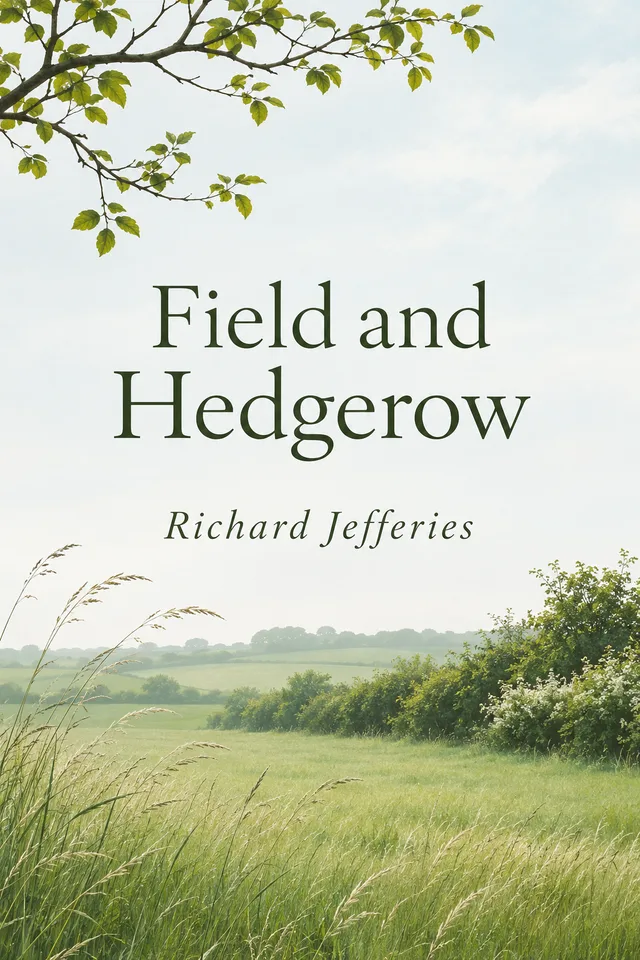
Field and Hedgerow
Edición BooksWhale en inglés de Richard Jefferies
Richard Jefferies observes birds, hedgerows, harvests, village life, and the changing seasons in his final collection of essays.
- Vista previa
- Muestra del texto preparado
- Formatos
- Lector online, EPUB, PDF
- Acceso
- Claim de Biblioteca
Introducción del libro
Field and Hedgerow
From early spring birdsong to summer fields and the approach of winter, Jefferies records the English countryside through careful observation. His essays move between gardens, wheat fields, parks, and village lanes, attending to animals, weather, and the rural work that gives each landscape its particular rhythm.
Edición BooksWhale
Cómo se preparó esta edición
Esta edición se basa en un texto de dominio público y fue preparada por BooksWhale para lectura digital.
Base de dominio público
Por qué puede compartirse
Richard Jefferies died in 1887. This is the historical English text from the 1889 edition.
Leer vista previa
Muestra del texto preparado
Vista previa seleccionada del texto preparado.
Capítulo de vista previaHOURS OF SPRING.Leer vista previa
It is sweet on awaking in the early morn to listen to the small bird singing on the tree. No sound of voice or flute is like to the bird's song; there is something in it distinct and separate from all other notes. The throat of woman gives forth a more perfect music, and the organ is the glory of man's soul. The bird upon the tree utters the meaning of the wind—a voice of the grass and wild flower, words of the green leaf; they speak through that slender tone. Sweetness of dew and rifts of sunshine, the dark hawthorn touched with breadths of open bud, the odour of the air, the colour of the daffodil—all that is delicious and beloved of spring-time are expressed in his song. Genius is nature, and his lay, like the sap in the bough from which he sings, rises without thought. Nor is it necessary that it should be a song; a few short notes in the sharp spring morning are sufficient to stir the heart. But yesterday the least of them all came to a bough by my window, and in his call I heard the sweet-briar wind rushing over the young grass. Refulgent fall the golden rays of the sun; a minute only, the clouds cover him and the hedge is dark. The bloom of the gorse is shut like a book; but it is there—a few hours of warmth and the covers will fall open. The meadow is bare, but in a little while the heart-shaped celandine leaves will come in their accustomed place. On the pollard willows the long wands are yellow-ruddy in the passing gleam of sunshine, the first colour of spring appears in their bark. The delicious wind rushes among them and they bow and rise; it touches the top of the dark pine that looks in the sun the same now as in summer; it lifts and swings the arching trail of bramble; it dries and crumbles the earth in its fingers; the hedge-sparrow's feathers are fluttered as he sings on the bush.
I wonder to myself how they can all get on without me—how they manage, bird and flower, without me to keep the calendar for them. For I noted it so carefully and lovingly, day by day, the seed-leaves on the mounds in the sheltered places that come so early, the pushing up of the young grass, the succulent dandelion, the coltsfoot on the heavy, thick clods, the trodden chickweed despised at the foot of the gate-post, so common and small, and yet so dear to me. Every blade of grass was mine, as though I had planted it separately. They were all my pets, as the roses the lover of his garden tends so faithfully. All the grasses of the meadow were my pets, I loved them all; and perhaps that was why I never had a 'pet,' never cultivated a flower, never kept a caged bird, or any creature. Why keep pets when every wild free hawk that passed overhead in the air was mine? I joyed in his swift, careless flight, in the throw of his pinions, in his rush over the elms and miles of woodland; it was happiness to see his unchecked life. What more beautiful than the sweep and curve of his going through the azure sky? These were my pets, and all the grass. Under the wind it seemed to dry and become grey, and the starlings running to and fro on the surface that did not sink now stood high above it and were larger. The dust that drifted along blessed it and it grew. Day by day a change; always a note to make. The moss drying on the tree trunks, dog's-mercury stirring under the ash-poles, bird's-claw buds of beech lengthening; books upon books to be filled with these things. I cannot think how they manage without me.
Capítulo de vista previaNATURE AND BOOKS.Vista previa
What is the colour of the dandelion? There are many dandelions: that which I mean flowers in May, when the meadow-grass has started and the hares are busy by daylight. That which flowers very early in the year has a thickness of hue, and is not interesting; in autumn the dandelions quite change their colour and are pale. The right dandelion for this question is the one that comes about May with a very broad disc, and in such quantities as often to cover a whole meadow. I used to admire them very much in the fields by Surbiton (strong clay soil), and also on the towing-path of the Thames where the sward is very broad, opposite Long Ditton; indeed, I have often walked up that towing-path on a beautiful sunny morning, when all was quiet except the nightingales in the Palace hedge, on purpose to admire them. I dare say they are all gone now for evermore; still, it is a pleasure to look back on anything beautiful. What colour is this dandelion? It is not yellow, nor orange, nor gold; put a sovereign on it and see the difference. They say the gipsies call it the Queen's great hairy dog-flower—a number of words to one stalk; and so, to get a colour to it, you may call it the yellow-gold-orange plant. In the winter, on the black mud under a dark, dripping tree, I found a piece of orange peel, lately dropped—a bright red orange speck in the middle of the blackness. It looked very beautiful, and instantly recalled to my mind the great dandelion discs in the sunshine of summer. Yet certainly they are not red-orange. Perhaps, if ten people answered this question, they would each give different answers. Again, a bright day or a cloudy, the presence of a slight haze, or the juxtaposition of other colours, alters it very much; for the dandelion is not a glazed colour, like the buttercup, but sensitive. It is like a sponge, and adds to its own hue that which is passing, sucking it up.
The shadows of the trees in the wood, why are they blue? Ought they not to be dark? Is it really blue, or an illusion? And what is their colour when you see the shadow of a tall trunk aslant in the air like a leaning pillar? The fallen brown leaves wet with dew have a different brown from those that are dry, and the upper surface of the green growing leaf is different from the under surface. The yellow butterfly, if you meet one in October, has so toned down his spring yellow that you might fancy him a pale green leaf floating along the road. There is a shining, quivering, gleaming; there is a changing, fluttering, shifting; there is a mixing, weaving—varnished wings, translucent wings, wings with dots and veins, all playing over the purple heath; a very tangle of many-toned lights and hues. Then come the apples: if you look upon them from an upper window, so as to glance along the level plane of the fruit, delicate streaks of scarlet, like those that lie parallel to the eastern horizon before sunrise; golden tints under bronze, and apple-green, and some that the wasps have hollowed, more glowingly beautiful than the rest; sober leaves and black and white swallows: to see it you must be high up, as if the apples were strewn on a sward of foliage. So have I gone in three steps from May dandelion to September apple; an immense space measured by things beautiful, so filled that ten folio volumes could not hold the description of them, and I have left out the meadows, the brooks, and hills. Often in writing about these things I have felt very earnestly my own incompetence to give the least idea of their brilliancy and many-sided colours. My gamut was so very limited in its terms, and would not give a note to one in a thousand of those I saw. At last I said, I will have more words; I will have more terms; I will have a book on colour, and I will find and use the right technical name for each one of these lovely tints. I was told that the very best book was by Chevreul, which had tinted illustrations, chromatic scales, and all that could be desired.
Capítulo de vista previaTHE JULY GRASS.Vista previa
A July fly went sideways over the long grass. His wings made a burr about him like a net, beating so fast they wrapped him round with a cloud. Every now and then, as he flew over the trees of grass, a taller one than common stopped him, and there he clung, and then the eye had time to see the scarlet spots—the loveliest colour—on his wings. The wind swung the bennet and loosened his hold, and away he went again over the grasses, and not one jot did he care if they were Poa or Festuca, or Bromus or Hordeum, or any other name. Names were nothing to him; all he had to do was to whirl his scarlet spots about in the brilliant sun, rest when he liked, and go on again. I wonder whether it is a joy to have bright scarlet spots, and to be clad in the purple and gold of life; is the colour felt by the creature that wears it? The rose, restful of a dewy morn before the sunbeams have topped the garden wall, must feel a joy in its own fragrance, and know the exquisite hue of its stained petals. The rose sleeps in its beauty.
The fly whirls his scarlet-spotted wings about and splashes himself with sunlight, like the children on the sands. He thinks not of the grass and sun; he does not heed them at all—and that is why he is so happy— any more than the barefoot children ask why the sea is there, or why it does not quite dry up when it ebbs. He is unconscious; he lives without thinking about living; and if the sunshine were a hundred hours long, still it would not be long enough. No, never enough of sun and sliding shadows that come like a hand over the table to lovingly reach our shoulder, never enough of the grass that smells sweet as a flower, not if we could live years and years equal in number to the tides that have ebbed and flowed counting backwards four years to every day and night, backward still till we found out which came first, the night or the day. The scarlet-dotted fly knows nothing of the names of the grasses that grow here where the sward nears the sea, and thinking of him I have decided not to wilfully seek to learn any more of their names either. My big grass book I have left at home, and the dust is settling on the gold of the binding. I have picked a handful this morning of which I know nothing. I will sit here on the turf and the scarlet-dotted flies shall pass over me, as if I too were but a grass. I will not think, I will be unconscious, I will live.
Listen! that was the low sound of a summer wavelet striking the uncovered rock over there beneath in the green sea. All things that are beautiful are found by chance, like everything that is good. Here by me is a praying-rug, just wide enough to kneel on, of the richest gold inwoven with crimson. All the Sultans of the East never had such beauty as that to kneel on. It is, indeed, too beautiful to kneel on, for the life in these golden flowers must not be broken down even for that purpose. They must not be defaced, not a stem bent; it is more reverent not to kneel on them, for this carpet prays itself I will sit by it and let it pray for me. It is so common, the bird's-foot lotus, it grows everywhere; yet if I purposely searched for days I should not have found a plot like this, so rich, so golden, so glowing with sunshine. You might pass by it in one stride, yet it is worthy to be thought of for a week and remembered for a year. Slender grasses, branched round about with slenderer boughs, each tipped with pollen and rising in tiers cone-shaped—too delicate to grow tall—cluster at the base of the mound. They dare not grow tall or the wind would snap them. A great grass, stout and thick, rises three feet by the hedge, with a head another foot nearly, very green and strong and bold, lifting itself right up to you; you must say, 'What a fine grass!' Grasses whose awns succeed each other alternately; grasses whose tops seem flattened; others drooping over the shorter blades beneath; some that you can only find by parting the heavier growth around them; hundreds and hundreds, thousands and thousands. The kingly poppies on the dry summit of the mound take no heed of these, the populace, their subjects so numerous they cannot be numbered. A barren race they are, the proud poppies, lords of the July field, taking no deep root, but raising up a brilliant blazon of scarlet heraldry out of nothing. They are useless, they are bitter, they are allied to sleep and poison and everlasting night; yet they are forgiven because they are not commonplace. Nothing, no abundance of them, can ever make the poppies commonplace. There is genius in them, the genius of colour, and they are saved. Even when they take the room of the corn we must admire them. The mighty multitude of nations, the millions and millions of the grass stretching away in intertangled ranks, through pasture and mead from shore to shore, have no kinship with these their lords. The ruler is always a foreigner. From England to China the native born is no king; the poppies are the Normans of the field. One of these on the mound is very beautiful, a width of petal, a clear silkiness of colour three shades higher than the rest—it is almost dark with scarlet. I wish I could do something more than gaze at all this scarlet and gold and crimson and green, something more than see it, not exactly to drink it or inhale it, but in some way to make it part of me that I might live it.
Índice
Dentro de esta edición
- 01HOURS OF SPRING.
- 02NATURE AND BOOKS.
- 03THE JULY GRASS.
- 04WINDS OF HEAVEN.
- 05THE COUNTRY SUNDAY
- 06THE COUNTRY-SIDE: SUSSEX.
- 07I
- 08II.
- 09SWALLOW-TIME
- 10BUCKHURST PARK.
- 11HOUSE-MARTINS.
- 12AMONG THE NUTS.
- 13WALKS IN THE WHEAT-FIELDS.
- 14I.
- 15II.
- 16JUST BEFORE WINTER.
- 17LOCALITY AND NATURE.
- 18COUNTRY PLACES.
- 19I.
- 20II.
- 21FIELD WORDS AND WAYS.
- 22COTTAGE IDEAS.
- 23APRIL GOSSIP
- 24SOME APRIL INSECTS.
- 25THE TIME OF YEAR.
- 26MIXED DAYS OF MAY AND DECEMBER
- 27THE MAKERS OF SUMMER.
- 28STEAM ON COUNTRY ROADS.
- 29FIELD SPORTS IN ART. THE MAMMOTH HUNTER.
- 30BIRDS' NESTS
- 31NATURE IN THE LOUVRE.
- 32SUMMER IN SOMERSET.
- 33AN ENGLISH DEER-PARK.
- 34MY OLD VILLAGE.
- 35MY CHAFFINCH
Disponibilidad de idiomas
Otros idiomas
Aún no hay otras ediciones lingüísticas publicadas. Esta sección enlazará las disponibles.
Solicitar otro idioma