inglés Edición
Literatura
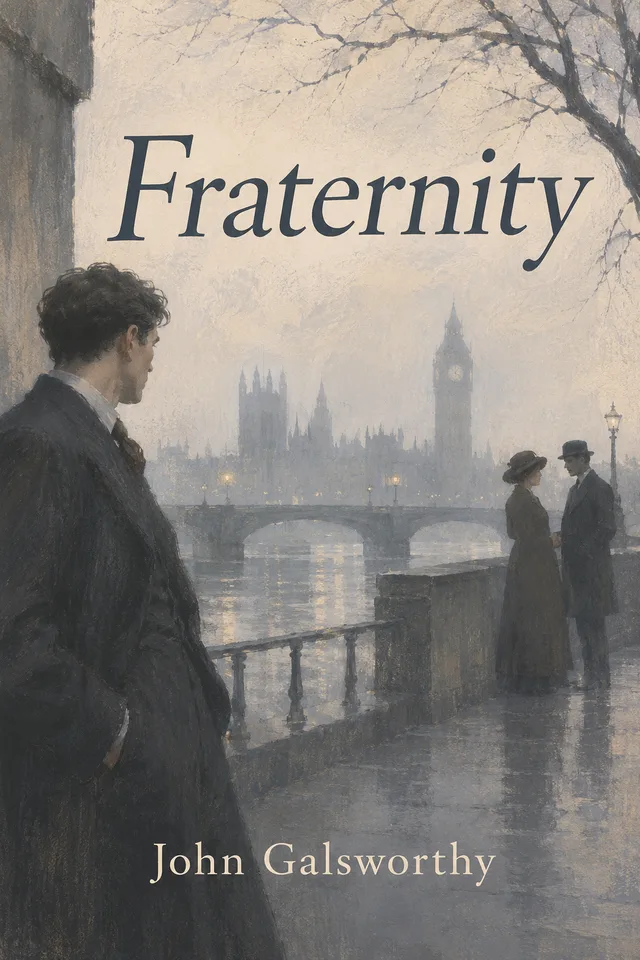
Fraternity
Edición BooksWhale en inglés de John Galsworthy
A London family’s ideal of brotherhood encounters class barriers, desire, and the precarious life of a young artist’s model.
- Vista previa
- Muestra del texto preparado
- Formatos
- Lector online, EPUB, PDF
- Acceso
- Claim de Biblioteca
Introducción del libro
Fraternity
John Galsworthy follows the Dallison family and their circle as an appeal to universal brotherhood meets the unequal conditions of everyday London. Hilary’s concern for a young model unsettles his marriage, while Mr Stone works on a book about humanity’s shared life. Across forty-one chapters, private loyalties and acts of charity expose the distance between sympathetic intentions and the social divisions people continue to defend.
Edición BooksWhale
Cómo se preparó esta edición
Esta edición se basa en un texto de dominio público y fue preparada por BooksWhale para lectura digital.
Base de dominio público
Por qué puede compartirse
John Galsworthy died in 1933. This edition uses the public-domain English text supplied by Project Gutenberg, without later editorial introductions or notes.
Leer vista previa
Muestra del texto preparado
Vista previa seleccionada del texto preparado.
Capítulo de vista previaFull textLeer vista previa
Fraternity
Capítulo de vista previaCHAPTER I — THE SHADOWVista previa
In the afternoon of the last day of April, 190-, a billowy sea of little broken clouds crowned the thin air above High Street, Kensington. This soft tumult of vapours, covering nearly all the firmament, was in onslaught round a patch of blue sky, shaped somewhat like a star, which still gleamed—a single gentian flower amongst innumerable grass. Each of these small clouds seemed fitted with a pair of unseen wings, and, as insects flight on their too constant journeys, they were setting forth all ways round this starry blossom which burned so clear with the colour of its far fixity. On one side they were massed in fleecy congeries, so crowding each other that no edge or outline was preserved; on the other, higher, stronger, emergent from their fellow-clouds, they seemed leading the attack on that surviving gleam of the ineffable. Infinite was the variety of those million separate vapours, infinite the unchanging unity of that fixed blue star.
Down in the street beneath this eternal warring of the various soft-winged clouds on the unmisted ether, men, women, children, and their familiars—horses, dogs, and cats—were pursuing their occupations with the sweet zest of the Spring. They streamed along, and the noise of their frequenting rose in an unbroken roar: “I, I—I, I!”
The crowd was perhaps thickest outside the premises of Messrs. Rose and Thorn. Every kind of being, from the highest to the lowest, passed in front of the hundred doors of this establishment; and before the costume window a rather tall, slight, graceful woman stood thinking: “It really is gentian blue! But I don't know whether I ought to buy it, with all this distress about!”
Her eyes, which were greenish-grey, and often ironical lest they should reveal her soul, seemed probing a blue gown displayed in that window, to the very heart of its desirability.
“And suppose Stephen doesn't like me in it!” This doubt set her gloved fingers pleating the bosom of her frock. Into that little pleat she folded the essence of herself, the wish to have and the fear of having, the wish to be and the fear of being, and her veil, falling from the edge of her hat, three inches from her face, shrouded with its tissue her half-decided little features, her rather too high cheek-bones, her cheeks which were slightly hollowed, as though Time had kissed them just too much.
The old man, with a long face, eyes rimmed like a parrot's, and discoloured nose, who, so long as he did not sit down, was permitted to frequent the pavement just there and sell the 'Westminster Gazette', marked her, and took his empty pipe out of his mouth.
It was his business to know all the passers-by, and his pleasure too; his mind was thus distracted from the condition of his feet. He knew this particular lady with the delicate face, and found her puzzling; she sometimes bought the paper which Fate condemned him, against his politics, to sell. The Tory journals were undoubtedly those which her class of person ought to purchase. He knew a lady when he saw one. In fact, before Life threw him into the streets, by giving him a disease in curing which his savings had disappeared, he had been a butler, and for the gentry had a respect as incurable as was his distrust of “all that class of people” who bought their things at “these 'ere large establishments,” and attended “these 'ere subscription dances at the Town 'All over there.” He watched her with special interest, not, indeed, attempting to attract attention, though conscious in every fibre that he had only sold five copies of his early issues. And he was sorry and surprised when she passed from his sight through one of the hundred doors.
The thought which spurred her into Messrs. Rose and Thorn's was this: “I am thirty-eight; I have a daughter of seventeen. I cannot afford to lose my husband's admiration. The time is on me when I really must make myself look nice!”
Capítulo de vista previaCHAPTER II — A FAMILY DISCUSSIONVista previa
The marriage of Sylvanus Stone, Professor of the Natural Sciences, to Anne, daughter of Mr. Justice Carfax, of the well-known county family—the Carfaxes of Spring Deans, Hants—was recorded in the sixties. The baptisms of Martin, Cecilia, and Bianca, son and daughters of Sylvanus and Anne Stone, were to be discovered registered in Kensington in the three consecutive years following, as though some single-minded person had been connected with their births. After this the baptisms of no more offspring were to be found anywhere, as if that single mind had encountered opposition. But in the eighties there was noted in the register of the same church the burial of “Anne, nee Carfax, wife of Sylvanus Stone.” In that “nee Carfax” there was, to those who knew, something more than met the eye. It summed up the mother of Cecilia and Bianca, and, in more subtle fashion, Cecilia and Bianca, too. It summed up that fugitive, barricading look in their bright eyes, which, though spoken of in the family as “the Carfax eyes,” were in reality far from coming from old Mr. Justice Carfax. They had been his wife's in turn, and had much annoyed a man of his decided character. He himself had always known his mind, and had let others know it, too; reminding his wife that she was an impracticable woman, who knew not her own mind; and devoting his lawful gains to securing the future of his progeny. It would have disturbed him if he had lived to see his grand-daughters and their times. Like so many able men of his generation, far-seeing enough in practical affairs, he had never considered the possibility that the descendants of those who, like himself, had laid up treasure for their children's children might acquire the quality of taking time, balancing pros and cons, looking ahead, and not putting one foot down before picking the other up. He had not foreseen, in deed, that to wobble might become an art, in order that, before anything was done, people might know the full necessity for doing some thing, and how impossible it would be to do indeed, foolish to attempt to do—that which would fully meet the case. He, who had been a man of action all his life, had not perceived how it would grow to be matter of common instinct that to act was to commit oneself, and that, while what one had was not precisely what one wanted, what one had not (if one had it) would be as bad. He had never been self-conscious—it was not the custom of his generation—and, having but little imagination, had never suspected that he was laying up that quality for his descendants, together with a competence which secured them a comfortable leisure.
Of all the persons in his grand-daughter's studio that afternoon, that stray sheep Mr. Purcey would have been, perhaps, the only one whose judgments he would have considered sound. No one had laid up a competence for Mr. Purcey, who had been in business from the age of twenty.
It is uncertain whether the mere fact that he was not in his own fold kept this visitor lingering in the studio when all other guests were gone; or whether it was simply the feeling that the longer he stayed in contact with really artistic people the more distinguished he was becoming. Probably the latter, for the possession of that Harpignies, a good specimen, which he had bought by accident, and subsequently by accident discovered to have a peculiar value, had become a factor in his life, marking him out from all his friends, who went in more for a neat type of Royal Academy landscape, together with reproductions of young ladies in eighteenth-century costumes seated on horseback, or in Scotch gardens. A junior partner in a banking-house of some importance, he lived at Wimbledon, whence he passed up and down daily in his car. To this he owed his acquaintance with the family of Dallison. For one day, after telling his chauffeur to meet him at the Albert Gate, he had set out to stroll down Rotten Row, as he often did on the way home, designing to nod to anybody that he knew. It had turned out a somewhat barren expedition. No one of any consequence had met his eye; and it was with a certain almost fretful longing for distraction that in Kensington Gardens he came on an old man feeding birds out of a paper bag. The birds having flown away on seeing him, he approached the feeder to apologize.
Índice
Dentro de esta edición
- 01Full text
- 02CHAPTER I — THE SHADOW
- 03CHAPTER II — A FAMILY DISCUSSION
- 04CHAPTER III — HILARY'S BROWN STUDY
- 05CHAPTER IV — THE LITTLE MODEL
- 06CHAPTER V — THE COMEDY BEGINS
- 07CHAPTER VI — FIRST PILGRIMAGE TO HOUND STREET
- 08CHAPTER VII — CECILIA'S SCATTERED THOUGHTS
- 09CHAPTER VIII — THE SINGLE MIND OF MR. STONE
- 10CHAPTER IX — HILARY GIVES CHASE
- 11CHAPTER X — THE TROUSSEAU
- 12CHAPTER XI — PEAR BLOSSOM
- 13CHAPTER XII — SHIPS IN SAIL
- 14CHAPTER XIII — SOUND IN THE NIGHT
- 15CHAPTER XIV — A WALK ABROAD
- 16CHAPTER XV — SECOND PILGRIMAGE TO HOUND STREET
- 17CHAPTER XVI — BENEATH THE ELMS
- 18CHAPTER XVII — TWO BROTHERS
- 19CHAPTER XVIII — THE PERFECT DOG
- 20CHAPTER XIX — BIANCA
- 21CHAPTER XX — THE HUSBAND AND THE WIFE
- 22CHAPTER XXI — A DAY OF REST
- 23CHAPTER XXII — HILARY PUTS AN END TO IT
- 24CHAPTER XXIII — THE “BOOK OF UNIVERSAL BROTHERHOOD”
- 25CHAPTER XXIV — SHADOWLAND
- 26CHAPTER XXV — MR. STONE IN WAITING
- 27CHAPTER XXVI — THIRD PILGRIMAGE TO HOUND STREET
- 28CHAPTER XXVII — STEPHEN'S PRIVATE LIFE
- 29CHAPTER XXVIII — HILARY HEARS THE CUCKOO SING
- 30CHAPTER XXIX — RETURN OF THE LITTLE MODEL
- 31CHAPTER XXX — FUNERAL OF A BABY
- 32CHAPTER XXXI — SWAN SONG
- 33CHAPTER XXXII — BEHIND BIANCA'S VEIL
- 34CHAPTER XXXIII — HILARY DEALS WITH THE SITUATION
- 35CHAPTER XXXIV — THYME'S ADVENTURE
- 36CHAPTER XXXV — A YOUNG GIRL'S MIND
- 37CHAPTER XXXVI — STEPHEN SIGNS CHEQUES
- 38CHAPTER XXXVII — THE FLOWERING OF THE ALOE
- 39CHAPTER XXXVIII — THE HOME-COMING OF HUGHS
- 40CHAPTER XXXIX — THE DUEL
- 41CHAPTER XL — FINISH OF THE COMEDY
- 42CHAPTER XLI — THE HOUSE OF HARMONY
Disponibilidad de idiomas
Otros idiomas
Aún no hay otras ediciones lingüísticas publicadas. Esta sección enlazará las disponibles.
Solicitar otro idioma