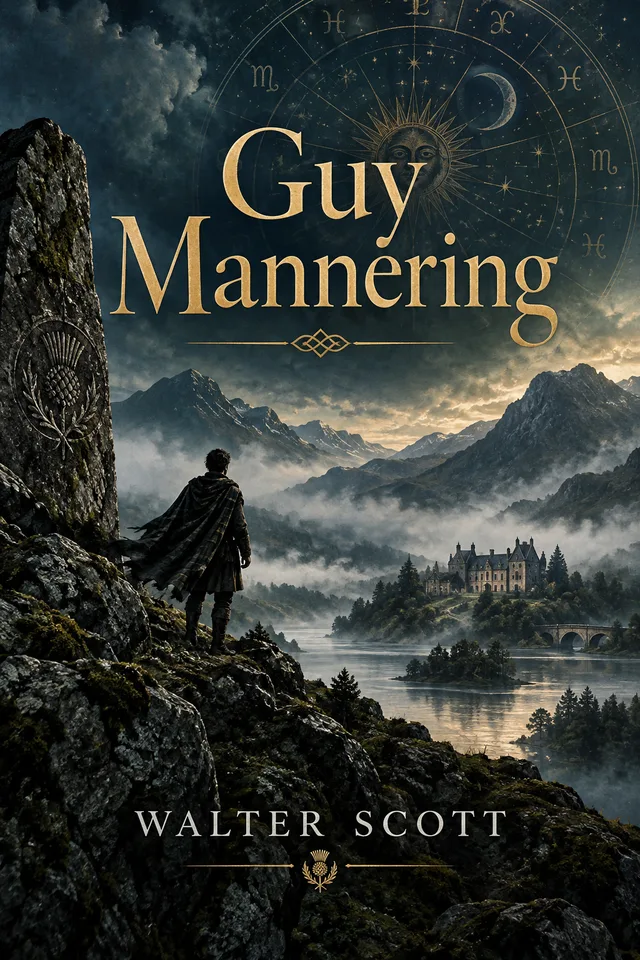
inglés Edición
Literatura
Guy Mannering
Edición BooksWhale en inglés de Walter Scott
A Scottish tale of prophecy, lost identity, inheritance, and divided loyalties.
- Vista previa
- Muestra del texto preparado
- Formatos
- Lector online, EPUB, PDF
- Acceso
- Claim de Biblioteca
Introducción del libro
Guy Mannering
Colonel Guy Mannering’s horoscope sets in motion the disappearance and recovery of Harry Bertram, linking fortune-telling, family secrets, smugglers, and the landscapes of Scotland.
Edición BooksWhale
Cómo se preparó esta edición
Esta edición se basa en un texto de dominio público y fue preparada por BooksWhale para lectura digital.
Base de dominio público
Por qué puede compartirse
The original work is a public-domain classic by Walter Scott, who died in 1832.
Leer vista previa
Muestra del texto preparado
Vista previa seleccionada del texto preparado.
Capítulo de vista previaFull textLeer vista previa
Guy Mannering
Walter Scott
Capítulo de vista previaVOLUME IVista previa
‘Tis said that words and signs have power O’er sprites in planetary hour; But scarce I praise their venturous part Who tamper with such dangerous art. Lay of the Last Minstrel.
INTRODUCTION
The Novel or Romance of Waverley made its way to the public slowly, of course, at first, but afterwards with such accumulating popularity as to encourage the Author to a second attempt. He looked about for a name and a subject; and the manner in which the novels were composed cannot be better illustrated than by reciting the simple narrative on which Guy Mannering was originally founded; but to which, in the progress of the work, the production ceased to bear any, even the most distant resemblance. The tale was originally told me by an old servant of my father’s, an excellent old Highlander, without a fault, unless a preference to mountain dew over less potent liquors be accounted one. He believed as firmly in the story as in any part of his creed.
A grave and elderly person, according to old John MacKinlay’s account, while travelling in the wilder parts of Galloway, was benighted. With difficulty he found his way to a country seat, where, with the hospitality of the time and country, he was readily admitted. The owner of the house, a gentleman of good fortune, was much struck by the reverend appearance of his guest, and apologised to him for a certain degree of confusion which must unavoidably attend his reception, and could not escape his eye. The lady of the house was, he said, confined to her apartment, and on the point of making her husband a father for the first time, though they had been ten years married. At such an emergency, the laird said, he feared his guest might meet with some apparent neglect.
‘Not so, sir,’ said the stranger; ‘my wants are few, and easily supplied, and I trust the present circumstances may even afford an opportunity of showing my gratitude for your hospitality. Let me only request that I may be informed of the exact minute of the birth; and I hope to be able to put you in possession of some particulars which may influence in an important manner the future prospects of the child now about to come into this busy and changeful world. I will not conceal from you that I am skilful in understanding and interpreting the movements of those planetary bodies which exert their influences on the destiny of mortals. It is a science which I do not practise, like others who call themselves astrologers, for hire or reward; for I have a competent estate, and only use the knowledge I possess for the benefit of those in whom I feel an interest.’ The laird bowed in respect and gratitude, and the stranger was accommodated with an apartment which commanded an ample view of the astral regions.
The guest spent a part of the night in ascertaining the position of the heavenly bodies, and calculating their probable influence; until at length the result of his observations induced him to send for the father and conjure him in the most solemn manner to cause the assistants to retard the birth if practicable, were it but for five minutes. The answer declared this to be impossible; and almost in the instant that the message was returned the father and his guest were made acquainted with the birth of a boy.
The Astrologer on the morrow met the party who gathered around the breakfast table with looks so grave and ominous as to alarm the fears of the father, who had hitherto exulted in the prospects held out by the birth of an heir to his ancient property, failing which event it must have passed to a distant branch of the family. He hastened to draw the stranger into a private room.
‘I fear from your looks,’ said the father, ‘that you have bad tidings to tell me of my young stranger; perhaps God will resume the blessing He has bestowed ere he attains the age of manhood, or perhaps he is destined to be unworthy of the affection which we are naturally disposed to devote to our offspring?’
Capítulo de vista previaCHAPTER IVista previa
He could not deny that, looking round upon the dreary region, and seeing nothing but bleak fields and naked trees, hills obscured by fogs, and flats covered with inundations, he did for some time suffer melancholy to prevail upon him, and wished himself again safe at home. --’Travels of Will. Marvel,’ IDLER, No. 49.
It was in the beginning of the month of November 17--when a young English gentleman, who had just left the university of Oxford, made use of the liberty afforded him to visit some parts of the north of England; and curiosity extended his tour into the adjacent frontier of the sister country. He had visited, on the day that opens our history, some monastic ruins in the county of Dumfries, and spent much of the day in making drawings of them from different points, so that, on mounting his horse to resume his journey, the brief and gloomy twilight of the season had already commenced. His way lay through a wide tract of black moss, extending for miles on each side and before him. Little eminences arose like islands on its surface, bearing here and there patches of corn, which even at this season was green, and sometimes a hut or farm-house, shaded by a willow or two and surrounded by large elder-bushes. These insulated dwellings communicated with each other by winding passages through the moss, impassable by any but the natives themselves. The public road, however, was tolerably well made and safe, so that the prospect of being benighted brought with it no real danger. Still it is uncomfortable to travel alone and in the dark through an unknown country; and there are few ordinary occasions upon which Fancy frets herself so much as in a situation like that of Mannering.
As the light grew faint and more faint, and the morass appeared blacker and blacker, our traveller questioned more closely each chance passenger on his distance from the village of Kippletringan, where he proposed to quarter for the night. His queries were usually answered by a counter-challenge respecting the place from whence he came. While sufficient daylight remained to show the dress and appearance of a gentleman, these cross interrogatories were usually put in the form of a case supposed, as, ‘Ye’ll hae been at the auld abbey o’ Halycross, sir? there’s mony English gentlemen gang to see that.’--Or, ‘Your honour will become frae the house o’ Pouderloupat?’ But when the voice of the querist alone was distinguishable, the response usually was, ‘Where are ye coming frae at sic a time o’ night as the like o’ this?’--or, ‘Ye’ll no be o’ this country, freend?’ The answers, when obtained, were neither very reconcilable to each other nor accurate in the information which they afforded. Kippletringan was distant at first ‘a gey bit’; then the ‘gey bit’ was more accurately described as ‘ablins three mile’; then the ‘three mile’ diminished into ‘like a mile and a bittock’; then extended themselves into ‘four mile or thereawa’; and, lastly, a female voice, having hushed a wailing infant which the spokeswoman carried in her arms, assured Guy Mannering, ‘It was a weary lang gate yet to Kippletringan, and unco heavy road for foot passengers.’ The poor hack upon which Mannering was mounted was probably of opinion that it suited him as ill as the female respondent; for he began to flag very much, answered each application of the spur with a groan, and stumbled at every stone (and they were not few) which lay in his road.
Mannering now grew impatient. He was occasionally betrayed into a deceitful hope that the end of his journey was near by the apparition of a twinkling light or two; but, as he came up, he was disappointed to find that the gleams proceeded from some of those farm-houses which occasionally ornamented the surface of the extensive bog. At length, to complete his perplexity, he arrived at a place where the road divided into two. If there had been light to consult the relics of a finger-post which stood there, it would have been of little avail, as, according to the good custom of North Britain, the inscription had been defaced shortly after its erection. Our adventurer was therefore compelled, like a knight-errant of old, to trust to the sagacity of his horse, which, without any demur, chose the left-hand path, and seemed to proceed at a somewhat livelier pace than before, affording thereby a hope that he knew he was drawing near to his quarters for the evening. This hope, however, was not speedily accomplished, and Mannering, whose impatience made every furlong seem three, began to think that Kippletringan was actually retreating before him in proportion to his advance.
Índice
Dentro de esta edición
- 01Full text
- 02VOLUME I
- 03CHAPTER I
- 04CHAPTER II
- 05CHAPTER III
- 06CHAPTER IV
- 07CHAPTER V
- 08CHAPTER VI
- 09CHAPTER VII
- 10CHAPTER VIII
- 11CHAPTER IX
- 12CHAPTER X
- 13CHAPTER XI
- 14I daur say Mr. Skreigh can sing us the ballant.’
- 15CHAPTER XII
- 16CHAPTER XIII
- 17CHAPTER XIV
- 18CHAPTER XV
- 19CHAPTER XVI
- 20CHAPTER XVII
- 21CHAPTER XVIII
- 22CHAPTER XIX
- 23CHAPTER XX
- 24CHAPTER XXI
- 25CHAPTER XXII
- 26CHAPTER XXIII
- 27CHAPTER XXIV
- 28CHAPTER XXV
- 29CHAPTER XXVI
- 30CHAPTER XXVII
- 31CHAPTER XXVIII
- 32CHAPTER XXIX
- 33VOLUME II
- 34CHAPTER I
- 35CHAPTER II
- 36CHAPTER III
- 37CHAPTER IV
- 38CHAPTER V
- 39CHAPTER VI
- 40CHAPTER VII
- 41CHAPTER VIII
- 42CHAPTER IX
- 43CHAPTER X
- 44I am going to the parliament; You understand this bag. If you have any business Depending there be short, and let me hear it, And pay your fees. Little French Lawyer
- 45CHAPTER XI
- 46CHAPTER XII
- 47I cannot remember the last line--on some particular height; HEIGHT is the rhyme, I am sure; but I cannot hit upon the preceding word.’
- 48CHAPTER XIII
- 49CHAPTER XIV
- 50CHAPTER XV
- 51CHAPTER XVI
- 52CHAPTER XVII
- 53I have seen him twice when he saw na me; I ken when he was in this country first, and I ken what’s brought him back again. Up an’ to the gate! ye’re ower lang here; follow me.’
- 54CHAPTER XVIII
- 55CHAPTER XIX
- 56CHAPTER XX
- 57CHAPTER XXI
- 58CHAPTER XXII
- 59CHAPTER XXIII
- 60CHAPTER XXIV
- 61CHAPTER XXV
- 62CHAPTER XXVI
- 63CHAPTER XXVII
- 64CHAPTER XXVIII
- 65CHAPTER XXIX
Disponibilidad de idiomas
Otros idiomas
Aún no hay otras ediciones lingüísticas publicadas. Esta sección enlazará las disponibles.
Solicitar otro idioma