inglés Edición
Historia
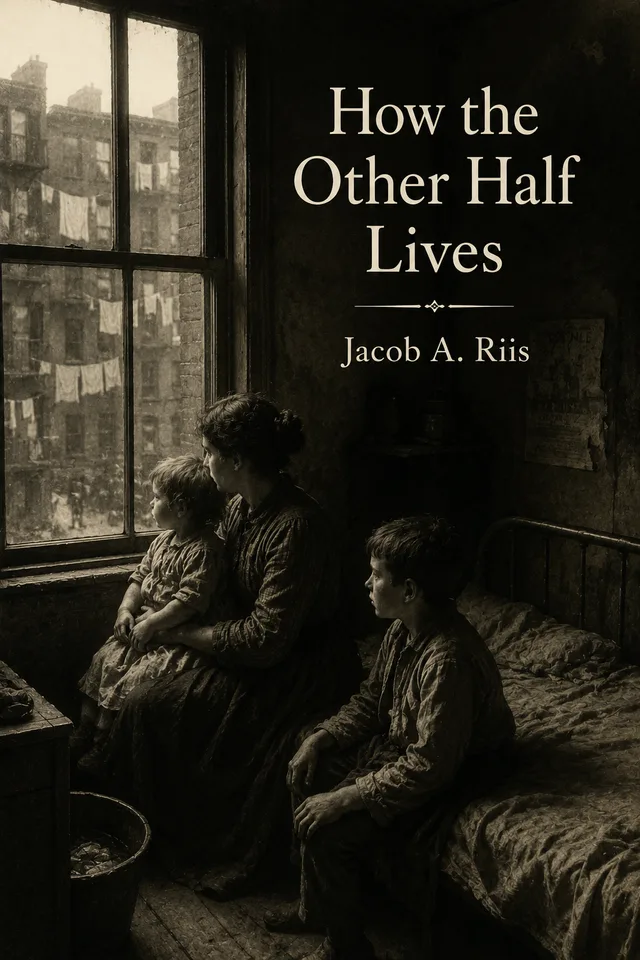
How the Other Half Lives
Edición BooksWhale en inglés de Jacob A. Riis
A public-domain classic of urban poverty, immigration, housing, and social reform, presented in a clean BooksWhale reading edition.
- Vista previa
- Muestra del texto preparado
- Formatos
- Lector online, EPUB, PDF
- Acceso
- Claim de Biblioteca
Introducción del libro
How the Other Half Lives
How the Other Half Lives by Jacob A. Riis is a public-domain classic of urban poverty, immigration, housing, and social reform. This edition presents the text in a clean reading format for sustained reading and catalog discovery.
Edición BooksWhale
Cómo se preparó esta edición
Esta edición se basa en un texto de dominio público y fue preparada por BooksWhale para lectura digital.
Base de dominio público
Por qué puede compartirse
Jacob A. Riis died in 1914, and How the Other Half Lives was first published around 1890. These dates support the public-domain basis for the source text used in this edition.
Leer vista previa
Muestra del texto preparado
Vista previa seleccionada del texto preparado.
Capítulo de vista previaFull textLeer vista previa
How the Other Half Lives
Jacob A. Riis
Capítulo de vista previaPrefaceVista previa
The belief that every man’s experience ought to be worth something to the community from which he drew it, no matter what that experience may be, so long as it was gleaned along the line of some decent, honest work, made me begin this book. With the result before him, the reader can judge for himself now whether or not I was right. Right or wrong, the many and exacting duties of a newspaper man’s life would hardly have allowed me to bring it to an end but for frequent friendly lifts given me by willing hands. To the President of the Board of Health, Mr. Charles G. Wilson, and to Chief Inspector Byrnes of the Police Force I am indebted for much kindness. The patient friendship of Dr. Roger S. Tracy, the Registrar of Vital Statistics, has done for me what I never could have done for myself; for I know nothing of tables, statistics and percentages, while there is nothing about them that he does not know. Most of all, I owe in this, as in all things else, to the womanly sympathy and the loving companionship of my dear wife, ever my chief helper, my wisest counsellor, and my gentlest critic.
J. A. R.
Capítulo de vista previaIntroductionVista previa
Long ago it was said that “one half of the world does not know how the other half lives.” That was true then. It did not know because it did not care. The half that was on top cared little for the struggles, and less for the fate of those who were underneath, so long as it was able to hold them there and keep its own seat. There came a time when the discomfort and crowding below were so great, and the consequent upheavals so violent, that it was no longer an easy thing to do, and then the upper half fell to inquiring what was the matter. Information on the subject has been accumulating rapidly since, and the whole world has had its hands full answering for its old ignorance.
In New York, the youngest of the world’s great cities, that time came later than elsewhere, because the crowding had not been so great. There were those who believed that it would never come; but their hopes were vain. Greed and reckless selfishness wrought like results here as in the cities of older lands. “When the great riot occurred in 1863,” so reads the testimony of the Secretary of the Prison Association of New York before a legislative committee appointed to investigate causes of the increase of crime in the State twenty-five years ago, “every hiding-place and nursery of crime discovered itself by immediate and active participation in the operations of the mob. Those very places and domiciles, and all that are like them, are to-day nurseries of crime, and of the vices and disorderly courses which lead to crime. By far the largest part—eighty per cent. at least—of crimes against property and against the person are perpetrated by individuals who have either lost connection with home life, or never had any, or whose homes had ceased to be sufficiently separate, decent, and desirable to afford what are regarded as ordinary wholesome influences of home and family .... The younger criminals seem to come almost exclusively from the worst tenement house districts, that is, when traced back to the very places where they had their homes in the city here.” Of one thing New York made sure at that early stage of the inquiry: the boundary line of the Other Half lies through the tenements.
It is ten years and over, now, since that line divided New York’s population evenly. To-day three-fourths of its people live in the tenements, and the nineteenth century drift of the population to the cities is sending ever-increasing multitudes to crowd them. The fifteen thousand tenant houses that were the despair of the sanitarian in the past generation have swelled into thirty-seven thousand, and more than twelve hundred thousand persons call them home. The one way out he saw—rapid transit to the suburbs—has brought no relief. We know now that there is no way out; that the ‘system’ that was the evil offspring of public neglect and private greed has come to stay, a storm-centre forever of our civilization. Nothing is left but to make the best of a bad bargain.
What the tenements are and how they grow to what they are, we shall see hereafter. The story is dark enough, drawn from the plain public records, to send a chill to any heart. If it shall appear that the sufferings and the sins of the “other half,” and the evil they breed, are but as a just punishment upon the community that gave it no other choice, it will be because that is the truth. The boundary line lies there because, while the forces for good on one side vastly outweigh the bad—it were not well otherwise—in the tenements all the influences make for evil; because they are the hot-beds of the epidemics that carry death to rich and poor alike; the nurseries of pauperism and crime that fill our jails and police courts; that throw off a scum of forty thousand human wrecks to the island asylums and workhouses year by year; that turned out in the last eight years a round half million beggars to prey upon our charities; that maintain a standing army of ten thousand tramps with all that that implies; because, above all, they touch the family life with deadly moral contagion. This is their worst crime, inseparable from the system. That we have to own it the child of our own wrong does not excuse it, even though it gives it claim upon our utmost patience and tenderest charity.
Índice
Dentro de esta edición
- 01Full text
- 02Preface
- 03Introduction
- 04Chapter I. Genesis Of The Tenement.
- 05Chapter Ii. The Awakening.
- 06Chapter Iii. The Mixed Crowd.
- 07Chapter Iv. The Down Town Back-Alleys.
- 08Chapter V. The Italian In New York.
- 09Chapter Vi. The Bend.
- 10Chapter Vii. A Raid On The Stale-Beer Dives.
- 11Chapter Viii. The Cheap Lodging-Houses.
- 12Chapter Ix. Chinatown.
- 13Chapter X. Jewtown.
- 14Chapter Xi. The Sweaters Of Jewtown.
- 15Chapter Xii. The Bohemians—Tenement-House Cigarmaking.
- 16Chapter Xiii. The Color Line In New York.
- 17Chapter Xiv. The Common Herd.
- 18Chapter Xv. The Problem Of The Children.
- 19Chapter Xvi. Waifs Of The City’S Slums.
- 20Chapter Xvii. The Street Arab.
- 21Chapter Xviii. The Reign Of Rum.
- 22Chapter Xix. The Harvest Of Tares.
- 23Chapter Xx. The Working Girls Of New York.
- 24Chapter Xxi. Pauperism In The Tenements.
- 25Chapter Xxii. The Wrecks And The Waste.
- 26Chapter Xxiii. The Man With The Knife.
- 27Chapter Xxiv. What Has Been Done.
- 28Chapter Xxv. How The Case Stands.
Disponibilidad de idiomas
Otros idiomas
Aún no hay otras ediciones lingüísticas publicadas. Esta sección enlazará las disponibles.
Solicitar otro idioma