inglés Edición
Literatura
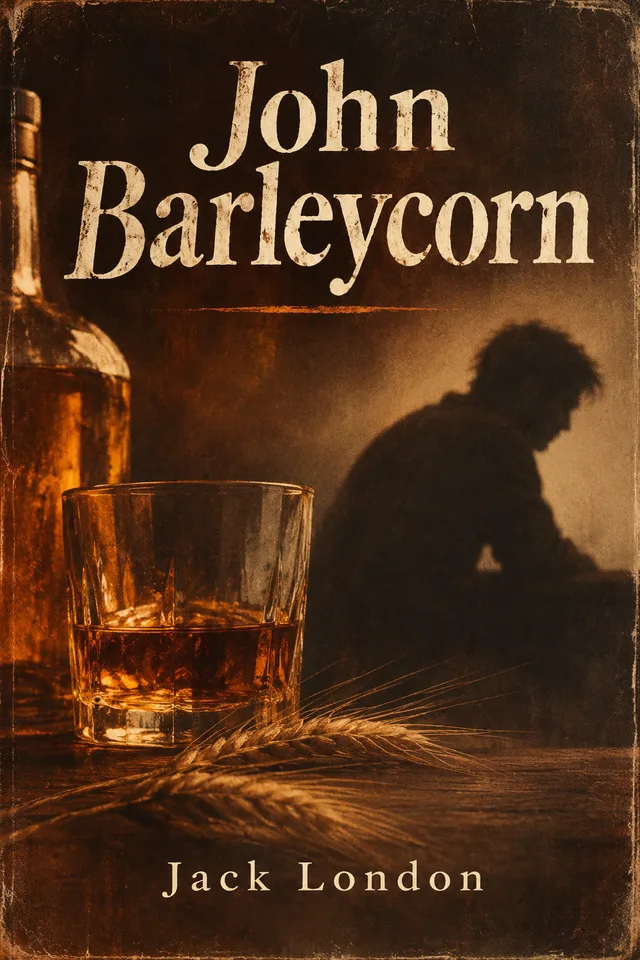
John Barleycorn
Edición BooksWhale en inglés de Jack London
Jack London traces his encounters with alcohol from childhood adventures to literary success, testing freedom, habit, and self-deception.
- Vista previa
- Muestra del texto preparado
- Formatos
- Lector online, EPUB, PDF
- Acceso
- Claim de Biblioteca
Introducción del libro
John Barleycorn
John Barleycorn is Jack London’s autobiographical account of drinking and the contradictory attractions of alcohol. Experiences on the waterfront, at sea, on the road, and in working life lead toward a searching examination of habit and despair. Across thirty-nine chapters, London connects private vulnerability with the social customs surrounding masculine companionship and drink.
Edición BooksWhale
Cómo se preparó esta edición
Esta edición se basa en un texto de dominio público y fue preparada por BooksWhale para lectura digital.
Base de dominio público
Por qué puede compartirse
Jack London died in 1916. This edition uses the original English text of John Barleycorn from Project Gutenberg, which identifies this source as public domain in the United States; later editorial notes and illustrations are excluded.
Leer vista previa
Muestra del texto preparado
Vista previa seleccionada del texto preparado.
Capítulo de vista previaFull textLeer vista previa
John Barleycorn
Jack London
Capítulo de vista previaCHAPTER IVista previa
It all came to me one election day. It was on a warm California afternoon, and I had ridden down into the Valley of the Moon from the ranch to the little village to vote Yes and No to a host of proposed amendments to the Constitution of the State of California. Because of the warmth of the day I had had several drinks before casting my ballot, and divers drinks after casting it. Then I had ridden up through the vine-clad hills and rolling pastures of the ranch, and arrived at the farm-house in time for another drink and supper.
"How did you vote on the suffrage amendment?" Charmian asked.
"I voted for it."
She uttered an exclamation of surprise. For, be it known, in my younger days, despite my ardent democracy, I had been opposed to woman suffrage. In my later and more tolerant years I had been unenthusiastic in my acceptance of it as an inevitable social phenomenon.
"Now just why did you vote for it?" Charmian asked.
I answered. I answered at length. I answered indignantly. The more I answered, the more indignant I became. (No; I was not drunk. The horse I had ridden was well named "The Outlaw." I'd like to see any drunken man ride her.)
And yet—how shall I say?—I was lighted up, I was feeling "good," I was pleasantly jingled.
"When the women get the ballot, they will vote for prohibition," I said. "It is the wives, and sisters, and mothers, and they only, who will drive the nails into the coffin of John Barleycorn——"
"But I thought you were a friend to John Barleycorn," Charmian interpolated.
"I am. I was. I am not. I never am. I am never less his friend than when he is with me and when I seem most his friend. He is the king of liars. He is the frankest truthsayer. He is the august companion with whom one walks with the gods. He is also in league with the Noseless One. His way leads to truth naked, and to death. He gives clear vision, and muddy dreams. He is the enemy of life, and the teacher of wisdom beyond life's wisdom. He is a red-handed killer, and he slays youth."
And Charmian looked at me, and I knew she wondered where I had got it.
I continued to talk. As I say, I was lighted up. In my brain every thought was at home. Every thought, in its little cell, crouched ready-dressed at the door, like prisoners at midnight waiting a jail-break. And every thought was a vision, bright-imaged, sharp-cut, unmistakable. My brain was illuminated by the clear, white light of alcohol. John Barleycorn was on a truth-telling rampage, giving away the choicest secrets on himself. And I was his spokesman. There moved the multitudes of memories of my past life, all orderly arranged like soldiers in some vast review. It was mine to pick and choose. I was a lord of thought, the master of my vocabulary and of the totality of my experience, unerringly capable of selecting my data and building my exposition. For so John Barleycorn tricks and lures, setting the maggots of intelligence gnawing, whispering his fatal intuitions of truth, flinging purple passages into the monotony of one's days.
I outlined my life to Charmian, and expounded the make-up of my constitution. I was no hereditary alcoholic. I had been born with no organic, chemical predisposition toward alcohol. In this matter I was normal in my generation. Alcohol was an acquired taste. It had been painfully acquired. Alcohol had been a dreadfully repugnant thing—more nauseous than any physic. Even now I did not like the taste of it. I drank it only for its "kick." And from the age of five to that of twenty-five I had not learned to care for its kick. Twenty years of unwilling apprenticeship had been required to make my system rebelliously tolerant of alcohol, to make me, in the heart and the deeps of me, desirous of alcohol.
Capítulo de vista previaCHAPTER IIVista previa
And, ere I begin, I must ask the reader to walk with me in all sympathy; and, since sympathy is merely understanding, begin by understanding me and whom and what I write about. In the first place, I am a seasoned drinker. I have no constitutional predisposition for alcohol. I am not stupid. I am not a swine. I know the drinking game from A to Z, and I have used my judgment in drinking. I never have to be put to bed. Nor do I stagger. In short, I am a normal, average man; and I drink in the normal, average way, as drinking goes. And this is the very point: I am writing of the effects of alcohol on the normal, average man. I have no word to say for or about the microscopically unimportant excessivist, the dipsomaniac.
There are, broadly speaking, two types of drinkers. There is the man whom we all know, stupid, unimaginative, whose brain is bitten numbly by numb maggots; who walks generously with wide-spread, tentative legs, falls frequently in the gutter, and who sees, in the extremity of his ecstasy, blue mice and pink elephants. He is the type that gives rise to the jokes in the funny papers.
The other type of drinker has imagination, vision. Even when most pleasantly jingled, he walks straight and naturally, never staggers nor falls, and knows just where he is and what he is doing. It is not his body but his brain that is drunken. He may bubble with wit, or expand with good fellowship. Or he may see intellectual spectres and phantoms that are cosmic and logical and that take the forms of syllogisms. It is when in this condition that he strips away the husks of life's healthiest illusions and gravely considers the iron collar of necessity welded about the neck of his soul. This is the hour of John Barleycorn's subtlest power. It is easy for any man to roll in the gutter. But it is a terrible ordeal for a man to stand upright on his two legs unswaying, and decide that in all the universe he finds for himself but one freedom—namely, the anticipating of the day of his death. With this man this is the hour of the white logic (of which more anon), when he knows that he may know only the laws of things—the meaning of things never. This is his danger hour. His feet are taking hold of the pathway that leads down into the grave.
All is clear to him. All these baffling head-reaches after immortality are but the panics of souls frightened by the fear of death, and cursed with the thrice-cursed gift of imagination. They have not the instinct for death; they lack the will to die when the time to die is at hand. They trick themselves into believing they will outwit the game and win to a future, leaving the other animals to the darkness of the grave or the annihilating heats of the crematory. But he, this man in the hour of his white logic, knows that they trick and outwit themselves. The one event happeneth to all alike. There is no new thing under the sun, not even that yearned-for bauble of feeble souls—immortality. But he knows, HE knows, standing upright on his two legs unswaying. He is compounded of meat and wine and sparkle, of sun-mote and world-dust, a frail mechanism made to run for a span, to be tinkered at by doctors of divinity and doctors of physic, and to be flung into the scrap-heap at the end.
Of course, all this is soul-sickness, life-sickness. It is the penalty the imaginative man must pay for his friendship with John Barleycorn. The penalty paid by the stupid man is simpler, easier. He drinks himself into sottish unconsciousness. He sleeps a drugged sleep, and, if he dream, his dreams are dim and inarticulate. But to the imaginative man, John Barleycorn sends the pitiless, spectral syllogisms of the white logic. He looks upon life and all its affairs with the jaundiced eye of a pessimistic German philosopher. He sees through all illusions. He transvalues all values. Good is bad, truth is a cheat, and life is a joke. From his calm-mad heights, with the certitude of a god, he beholds all life as evil. Wife, children, friends—in the clear, white light of his logic they are exposed as frauds and shams. He sees through them, and all that he sees is their frailty, their meagreness, their sordidness, their pitifulness. No longer do they fool him. They are miserable little egotisms, like all the other little humans, fluttering their May-fly life-dance of an hour. They are without freedom. They are puppets of chance. So is he. He realises that. But there is one difference. He sees; he knows. And he knows his one freedom: he may anticipate the day of his death. All of which is not good for a man who is made to live and love and be loved. Yet suicide, quick or slow, a sudden spill or a gradual oozing away through the years, is the price John Barleycorn exacts. No friend of his ever escapes making the just, due payment.
Índice
Dentro de esta edición
- 01Full text
- 02CHAPTER I
- 03CHAPTER II
- 04CHAPTER III
- 05CHAPTER IV
- 06CHAPTER V
- 07CHAPTER VI
- 08CHAPTER VII
- 09CHAPTER VIII
- 10CHAPTER IX
- 11CHAPTER X
- 12CHAPTER XI
- 13CHAPTER XII
- 14CHAPTER XIII
- 15CHAPTER XIV
- 16CHAPTER XV
- 17CHAPTER XVI
- 18CHAPTER XVII
- 19CHAPTER XVIII
- 20CHAPTER XIX
- 21CHAPTER XX
- 22CHAPTER XXI
- 23CHAPTER XXII
- 24CHAPTER XXIII
- 25CHAPTER XXIV
- 26CHAPTER XXV
- 27CHAPTER XXVI
- 28CHAPTER XXVII
- 29CHAPTER XXVIII
- 30CHAPTER XXIX
- 31CHAPTER XXX
- 32CHAPTER XXXI
- 33CHAPTER XXXII
- 34CHAPTER XXXIII
- 35CHAPTER XXXIV
- 36CHAPTER XXXV
- 37CHAPTER XXXVI
- 38CHAPTER XXXVII
- 39CHAPTER XXXVIII
- 40CHAPTER XXXIX
Disponibilidad de idiomas
Otros idiomas
Aún no hay otras ediciones lingüísticas publicadas. Esta sección enlazará las disponibles.
Solicitar otro idioma