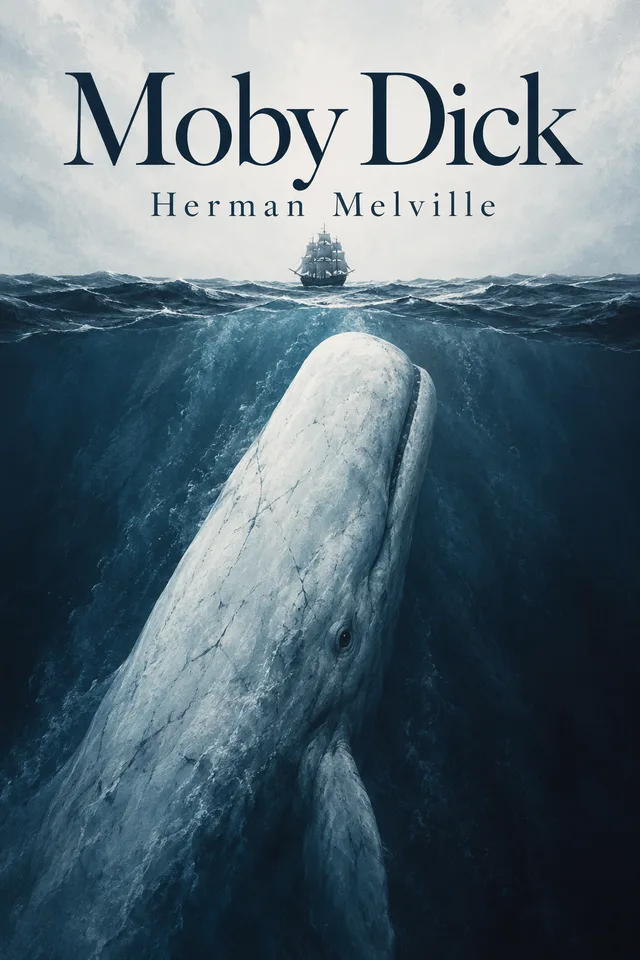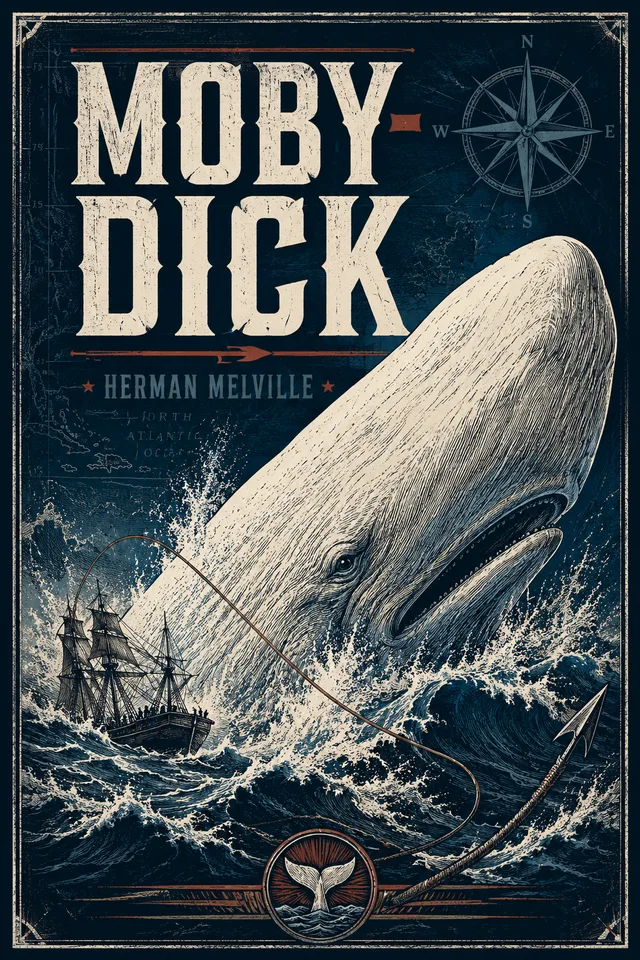
inglés Edición
Literatura
Moby-Dick
Edición BooksWhale en inglés de Herman Melville
Título original: Moby-Dick; or, The Whale
A sea voyage turned metaphysical quest, obsessed with whales, fate, language, and Captain Ahab’s will.
- Vista previa
- Muestra del texto preparado
- Formatos
- Lector online, EPUB, PDF
- Acceso
- Claim de Biblioteca
Introducción del libro
Moby-Dick
Herman Melville’s Moby-Dick begins as a whaling adventure and expands into a vast meditation on obsession, knowledge, labor, nature, race, and the limits of human interpretation. Ahab’s pursuit of the white whale becomes one of literature’s great images of destructive certainty.
Edición BooksWhale
Cómo se preparó esta edición
Esta edición se basa en un texto de dominio público y fue preparada por BooksWhale para lectura digital.
Base de dominio público
Por qué puede compartirse
Herman Melville died in 1891; the source text is public domain.
Leer vista previa
Muestra del texto preparado
Vista previa seleccionada del texto preparado.
Capítulo de vista previaFull textLeer vista previa
Moby-Dick; or, The Whale
Herman Melville
Capítulo de vista previaCHAPTER 1. LoomingsVista previa
Call me Ishmael. Some years ago—never mind how long precisely—having little or no money in my purse, and nothing particular to interest me on shore, I thought I would sail about a little and see the watery part of the world. It is a way I have of driving off the spleen, and regulating the circulation. Whenever I find myself growing grim about the mouth; whenever it is a damp, drizzly November in my soul; whenever I find myself involuntarily pausing before coffin warehouses, and bringing up the rear of every funeral I meet; and especially whenever my hypos get such an upper hand of me, that it requires a strong moral principle to prevent me from deliberately stepping into the street, and methodically knocking people’s hats off—then, I account it high time to get to sea as soon as I can. This is my substitute for pistol and ball. With a philosophical flourish Cato throws himself upon his sword; I quietly take to the ship. There is nothing surprising in this. If they but knew it, almost all men in their degree, some time or other, cherish very nearly the same feelings towards the ocean with me.
There now is your insular city of the Manhattoes, belted round by wharves as Indian isles by coral reefs—commerce surrounds it with her surf. Right and left, the streets take you waterward. Its extreme down-town is the Battery, where that noble mole is washed by waves, and cooled by breezes, which a few hours previous were out of sight of land. Look at the crowds of water-gazers there.
Circumambulate the city of a dreamy Sabbath afternoon. Go from Corlears Hook to Coenties Slip, and from thence, by Whitehall, northward. What do you see?—Posted like silent sentinels all around the town, stand thousands upon thousands of mortal men fixed in ocean reveries. Some leaning against the spiles; some seated upon the pier-heads; some looking over the bulwarks of ships from China; some high aloft in the rigging, as if striving to get a still better seaward peep. But these are all landsmen; of week days pent up in lath and plaster—tied to counters, nailed to benches, clinched to desks. How then is this? Are the green fields gone? What do they here?
But look! here come more crowds, pacing straight for the water, and seemingly bound for a dive. Strange! Nothing will content them but the extremest limit of the land; loitering under the shady lee of yonder warehouses will not suffice. No. They must get just as nigh the water as they possibly can without falling in. And there they stand—miles of them—leagues. Inlanders all, they come from lanes and alleys, streets and avenues—north, east, south, and west. Yet here they all unite. Tell me, does the magnetic virtue of the needles of the compasses of all those ships attract them thither?
Once more. Say, you are in the country; in some high land of lakes. Take almost any path you please, and ten to one it carries you down in a dale, and leaves you there by a pool in the stream. There is magic in it. Let the most absent-minded of men be plunged in his deepest reveries—stand that man on his legs, set his feet a-going, and he will infallibly lead you to water, if water there be in all that region. Should you ever be athirst in the great American desert, try this experiment, if your caravan happen to be supplied with a metaphysical professor. Yes, as every one knows, meditation and water are wedded for ever.
But here is an artist. He desires to paint you the dreamiest, shadiest, quietest, most enchanting bit of romantic landscape in all the valley of the Saco. What is the chief element he employs? There stand his trees, each with a hollow trunk, as if a hermit and a crucifix were within; and here sleeps his meadow, and there sleep his cattle; and up from yonder cottage goes a sleepy smoke. Deep into distant woodlands winds a mazy way, reaching to overlapping spurs of mountains bathed in their hill-side blue. But though the picture lies thus tranced, and though this pine-tree shakes down its sighs like leaves upon this shepherd’s head, yet all were vain, unless the shepherd’s eye were fixed upon the magic stream before him. Go visit the Prairies in June, when for scores on scores of miles you wade knee-deep among Tiger-lilies—what is the one charm wanting?—Water—there is not a drop of water there! Were Niagara but a cataract of sand, would you travel your thousand miles to see it? Why did the poor poet of Tennessee, upon suddenly receiving two handfuls of silver, deliberate whether to buy him a coat, which he sadly needed, or invest his money in a pedestrian trip to Rockaway Beach? Why is almost every robust healthy boy with a robust healthy soul in him, at some time or other crazy to go to sea? Why upon your first voyage as a passenger, did you yourself feel such a mystical vibration, when first told that you and your ship were now out of sight of land? Why did the old Persians hold the sea holy? Why did the Greeks give it a separate deity, and make him the own brother of Jove? Surely all this is not without meaning. And still deeper the meaning of that story of Narcissus, who because he could not grasp the tormenting, mild image he saw in the fountain, plunged into it and was drowned. But that same image, we ourselves see in all rivers and oceans. It is the image of the ungraspable phantom of life; and this is the key to it all.
Capítulo de vista previaCHAPTER 2. The Carpet-BagVista previa
I stuffed a shirt or two into my old carpet-bag, tucked it under my arm, and started for Cape Horn and the Pacific. Quitting the good city of old Manhatto, I duly arrived in New Bedford. It was on a Saturday night in December. Much was I disappointed upon learning that the little packet for Nantucket had already sailed, and that no way of reaching that place would offer, till the following Monday.
As most young candidates for the pains and penalties of whaling stop at this same New Bedford, thence to embark on their voyage, it may as well be related that I, for one, had no idea of so doing. For my mind was made up to sail in no other than a Nantucket craft, because there was a fine, boisterous something about everything connected with that famous old island, which amazingly pleased me. Besides though New Bedford has of late been gradually monopolizing the business of whaling, and though in this matter poor old Nantucket is now much behind her, yet Nantucket was her great original—the Tyre of this Carthage;—the place where the first dead American whale was stranded. Where else but from Nantucket did those aboriginal whalemen, the Red-Men, first sally out in canoes to give chase to the Leviathan? And where but from Nantucket, too, did that first adventurous little sloop put forth, partly laden with imported cobble-stones—so goes the story—to throw at the whales, in order to discover when they were nigh enough to risk a harpoon from the bowsprit?
Now having a night, a day, and still another night following before me in New Bedford, ere I could embark for my destined port, it became a matter of concernment where I was to eat and sleep meanwhile. It was a very dubious-looking, nay, a very dark and dismal night, bitingly cold and cheerless. I knew no one in the place. With anxious grapnels I had sounded my pocket, and only brought up a few pieces of silver,—So, wherever you go, Ishmael, said I to myself, as I stood in the middle of a dreary street shouldering my bag, and comparing the gloom towards the north with the darkness towards the south—wherever in your wisdom you may conclude to lodge for the night, my dear Ishmael, be sure to inquire the price, and don’t be too particular.
With halting steps I paced the streets, and passed the sign of “The Crossed Harpoons”—but it looked too expensive and jolly there. Further on, from the bright red windows of the “Sword-Fish Inn,” there came such fervent rays, that it seemed to have melted the packed snow and ice from before the house, for everywhere else the congealed frost lay ten inches thick in a hard, asphaltic pavement,—rather weary for me, when I struck my foot against the flinty projections, because from hard, remorseless service the soles of my boots were in a most miserable plight. Too expensive and jolly, again thought I, pausing one moment to watch the broad glare in the street, and hear the sounds of the tinkling glasses within. But go on, Ishmael, said I at last; don’t you hear? get away from before the door; your patched boots are stopping the way. So on I went. I now by instinct followed the streets that took me waterward, for there, doubtless, were the cheapest, if not the cheeriest inns.
Such dreary streets! blocks of blackness, not houses, on either hand, and here and there a candle, like a candle moving about in a tomb. At this hour of the night, of the last day of the week, that quarter of the town proved all but deserted. But presently I came to a smoky light proceeding from a low, wide building, the door of which stood invitingly open. It had a careless look, as if it were meant for the uses of the public; so, entering, the first thing I did was to stumble over an ash-box in the porch. Ha! thought I, ha, as the flying particles almost choked me, are these ashes from that destroyed city, Gomorrah? But “The Crossed Harpoons,” and “The Sword-Fish?”—this, then, must needs be the sign of “The Trap.” However, I picked myself up and hearing a loud voice within, pushed on and opened a second, interior door.
Índice
Dentro de esta edición
- 01Full text
- 02CHAPTER 1. Loomings
- 03CHAPTER 2. The Carpet-Bag
- 04CHAPTER 3. The Spouter-Inn
- 05CHAPTER 4. The Counterpane
- 06CHAPTER 5. Breakfast
- 07CHAPTER 6. The Street
- 08CHAPTER 7. The Chapel
- 09CHAPTER 8. The Pulpit
- 10CHAPTER 9. The Sermon
- 11CHAPTER 10. A Bosom Friend
- 12CHAPTER 11. Nightgown
- 13CHAPTER 12. Biographical
- 14CHAPTER 13. Wheelbarrow
- 15CHAPTER 14. Nantucket
- 16CHAPTER 15. Chowder
- 17CHAPTER 16. The Ship
- 18CHAPTER 17. The Ramadan
- 19CHAPTER 18. His Mark
- 20CHAPTER 19. The Prophet
- 21CHAPTER 20. All Astir
- 22CHAPTER 21. Going Aboard
- 23CHAPTER 22. Merry Christmas
- 24CHAPTER 23. The Lee Shore
- 25CHAPTER 24. The Advocate
- 26CHAPTER 25. Postscript
- 27CHAPTER 26. Knights and Squires
- 28CHAPTER 27. Knights and Squires
- 29CHAPTER 28. Ahab
- 30CHAPTER 29. Enter Ahab; to him, Stubb
- 31CHAPTER 30. The Pipe
- 32CHAPTER 31. Queen Mab
- 33CHAPTER 32. Cetology
- 34CHAPTER 33. The Specksynder
- 35CHAPTER 34. The Cabin-Table
- 36CHAPTER 35. The Mast-Head
- 37CHAPTER 36. The Quarter-Deck
- 38CHAPTER 37. Sunset
- 39CHAPTER 38. Dusk
- 40CHAPTER 39. First Night-Watch
- 41CHAPTER 40. Midnight, Forecastle
- 42CHAPTER 41. Moby Dick
- 43CHAPTER 42. The Whiteness of the Whale
- 44CHAPTER 43. Hark!
- 45CHAPTER 44. The Chart
- 46CHAPTER 45. The Affidavit
- 47CHAPTER 46. Surmises
- 48CHAPTER 47. The Mat-Maker
- 49CHAPTER 48. The First Lowering
- 50CHAPTER 49. The Hyena
- 51CHAPTER 50. Ahab’s Boat and Crew • Fedallah
- 52CHAPTER 51. The Spirit-Spout
- 53CHAPTER 52. The Albatross
- 54CHAPTER 53. The Gam
- 55CHAPTER 54. The Town-Ho’s Story
- 56CHAPTER 55. Of the Monstrous Pictures of Whales
- 57CHAPTER 56. Of the Less Erroneous Pictures of Whales, and the True Pictures of Whaling Scenes
- 58CHAPTER 57. Of Whales in Paint; in Teeth; in Wood; in Sheet-Iron; in Stone; in Mountains; in Stars
- 59CHAPTER 58. Brit
- 60CHAPTER 59. Squid
- 61CHAPTER 60. The Line
- 62CHAPTER 61. Stubb kills a Whale
- 63CHAPTER 62. The Dart
- 64CHAPTER 63. The Crotch
- 65CHAPTER 64. Stubb’s Supper
- 66CHAPTER 65. The Whale as a Dish
- 67CHAPTER 66. The Shark Massacre
- 68CHAPTER 67. Cutting In
- 69CHAPTER 68. The Blanket
- 70CHAPTER 69. The Funeral
- 71CHAPTER 70. The Sphynx
- 72CHAPTER 71. The Jeroboam’s Story
- 73CHAPTER 72. The Monkey-rope
- 74CHAPTER 73. Stubb and Flask kill a Right Whale; and Then Have a Talk over Him
- 75CHAPTER 74. The Sperm Whale’s Head—Contrasted View
- 76CHAPTER 75. The Right Whale’s Head—Contrasted View
- 77CHAPTER 76. The Battering-Ram
- 78CHAPTER 77. The Great Heidelburgh Tun
- 79CHAPTER 78. Cistern and Buckets
- 80CHAPTER 79. The Prairie
- 81CHAPTER 80. The Nut
- 82CHAPTER 81. The Pequod meets the Virgin
- 83CHAPTER 82. The Honor and Glory of Whaling
- 84CHAPTER 83. Jonah Historically Regarded
- 85CHAPTER 84. Pitchpoling
- 86CHAPTER 85. The Fountain
- 87CHAPTER 86. The Tail
- 88CHAPTER 87. The Grand Armada
- 89CHAPTER 88. Schools and Schoolmasters
- 90CHAPTER 89. Fast-Fish and Loose-Fish
- 91CHAPTER 90. Heads or Tails
- 92CHAPTER 91. The Pequod meets the Rose-bud
- 93CHAPTER 92. Ambergris
- 94CHAPTER 93. The Castaway
- 95CHAPTER 94. A Squeeze of the Hand
- 96CHAPTER 95. The Cassock
- 97CHAPTER 96. The Try-Works
- 98CHAPTER 97. The Lamp
- 99CHAPTER 98. Stowing Down and Clearing Up
- 100CHAPTER 99. The Doubloon
- 101CHAPTER 100. Leg and Arm • The Pequod, of Nantucket, meets the Samuel Enderby, of London
- 102CHAPTER 101. The Decanter
- 103CHAPTER 102. A Bower in the Arsacides
- 104CHAPTER 103. Measurement of the Whale’s Skeleton
- 105CHAPTER 104. The Fossil Whale
- 106CHAPTER 105. Does the Whale’s Magnitude Dimimish?—Will He Perish?
- 107CHAPTER 106. Ahab’s Leg
- 108CHAPTER 107. The Carpenter
- 109CHAPTER 108. Ahab and the Carpenter
- 110CHAPTER 109. Ahab and Starbuck in the Cabin
- 111CHAPTER 110. Queequeg in his Coffin
- 112CHAPTER 111. The Pacific
- 113CHAPTER 112. The Blacksmith
- 114CHAPTER 113. The Forge
- 115CHAPTER 114. The Gilder
- 116CHAPTER 115. The Pequod meets the Bachelor
- 117CHAPTER 116. The Dying Whale
- 118CHAPTER 117. The Whale Watch
- 119CHAPTER 118. The Quadrant
- 120CHAPTER 119. The Candles
- 121CHAPTER 120. The Deck towards the End of the First Night Watch
- 122CHAPTER 121. Midnight—The Forecastle Bulwarks
- 123CHAPTER 122. Midnight Aloft—Thunder and Lightning
- 124CHAPTER 123. The Musket
- 125CHAPTER 124. The Needle
- 126CHAPTER 125. The Log and Line
- 127CHAPTER 126. The Life-Buoy
- 128CHAPTER 127. The Deck
- 129CHAPTER 128. The Pequod meets the Rachel
- 130CHAPTER 129. The Cabin
- 131CHAPTER 130. The Hat
- 132CHAPTER 131. The Pequod meets the Delight
- 133CHAPTER 132. The Symphony
- 134CHAPTER 133. The Chase—First Day
- 135CHAPTER 134. The Chase—Second Day
- 136CHAPTER 135. The Chase—Third Day
- 137EPILOGUE