inglés Edición
Educación
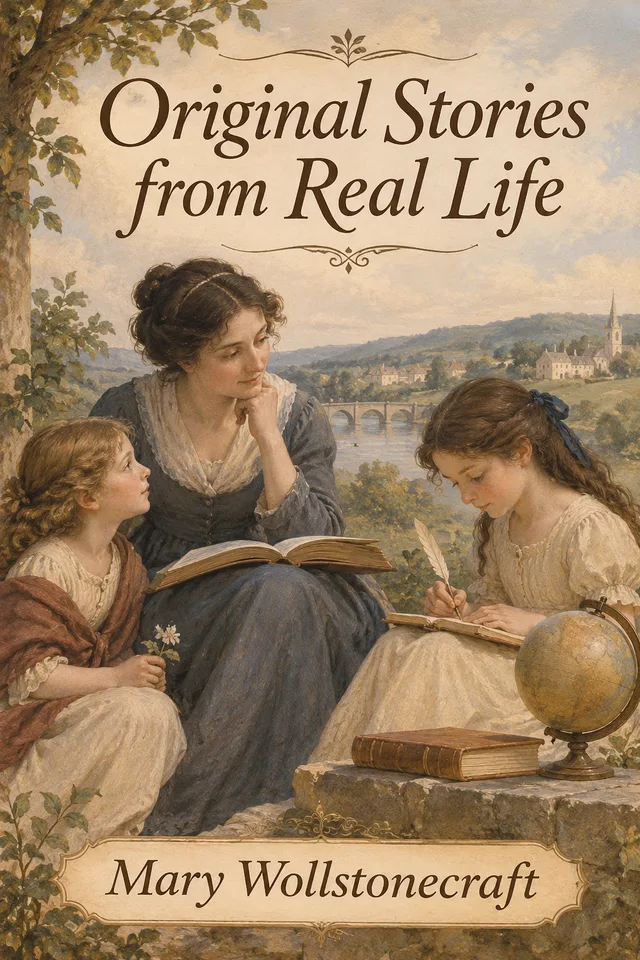
Original Stories from Real Life
Edición BooksWhale en inglés de Mary Wollstonecraft
Mrs. Mason guides Mary and Caroline through stories and everyday encounters that test kindness, truthfulness, judgment, and responsibility.
- Vista previa
- Muestra del texto preparado
- Formatos
- Lector online, EPUB, PDF
- Acceso
- Claim de Biblioteca
Introducción del libro
Original Stories from Real Life
Mary Wollstonecraft places two young girls under the care of Mrs. Mason, whose walks, conversations, and stories connect moral education with ordinary experience. Encounters with animals, neighbors, poverty, anger, and misplaced pride become lessons in attention and sympathy. The volume includes the author’s preface, introduction, and twenty-five chapters, preserving the narrative and conversational form of the original English work.
Edición BooksWhale
Cómo se preparó esta edición
Esta edición se basa en un texto de dominio público y fue preparada por BooksWhale para lectura digital.
Base de dominio público
Por qué puede compartirse
Mary Wollstonecraft died in 1797, and this work was first published in 1788. This edition uses the public-domain original English text from Project Gutenberg, without later editorial notes or illustrations.
Leer vista previa
Muestra del texto preparado
Vista previa seleccionada del texto preparado.
Capítulo de vista previaFull textLeer vista previa
Original Stories from Real Life
Mary Wollstonecraft
Capítulo de vista previaPREFACE.Vista previa
These conversations and tales are accommodated to the present state of society; which obliges the author to attempt to cure those faults by reason, which ought never to have taken root in the infant mind. Good habits, imperceptibly fixed, are far preferable to the precepts of reason; but, as this task requires more judgment than generally falls to the lot of parents, substitutes must be sought for, and medicines given, when regimen would have answered the purpose much better. I believe those who examine their own minds will readily agree with me, that reason, with difficulty, conquers settled habits, even when it is arrived at some degree of maturity: why then do we suffer children to be bound with fetters, which their half-formed faculties cannot break.
In writing the following work, I aim at perspicuity and simplicity of style; and try to avoid those unmeaning compliments, which slip from the tongue, but have not the least connection with the affections that should warm the heart, and animate the conduct. By this false politeness, sincerity is sacrificed, and truth violated; and thus artificial manners are necessarily taught. For true politeness is a polish, not a varnish; and should rather be acquired by observation than admonition. And we may remark, by way of illustration, that men do not attempt to polish precious stones, till age and air have given them that degree of solidity, which will enable them to bear the necessary friction, without destroying the main substance.
The way to render instruction most useful cannot always be adopted; knowledge should be gradually imparted, and flow more from example than teaching: example directly addresses the senses, the first inlets to the heart; and the improvement of those instruments of the understanding is the object education should have constantly in view, and over which we have most power. But to wish that parents would, themselves, mould the ductile passions, is a chimerical wish, for the present generation have their own passions to combat with, and fastidious pleasures to pursue, neglecting those pointed out by nature: we must therefore pour premature knowledge into the succeeding one; and, teaching virtue, explain the nature of vice. Cruel necessity!
The Conversations are intended to assist the teacher as well as the pupil; and this will obviate an objection which some may start, that the sentiments are not quite on a level with the capacity of a child. Every child requires a different mode of treatment; but a writer can only choose one, and that must be modified by those who are actually engaged with young people in their studies.
The tendency of the reasoning obviously tends to fix principles of truth and humanity on a solid and simple foundation; and to make religion an active, invigorating director of the affections, and not a mere attention to forms. Systems of Theology may be complicated; but when the character of the Supreme Being is displayed, and He is recognised as the Universal Father, the Author and Centre of Good, a child may be led to comprehend that dignity and happiness must arise from imitating Him; and this conviction should be twisted into, and be the foundation of every inculcated duty.
At any rate, the Tales which were written to illustrate the moral, may recall it, when the mind has gained sufficient strength to discuss the argument from which it was deduced.
Capítulo de vista previaINTRODUCTION.Vista previa
Mary and Caroline, though the children of wealthy parents were, in their infancy, left entirely to the management of servants, or people equally ignorant. Their mother died suddenly, and their father, who found them very troublesome at home, placed them under the tuition of a woman of tenderness and discernment, a near relation, who was induced to take on herself the important charge through motives of compassion.
They were shamefully ignorant, considering that Mary had been fourteen, and Caroline twelve years in the world. If they had been merely ignorant, the talk would not have appeared so arduous; but they had caught every prejudice that the vulgar casually instill. In order to eradicate these prejudices, and substitute good habits instead of those they had carelessly contracted, Mrs. Mason never suffered them to be out of her sight. They were allowed to ask questions on all occasions, a method she would not have adopted, had she educated them from the first, according to the suggestions of her own reason, to which experience had given its sanction.
They had tolerable capacities; but Mary had a turn for ridicule, and Caroline was vain of her person. She was, indeed, very handsome, and the inconsiderate encomiums that had, in her presence, been lavished on her beauty made her, even at that early age, affected.
Índice
Dentro de esta edición
- 01Full text
- 02PREFACE.
- 03INTRODUCTION.
- 04CHAP. I. The Treatment of Animals.—The Ant.—The Bee.—Goodness.—The Lark’s Nest.—The Asses.
- 05CHAP. II The Treatment of Animals.—The Difference between them and Man.—Parental Affection of a Dog.—Brutality punished.
- 06CHAP. III. The treatment of Animals.—The Story of crazy Robin.—The Man confined in the Bastille.
- 07CHAP. IV. Anger.—History of Jane Fretful.
- 08CHAP. V. Lying.—Honour.—Truth.—Small Duties.—History of Lady Sly and Mrs. Trueman.
- 09CHAP. VI. Anger.—Folly produces Self-contempt, and the Neglect of others.
- 10CHAP. VII. Virtue the Soul of Beauty.—The Tulip and the Rose.—The Nightingale.—External Ornaments.—Characters.
- 11CHAP. VIII. Summer Evening’s Amusement.—The Arrival of a Family of Haymakers.—Ridicule of personal Defects censured.—A Storm.—The Fear of Death.—The Cottage of honest Jack, the shipwrecked Sailor.—The History of Jack, and his faithful Dog Pompey.
- 12CHAP. IX. The Inconveniences of immoderate Indulgence.
- 13CHAP. X. The Danger of Delay.—Description of a Mansion-house in Ruins.—The History of Charles Townley.
- 14CHAP. XI. Dress.—A Character.—Remarks on Mrs. Trueman’s Manner of dressing.—Trifling Omissions undermine Affection.
- 15CHAP. XII. Behaviour to Servants.—True Dignity of Character.
- 16CHAP. XIII. Employment.—Idleness produces Misery.—The Cultivation of the Fancy raises us above the Vulgar, extends our Happiness, and leads to Virtue.
- 17CHAP. XIV. Innocent Amusements.—Description of a Welsh Castle.—History of a Welsh Harper.—A tyrannical Landlord.—Family Pride.
- 18CHAP. XV. Prayer.—A Moon-light Scene.—Resignation.
- 19CHAP. XVI. The Benefits arising from Devotion.—The History of the Village School-mistress.—Fatal Effects of Inattention to Expences, in the History of Mr. Lofty.
- 20CHAP. XVII. The Benefits arising from Devotion.—The History of the Village School-mistress concluded.
- 21CHAP. XVIII. Visit to the School-mistress.—True and false Pride.
- 22CHAP. XIX. Charity.—The History of Peggy and her Family.—The Sailor’s Widow.
- 23CHAP. XX. Visit to Mrs. Trueman.—The Use of Accomplishments.—Virtue the Soul of all.
- 24CHAP. XXI. The Benefit of bodily Pain.—Fortitude the Basis of Virtue.—The Folly of Irresolution.
- 25CHAP. XXII. Journey to London.
- 26CHAP. XXIII. Charity.—Shopping.—The distressed Stationer.—Mischievous Consequences of delaying Payment.
- 27CHAP. XXIV. Visit to a poor Family in London.—Idleness the Parent of Vice.—Prodigality and Generosity incompatible.—The Pleasures of Benevolence.—True and false Motives for saving.
- 28CHAP. XXV. Mrs. Mason’s farewell Advice to her young Friends.
Disponibilidad de idiomas
Otros idiomas
Aún no hay otras ediciones lingüísticas publicadas. Esta sección enlazará las disponibles.
Solicitar otro idioma