inglés Edición
Historia
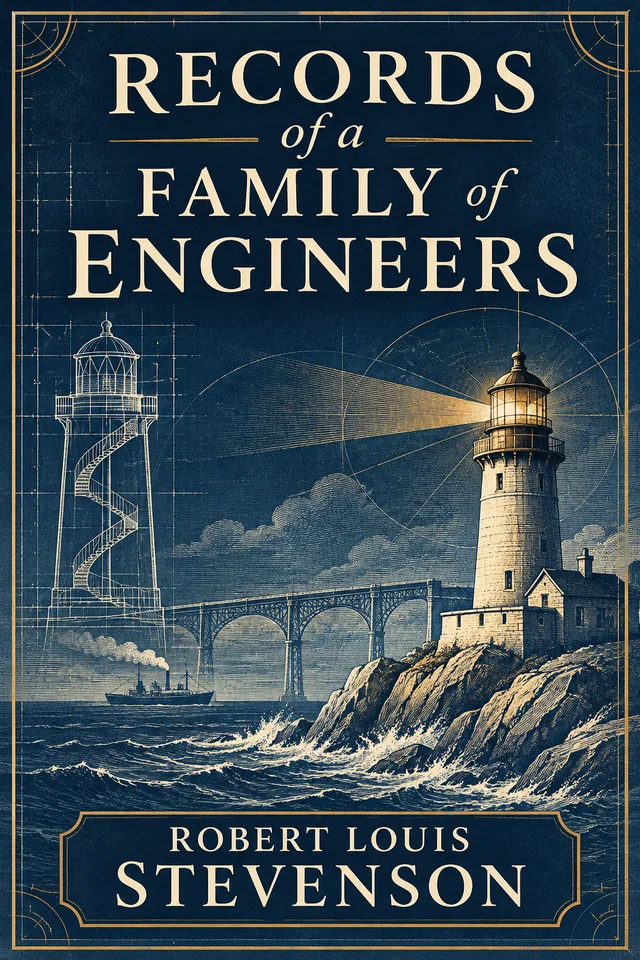
Records of a Family of Engineers
Edición BooksWhale en inglés de Robert Louis Stevenson
Family history and Robert Stevenson’s Bell Rock journals trace the labour, danger and ingenuity of lighthouse engineering.
- Vista previa
- Muestra del texto preparado
- Formatos
- Lector online, EPUB, PDF
- Acceso
- Claim de Biblioteca
Introducción del libro
Records of a Family of Engineers
Robert Louis Stevenson reconstructs the lives of his engineering forebears before turning to the Northern Lighthouse service and the building of the Bell Rock lighthouse. Family anecdotes give way to detailed accounts of weather, construction and seafaring work. The volume includes the introduction, three main chapters and the concluding record of the lighthouse’s first illumination.
Edición BooksWhale
Cómo se preparó esta edición
Esta edición se basa en un texto de dominio público y fue preparada por BooksWhale para lectura digital.
Base de dominio público
Por qué puede compartirse
Robert Louis Stevenson died in 1894. This edition uses the original-language text supplied by Project Gutenberg, identified there as public domain in the United States. Added illustrations and editorial notes are excluded.
Leer vista previa
Muestra del texto preparado
Vista previa seleccionada del texto preparado.
Capítulo de vista previaFull textLeer vista previa
Records of a Family of Engineers
Robert Louis Stevenson
Capítulo de vista previaINTRODUCTION: THE SURNAME OF STEVENSONVista previa
From the thirteenth century onwards, the name, under the various disguises of Stevinstoun, Stevensoun, Stevensonne, Stenesone, and Stewinsoune, spread across Scotland from the mouth of the Firth of Forth to the mouth of the Firth of Clyde. Four times at least it occurs as a place-name. There is a parish of Stevenston in Cunningham; a second place of the name in the Barony of Bothwell in Lanark; a third on Lyne, above Drochil Castle; the fourth on the Tyne, near Traprain Law. Stevenson of Stevenson (co. Lanark) swore fealty to Edward I in 1296, and the last of that family died after the Restoration. Stevensons of Hirdmanshiels, in Midlothian, rode in the Bishops’ Raid of Aberlady, served as jurors, stood bail for neighbours—Hunter of Polwood, for instance—and became extinct about the same period, or possibly earlier. A Stevenson of Luthrie and another of Pitroddie make their bows, give their names, and vanish. And by the year 1700 it does not appear that any acre of Scots land was vested in any Stevenson.
Here is, so far, a melancholy picture of backward progress, and a family posting towards extinction. But the law (however administered, and I am bound to aver that, in Scotland, ‘it couldna weel be waur’) acts as a kind of dredge, and with dispassionate impartiality brings up into the light of day, and shows us for a moment, in the jury-box or on the gallows, the creeping things of the past. By these broken glimpses we are able to trace the existence of many other and more inglorious Stevensons, picking a private way through the brawl that makes Scots history. They were members of Parliament for Peebles, Stirling, Pittenweem, Kilrenny, and Inverurie. We find them burgesses of Edinburgh; indwellers in Biggar, Perth, and Dalkeith. Thomas was the forester of Newbattle Park, Gavin was a baker, John a maltman, Francis a chirurgeon, and ‘Schir William’ a priest. In the feuds of Humes and Heatleys, Cunninghams, Montgomeries, Mures, Ogilvies, and Turnbulls, we find them inconspicuously involved, and apparently getting rather better than they gave. Schir William (reverend gentleman) was cruellie slaughtered on the Links of Kincraig in 1582; James (‘in the mill-town of Roberton’), murdered in 1590; Archibald (‘in Gallowfarren’), killed with shots of pistols and hagbuts in 1608. Three violent deaths in about seventy years, against which we can only put the case of Thomas, servant to Hume of Cowden Knowes, who was arraigned with his two young masters for the death of the Bastard of Mellerstanes in 1569. John (‘in Dalkeith’) stood sentry without Holyrood while the banded lords were despatching Rizzio within. William, at the ringing of Perth bell, ran before Gowrie House ‘with ane sword, and, entering to the yearde, saw George Craiggingilt with ane twa-handit sword and utheris nychtbouris; at quilk time James Boig cryit ower ane wynds, “Awa hame! ye will all be hangit”’—a piece of advice which William took, and immediately ‘depairtit.’ John got a maid with child to him in Biggar, and seemingly deserted her; she was hanged on the Castle Hill for infanticide, June 1614; and Martin, elder in Dalkeith, eternally disgraced the name by signing witness in a witch trial, 1661. These are two of our black sheep. Under the Restoration, one Stevenson was a bailie in Edinburgh, and another the lessee of the Canonmills. There were at the same period two physicians of the name in Edinburgh, one of whom, Dr. Archibald, appears to have been a famous man in his day and generation. The Court had continual need of him; it was he who reported, for instance, on the state of Rumbold; and he was for some time in the enjoyment of a pension of a thousand pounds Scots (about eighty pounds sterling) at a time when five hundred pounds is described as ‘an opulent future.’ I do not know if I should be glad or sorry that he failed to keep favour; but on 6th January 1682 (rather a cheerless New Year’s present) his pension was expunged. There need be no doubt, at least, of my exultation at the fact that he was knighted and recorded arms. Not quite so genteel, but still in public life, Hugh was Under-Clerk to the Privy Council, and liked being so extremely. I gather this from his conduct in September 1681, when, with all the lords and their servants, he took the woful and soul-destroying Test, swearing it ‘word by word upon his knees.’ And, behold! it was in vain, for Hugh was turned out of his small post in 1684. Sir Archibald and Hugh were both plainly inclined to be trimmers; but there was one witness of the name of Stevenson who held high the banner of the Covenant—John, ‘Land-Labourer, in the parish of Daily, in Carrick,’ that ‘eminently pious man.’ He seems to have been a poor sickly soul, and shows himself disabled with scrofula, and prostrate and groaning aloud with fever; but the enthusiasm of the martyr burned high within him.
Capítulo de vista previaCHAPTER I: DOMESTIC ANNALSVista previa
It is believed that in 1665, James Stevenson in Nether Carsewell, parish of Neilston, county of Renfrew, and presumably a tenant farmer, married one Jean Keir; and in 1675, without doubt, there was born to these two a son Robert, possibly a maltster in Glasgow. In 1710, Robert married, for a second time, Elizabeth Cumming, and there was born to them, in 1720, another Robert, certainly a maltster in Glasgow. In 1742, Robert the second married Margaret Fulton (Margret, she called herself), by whom he had ten children, among whom were Hugh, born February 1749, and Alan, born June 1752.
With these two brothers my story begins. Their deaths were simultaneous; their lives unusually brief and full. Tradition whispered me in childhood they were the owners of an islet near St. Kitts; and it is certain they had risen to be at the head of considerable interests in the West Indies, which Hugh managed abroad and Alan at home, at an age when others are still curveting a clerk’s stool. My kinsman, Mr. Stevenson of Stirling, has heard his father mention that there had been ‘something romantic’ about Alan’s marriage: and, alas! he has forgotten what. It was early at least. His wife was Jean, daughter of David Lillie, a builder in Glasgow, and several times ‘Deacon of the Wrights’: the date of the marriage has not reached me; but on 8th June 1772, when Robert, the only child of the union, was born, the husband and father had scarce passed, or had not yet attained, his twentieth year. Here was a youth making haste to give hostages to fortune. But this early scene of prosperity in love and business was on the point of closing.
There hung in the house of this young family, and successively in those of my grandfather and father, an oil painting of a ship of many tons burthen. Doubtless the brothers had an interest in the vessel; I was told she had belonged to them outright; and the picture was preserved through years of hardship, and remains to this day in the possession of the family, the only memorial of my great-grandsire Alan. It was on this ship that he sailed on his last adventure, summoned to the West Indies by Hugh. An agent had proved unfaithful on a serious scale; and it used to be told me in my childhood how the brothers pursued him from one island to another in an open boat, were exposed to the pernicious dews of the tropics, and simultaneously struck down. The dates and places of their deaths (now before me) would seem to indicate a more scattered and prolonged pursuit: Hugh, on the 16th April 1774, in Tobago, within sight of Trinidad; Alan, so late as 26th May, and so far away as ‘Santt Kittes,’ in the Leeward Islands—both, says the family Bible, ‘of a fiver’(!). The death of Hugh was probably announced by Alan in a letter, to which we may refer the details of the open boat and the dew. Thus, at least, in something like the course of post, both were called away, the one twenty-five, the other twenty-two; their brief generation became extinct, their short-lived house fell with them; and ‘in these lawless parts and lawless times’—the words are my grandfather’s—their property was stolen or became involved. Many years later, I understand some small recovery to have been made; but at the moment almost the whole means of the family seem to have perished with the young merchants. On the 27th April, eleven days after Hugh Stevenson, twenty-nine before Alan, died David Lillie, the Deacon of the Wrights; so that mother and son were orphaned in one month. Thus, from a few scraps of paper bearing little beyond dates, we construct the outlines of the tragedy that shadowed the cradle of Robert Stevenson.
Jean Lillie was a young woman of strong sense, well fitted to contend with poverty, and of a pious disposition, which it is like that these misfortunes heated. Like so many other widowed Scots-women, she vowed her son should wag his head in a pulpit; but her means were inadequate to her ambition. A charity school, and some time under a Mr. M’Intyre, ‘a famous linguist,’ were all she could afford in the way of education to the would-be minister. He learned no Greek; in one place he mentions that the Orations of Cicero were his highest book in Latin; in another that he had ‘delighted’ in Virgil and Horace; but his delight could never have been scholarly. This appears to have been the whole of his training previous to an event which changed his own destiny and moulded that of his descendants—the second marriage of his mother.
Índice
Dentro de esta edición
- 01Full text
- 02INTRODUCTION: THE SURNAME OF STEVENSON
- 03CHAPTER I: DOMESTIC ANNALS
- 04CHAPTER II: THE SERVICE OF THE NORTHERN LIGHTS
- 05I
- 06II
- 07III
- 08CHAPTER III: THE BUILDING OF THE BELL ROCK
- 09I—OPERATIONS OF 1807
- 10II—OPERATIONS OF 1808
- 11III—OPERATIONS OF 1809
- 12IV—OPERATIONS OF 1810
Disponibilidad de idiomas
Otros idiomas
Aún no hay otras ediciones lingüísticas publicadas. Esta sección enlazará las disponibles.
Solicitar otro idioma