inglés Edición
Literatura
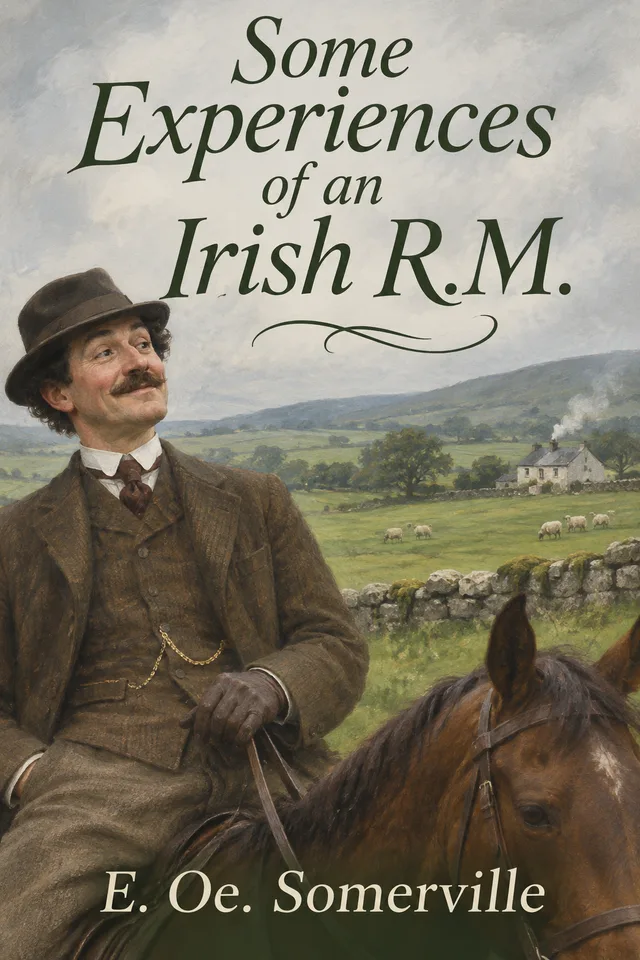
Some Experiences of an Irish R.M.
Edición BooksWhale en inglés de E. Oe. Somerville & Martin Ross
Twelve comic stories follow a resident magistrate as he tries to make sense of rural Irish society and its unwritten rules.
- Vista previa
- Muestra del texto preparado
- Formatos
- Lector online, EPUB, PDF
- Acceso
- Claim de Biblioteca
Introducción del libro
Some Experiences of an Irish R.M.
Major Yeates comes to Ireland as a resident magistrate and quickly learns that his official position offers little protection from practical jokes or local customs. E. Oe. Somerville and Martin Ross build the stories around horses, hunting, neighbourhood rivalries, and the resourceful Flurry Knox. The book contains all twelve stories of the first collection.
Edición BooksWhale
Cómo se preparó esta edición
Esta edición se basa en un texto de dominio público y fue preparada por BooksWhale para lectura digital.
Base de dominio público
Por qué puede compartirse
The twelve English stories were published as a collection in 1899 by E. Oe. Somerville and Martin Ross. The edition uses the story text from Project Gutenberg, which marks it as public domain in the United States.
Leer vista previa
Muestra del texto preparado
Vista previa seleccionada del texto preparado.
Capítulo de vista previaI GREAT-UNCLE McCARTHYLeer vista previa
A Resident Magistracy in Ireland is not an easy thing to come by nowadays; neither is it a very attractive job; yet on the evening when I first propounded the idea to the young lady who had recently consented to become Mrs. Sinclair Yeates, it seemed glittering with possibilities. There was, on that occasion, a sunset, and a string band playing "The Gondoliers," and there was also an ingenuous belief in the omnipotence of a godfather of Philippa's—(Philippa was the young lady)—who had once been a member of the Government.
I was then climbing the steep ascent of the Captains towards my Majority. I have no fault to find with Philippa's godfather; he did all and more than even Philippa had expected; nevertheless, I had attained to the dignity of mud major, and had spent a good deal on postage stamps, and on railway fares to interview people of influence, before I found myself in the hotel at Skebawn, opening long envelopes addressed to "Major Yeates, R.M."
My most immediate concern, as any one who has spent nine weeks at Mrs. Raverty's hotel will readily believe, was to leave it at the earliest opportunity; but in those nine weeks I had learned, amongst other painful things, a little, a very little, of the methods of the artisan in the West of Ireland. Finding a house had been easy enough. I had had my choice of several, each with some hundreds of acres of shooting, thoroughly poached, and a considerable portion of the roof intact. I had selected one; the one that had the largest extent of roof in proportion to the shooting, and had been assured by my landlord that in a fortnight or so it would be fit for occupation.
"There's a few little odd things to be done," he said easily; "a lick of paint here and there, and a slap of plaster——"
I am short-sighted; I am also of Irish extraction; both facts that make for toleration—but even I thought he was understating the case. So did the contractor.
At the end of three weeks the latter reported progress, which mainly consisted of the facts that the plumber had accused the carpenter of stealing sixteen feet of his inch-pipe to run a bell wire through, and that the carpenter had replied that he wished the divil might run the plumber through a wran's quill. The plumber having reflected upon the carpenter's parentage, the work of renovation had merged in battle, and at the next Petty Sessions I was reluctantly compelled to allot to each combatant seven days, without the option of a fine.
These and kindred difficulties extended in an unbroken chain through the summer months, until a certain wet and windy day in October, when, with my baggage, I drove over to establish myself at Shreelane. It was a tall, ugly house of three storeys high, its walls faced with weather-beaten slates, its windows staring, narrow, and vacant. Round the house ran an area, in which grew some laurustinus and holly bushes among ash heaps, and nettles, and broken bottles. I stood on the steps, waiting for the door to be opened, while the rain sluiced upon me from a broken eaveshoot that had, amongst many other things, escaped the notice of my landlord. I thought of Philippa, and of her plan, broached in to-day's letter, of having the hall done up as a sitting-room.
The door opened, and revealed the hall. It struck me that I had perhaps overestimated its possibilities. Among them I had certainly not included a flagged floor, sweating with damp, and a reek of cabbage from the adjacent kitchen stairs. A large elderly woman, with a red face, and a cap worn helmet-wise on her forehead, swept me a magnificent curtsey as I crossed the threshold.
"Your honour's welcome——" she began, and then every door in the house slammed in obedience to the gust that drove through it. With something that sounded like "Mend ye for a back door!" Mrs. Cadogan abandoned her opening speech and made for the kitchen stairs. (Improbable as it may appear, my housekeeper was called Cadogan, a name made locally possible by being pronounced Caydogawn.)
Capítulo de vista previaII IN THE CURRANHILTY COUNTRYVista previa
It is hardly credible that I should have been induced to depart from my usual walk of life by a creature so uninspiring as the grey horse that I bought from Flurry Knox for £25.
Perhaps it was the monotony of being questioned by every other person with whom I had five minutes' conversation, as to when I was coming out with the hounds, and being further informed that in the days when Captain Browne, the late Coastguard officer, had owned the grey, there was not a fence between this and Mallow big enough to please them. At all events, there came an epoch-making day when I mounted the Quaker and presented myself at a meet of Mr. Knox's hounds. It is my belief that six out of every dozen people who go out hunting are disagreeably conscious of a nervous system, and two out of the six are in what is brutally called "a blue funk." I was not in a blue funk, but I was conscious not only of a nervous system, but of the anatomical fact that I possessed large, round legs, handsome in their way, even admirable in their proper sphere, but singularly ill adapted for adhering to the slippery surfaces of a saddle. By a fatal intervention of Providence, the sport, on this my first day in the hunting-field, was such as I could have enjoyed from a bath-chair. The hunting-field was, on this occasion, a relative term, implying long stretches of unfenced moorland and bog, anything, in fact, save a field, the hunt itself might also have been termed a relative one, being mainly composed of Mr. Knox's relations in all degrees of cousinhood. It was a day when frost and sunshine combined went to one's head like iced champagne; the distant sea looked like the Mediterranean, and for four sunny hours the Knox relatives and I followed nine couple of hounds at a tranquil footpace along the hills, our progress mildly enlivened by one or two scrambles in the shape of jumps. At three o'clock I jogged home, and felt within me the newborn desire to brag to Peter Cadogan of the Quaker's doings, as I dismounted rather stiffly in my own yard.
I little thought that the result would be that three weeks later I should find myself in a railway carriage at an early hour of a December morning, in company with Flurry Knox and four or five of his clan, journeying towards an unknown town, named Drumcurran, with an appropriate number of horses in boxes behind us and a van full of hounds in front. Mr. Knox's hounds were on their way, by invitation, to have a day in the country of their neighbours, the Curranhilty Harriers, and with amazing fatuity I had allowed myself to be cajoled into joining the party. A northerly shower was striking in long spikes on the glass of the window, the atmosphere of the carriage was blue with tobacco smoke, and my feet, in a pair of new blucher boots, had sunk into a species of Arctic sleep.
"Well, you got my letter about the dance at the hotel to-night?" said Flurry Knox, breaking off a whispered conversation with his amateur whip, Dr. Jerome Hickey, and sitting down beside me. "And we're to go out with the Harriers to-day, and they've a sure fox for our hounds to-morrow. I tell you you'll have the best fun ever you had. It's a great country to ride. Fine honest banks, that you can come racing at anywhere you like."
Dr. Hickey, a saturnine young man, with a long nose and a black torpedo beard, returned to his pocket the lancet with which he had been trimming his nails.
"They're like the Tipperary banks," he said; "you climb down nine feet and you fall the rest."
It occurred to me that the Quaker and I would most probably fall all the way, but I said nothing.
Capítulo de vista previaIII TRINKET'S COLTVista previa
It was Petty Sessions day in Skebawn, a cold, grey day of February. A case of trespass had dragged its burden of cross summonses and cross swearing far into the afternoon, and when I left the bench my head was singing from the bellowings of the attorneys, and the smell of their clients was heavy upon my palate.
The streets still testified to the fact that it was market day, and I evaded with difficulty the sinuous course of carts full of soddenly screwed people, and steered an equally devious one for myself among the groups anchored round the doors of the public-houses. Skebawn possesses, among its legion of public-houses, one establishment which timorously, and almost imperceptibly, proffers tea to the thirsty. I turned in there, as was my custom on court days, and found the little dingy den, known as the Ladies' Coffee-Room, in the occupancy of my friend Mr. Florence McCarthy Knox, who was drinking strong tea and eating buns with serious simplicity. It was a first and quite unexpected glimpse of that domesticity that has now become a marked feature in his character.
"You're the very man I wanted to see," I said as I sat down beside him at the oilcloth-covered table; "a man I know in England who is not much of a judge of character has asked me to buy him a four-year-old down here, and as I should rather be stuck by a friend than a dealer, I wish you'd take over the job."
Flurry poured himself out another cup of tea, and dropped three lumps of sugar into it in silence.
Finally he said, "There isn't a four-year-old in this country that I'd be seen dead with at a pig fair."
This was discouraging, from the premier authority on horse-flesh in the district.
"But it isn't six weeks since you told me you had the finest filly in your stables that was ever foaled in the County Cork," I protested: "what's wrong with her?"
"Oh, is it that filly?" said Mr. Knox with a lenient smile; "she's gone these three weeks from me. I swapped her and £6 for a three-year-old Ironmonger colt, and after that I swapped the colt and £19 for that Bandon horse I rode last week at your place, and after that again I sold the Bandon horse for £75 to old Welply, and I had to give him back a couple of sovereigns luck-money. You see I did pretty well with the filly after all."
"Yes, yes—oh rather," I assented, as one dizzily accepts the propositions of a bimetallist; "and you don't know of anything else——?"
The room in which we were seated was closely screened from the shop by a door with a muslin-curtained window in it; several of the panes were broken, and at this juncture two voices that had for some time carried on a discussion forced themselves upon our attention.
"Begging your pardon for contradicting you, ma'am," said the voice of Mrs. McDonald, proprietress of the tea-shop, and a leading light in Skebawn Dissenting circles, shrilly tremulous with indignation, "if the servants I recommend you won't stop with you, it's no fault of mine. If respectable young girls are set picking grass out of your gravel, in place of their proper work, certainly they will give warning!"
The voice that replied struck me as being a notable one, well-bred and imperious.
"When I take a barefooted slut out of a cabin, I don't expect her to dictate to me what her duties are!"
Flurry jerked up his chin in a noiseless laugh. "It's my grandmother!" he whispered. "I bet you Mrs. McDonald don't get much change out of her!"
"If I set her to clean the pig-sty I expect her to obey me," continued the voice in accents that would have made me clean forty pig-sties had she desired me to do so.
Índice
Dentro de esta edición
- 01I GREAT-UNCLE McCARTHY
- 02II IN THE CURRANHILTY COUNTRY
- 03III TRINKET'S COLT
- 04IV THE WATERS OF STRIFE
- 05V LISHEEN RACES, SECOND-HAND
- 06VI PHILIPPA'S FOX-HUNT
- 07VII A MISDEAL
- 08VIII THE HOLY ISLAND
- 09IX THE POLICY OF THE CLOSED DOOR
- 10X THE HOUSE OF FAHY
- 11XI OCCASIONAL LICENSES
- 12XII "OH LOVE! OH FIRE!"
Disponibilidad de idiomas
Otros idiomas
Aún no hay otras ediciones lingüísticas publicadas. Esta sección enlazará las disponibles.
Solicitar otro idioma