inglés Edición
Literatura
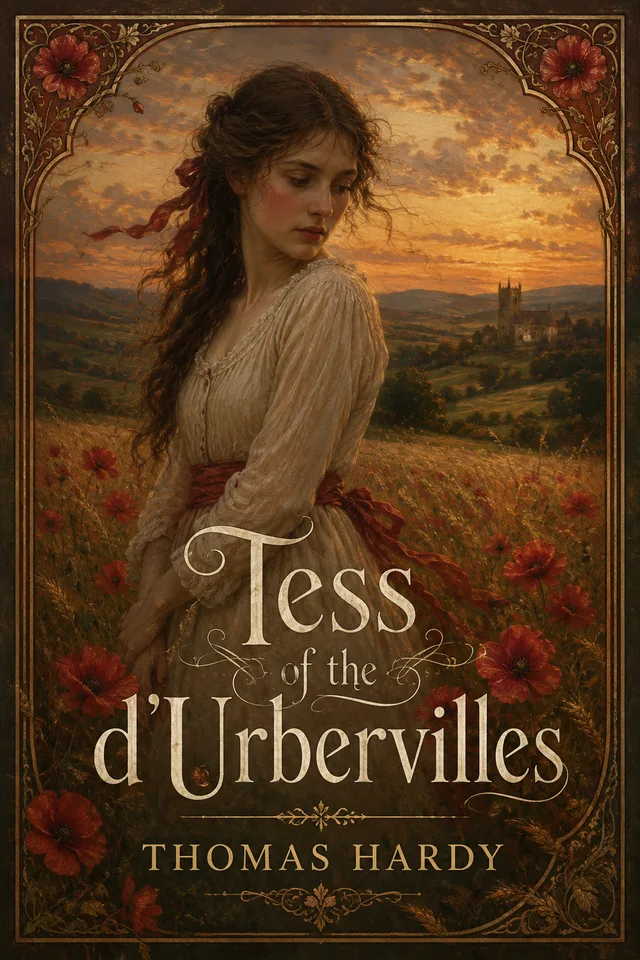
Tess of the d'Urbervilles
Edición BooksWhale en inglés de Thomas Hardy
A tragic rural novel of innocence, social judgment, desire, and fate.
- Vista previa
- Muestra del texto preparado
- Formatos
- Lector online, EPUB, PDF
- Acceso
- Claim de Biblioteca
Introducción del libro
Tess of the d'Urbervilles
Tess of the d'Urbervilles follows Tess Durbeyfield through love, exploitation, work, shame, and resistance in a world governed by class and convention. This English edition presents Hardy's powerful tragedy in a clean reading format.
Edición BooksWhale
Cómo se preparó esta edición
Esta edición se basa en un texto de dominio público y fue preparada por BooksWhale para lectura digital.
Base de dominio público
Por qué puede compartirse
Thomas Hardy died in 1928, and Tess of the d'Urbervilles was first published in 1891. These dates support the public-domain basis for the English source text used in this edition.
Leer vista previa
Muestra del texto preparado
Vista previa seleccionada del texto preparado.
Capítulo de vista previaFull textLeer vista previa
Tess of the d’Urbervilles
Thomas Hardy
Capítulo de vista previaExplanatory Note to the First EditionVista previa
The main portion of the following story appeared—with slight modifications—in the Graphic newspaper; other chapters, more especially addressed to adult readers, in the Fortnightly Review and the National Observer, as episodic sketches. My thanks are tendered to the editors and proprietors of those periodicals for enabling me now to piece the trunk and limbs of the novel together, and print it complete, as originally written two years ago.
I will just add that the story is sent out in all sincerity of purpose, as an attempt to give artistic form to a true sequence of things; and in respect of the book’s opinions and sentiments, I would ask any too genteel reader, who cannot endure to have said what everybody nowadays thinks and feels, to remember a well-worn sentence of St. Jerome’s: If an offense come out of the truth, better it is that the offense come than that the truth be concealed.
T.H.
November 1891.
Capítulo de vista previaAuthor’s Preface to the Fifth and Later EditionsVista previa
This novel being one wherein the great campaign of the heroine begins after an event in her experience which has usually been treated as fatal to her part of protagonist, or at least as the virtual ending of her enterprises and hopes, it was quite contrary to avowed conventions that the public should welcome the book and agree with me in holding that there was something more to be said in fiction than had been said about the shaded side of a well-known catastrophe. But the responsive spirit in which Tess of the d’Urbervilles has been received by the readers of England and America would seem to prove that the plan of laying down a story on the lines of tacit opinion, instead of making it to square with the merely vocal formulae of society, is not altogether a wrong one, even when exemplified in so unequal and partial an achievement as the present. For this responsiveness I cannot refrain from expressing my thanks; and my regret is that, in a world where one so often hungers in vain for friendship, where even not to be wilfully misunderstood is felt as a kindness, I shall never meet in person these appreciative readers, male and female, and shake them by the hand.
I include amongst them the reviewers—by far the majority—who have so generously welcomed the tale. Their words show that they, like the others, have only too largely repaired my defects of narration by their own imaginative intuition.
Nevertheless, though the novel was intended to be neither didactic nor aggressive, but in the scenic parts to be representative simply and in the contemplative to be oftener charged with impressions than with convictions, there have been objectors both to the matter and to the rendering.
The more austere of these maintain a conscientious difference of opinion concerning, among other things, subjects fit for art, and reveal an inability to associate the idea of the sub-title adjective with any but the artificial and derivative meaning which has resulted to it from the ordinances of civilization. They ignore the meaning of the word in Nature, together with all aesthetic claims upon it, not to mention the spiritual interpretation afforded by the finest side of their own Christianity. Others dissent on grounds which are intrinsically no more than an assertion that the novel embodies the views of life prevalent at the end of the nineteenth century, and not those of an earlier and simpler generation—an assertion which I can only hope may be well founded. Let me repeat that a novel is an impression, not an argument; and there the matter must rest; as one is reminded by a passage which occurs in the letters of Schiller to Goethe on judges of this class: “They are those who seek only their own ideas in a representation, and prize that which should be as higher than what is. The cause of the dispute, therefore, lies in the very first principles, and it would be utterly impossible to come to an understanding with them.” And again: “As soon as I observe that any one, when judging of poetical representations, considers anything more important than the inner Necessity and Truth, I have done with him.”
In the introductory words to the first edition I suggested the possible advent of the genteel person who would not be able to endure something or other in these pages. That person duly appeared among the aforesaid objectors. In one case he felt upset that it was not possible for him to read the book through three times, owing to my not having made that critical effort which “alone can prove the salvation of such an one.” In another, he objected to such vulgar articles as the Devil’s pitchfork, a lodging-house carving-knife, and a shame-bought parasol, appearing in a respectable story. In another place he was a gentleman who turned Christian for half-an-hour the better to express his grief that a disrespectful phrase about the Immortals should have been used; though the same innate gentility compelled him to excuse the author in words of pity that one cannot be too thankful for: “He does but give us of his best.” I can assure this great critic that to exclaim illogically against the gods, singular or plural, is not such an original sin of mine as he seems to imagine. True, it may have some local originality; though if Shakespeare were an authority on history, which perhaps he is not, I could show that the sin was introduced into Wessex as early as the Heptarchy itself. Says Glo’ster in Lear, otherwise Ina, king of that country:
Índice
Dentro de esta edición
- 01Full text
- 02Explanatory Note to the First Edition
- 03Author’s Preface to the Fifth and Later Editions
- 04Phase the First: The Maiden
- 05Chapter I
- 06Chapter II
- 07Chapter III
- 08Chapter IV
- 09Chapter V
- 10Chapter VI
- 11Chapter VII
- 12Chapter VIII
- 13Chapter IX
- 14Chapter X
- 15Chapter XI
- 16Phase the Second: Maiden No More
- 17Chapter XII
- 18Chapter XIII
- 19Chapter XIV
- 20Chapter XV
- 21Phase the Third: The Rally
- 22Chapter XVI
- 23Chapter XVII
- 24Chapter XVIII
- 25Chapter XIX
- 26Chapter XX
- 27Chapter XXI
- 28Chapter XXII
- 29Chapter XXIII
- 30Chapter XXIV
- 31Phase the Fourth: The Consequence
- 32Chapter XXV
- 33Chapter XXVI
- 34Chapter XXVII
- 35Chapter XXVIII
- 36Chapter XXIX
- 37Chapter XXX
- 38Chapter XXXI
- 39Chapter XXXII
- 40Chapter XXXIII
- 41Chapter XXXIV
- 42Phase the Fifth: The Woman Pays
- 43Chapter XXXV
- 44Chapter XXXVI
- 45Chapter XXXVII
- 46Chapter XXXVIII
- 47Chapter XXXIX
- 48Chapter XL
- 49Chapter XLI
- 50Chapter XLII
- 51Chapter XLIII
- 52Chapter XLIV
- 53Phase the Sixth: The Convert
- 54Chapter XLV
- 55Chapter XLVI
- 56Chapter XLVII
- 57Chapter XLVIII
- 58Chapter XLIX
- 59Chapter L
- 60Chapter LI
- 61Chapter LII
- 62Phase the Seventh: Fulfilment
- 63Chapter LIII
- 64Chapter LIV
- 65Chapter LV
- 66Chapter LVI
- 67Chapter LVII
- 68Chapter LVIII
- 69Chapter LIX
Disponibilidad de idiomas
Otros idiomas
Aún no hay otras ediciones lingüísticas publicadas. Esta sección enlazará las disponibles.
Solicitar otro idioma