inglés Edición
Política
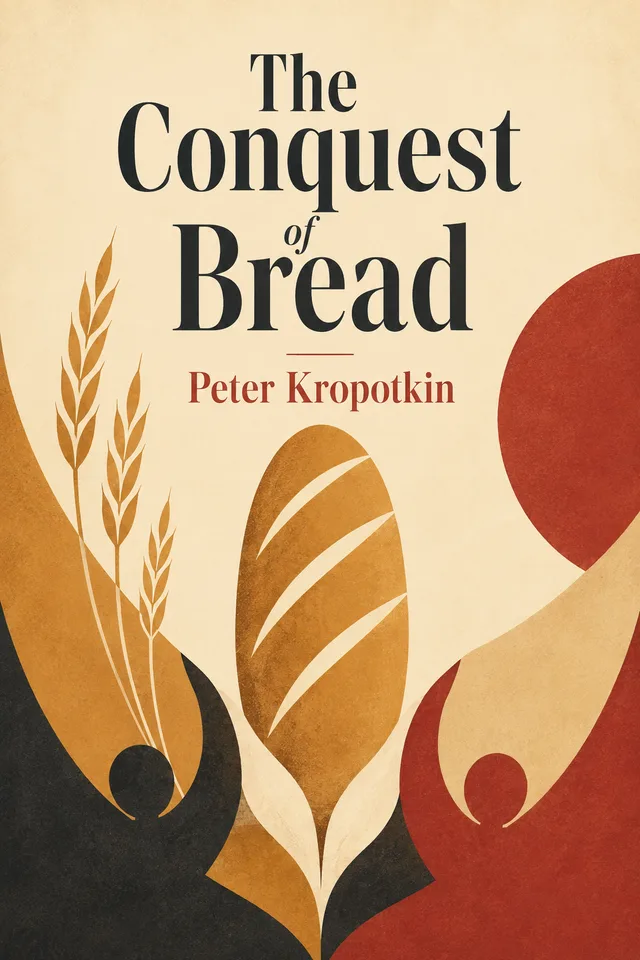
The Conquest of Bread
Edición BooksWhale en inglés de Peter Kropotkin
A classic anarchist argument about cooperation, labor, mutual aid, and social organization.
- Vista previa
- Muestra del texto preparado
- Formatos
- Lector online, EPUB, PDF
- Acceso
- Claim de Biblioteca
Introducción del libro
The Conquest of Bread
The Conquest of Bread sets out Kropotkin’s influential vision of anarchist communism, arguing from production, housing, food, labor, and communal responsibility. Its practical tone and ethical urgency made it a major political text for readers of socialism, anarchism, and mutual aid.
Edición BooksWhale
Cómo se preparó esta edición
Esta edición se basa en un texto de dominio público y fue preparada por BooksWhale para lectura digital.
Base de dominio público
Por qué puede compartirse
The Conquest of Bread is a public-domain work: the author died in 1921, and the text was first published in 1892. This edition uses the original English text.
Leer vista previa
Muestra del texto preparado
Vista previa seleccionada del texto preparado.
Capítulo de vista previaThe Conquest of BreadLeer vista previa
_By_ PETER KROPOTKIN
_Author of "Fields, Factories, and Workshops"
"The Memoirs of a Revolutionist," Etc._
[Illustration]
NEW YORK
VANGUARD PRESS
Capítulo de vista previaMCMXXVIVista previa
PRINTED IN THE UNITED STATES OF AMERICA
THE MAN (1842-1921):
_Prince Peter Alexeivitch Kropotkin_, revolutionary and scientist, was
descended from the old Russian nobility, but decided, at the age of
thirty, to throw in his lot with the social rebels not only of his own
country, but of the entire world. He became the intellectual leader of
Anarchist-Communism; took part in the labor movement; wrote many books
and pamphlets; established _Le Révolté_ in Geneva and _Freedom_ in
London; contributed to the _Encyclopedia Britannica_; was twice
imprisoned because of his radical activities; and twice visited America.
After the Bolshevist revolution he returned to Russia, kept himself
apart from Soviet activities, and died true to his ideals.
THE BOOK:
_The Conquest of Bread_ is a revolutionary idyl, a beautiful outline
sketch of a future society based on liberty, equality and fraternity. It
is, in Kropotkin's own words, "a study of the needs of humanity, and of
the economic means to satisfy them." Read in conjunction with the same
author's "Fields, Factories and Workshops," it meets all the
difficulties of the social inquirer who says: "The Anarchist ideal is
alluring, but how could you work it out?"
Capítulo de vista previaCHAPTER PAGEVista previa
I. OUR RICHES 1
II. WELL-BEING FOR ALL 12
III. ANARCHIST COMMUNISM 23
IV. EXPROPRIATION 34
V. FOOD 47
VI. DWELLINGS 73
VII. CLOTHING 84
VIII. WAYS AND MEANS 87
IX. THE NEED FOR LUXURY 95
X. AGREEABLE WORK 110
XI. FREE AGREEMENT 119
XII. OBJECTIONS 134
XIII. THE COLLECTIVIST WAGES SYSTEM 152
XIV. CONSUMPTION AND PRODUCTION 168
XV. THE DIVISION OF LABOUR 176
XVI. THE DECENTRALIZATION OF INDUSTRY 180
XVII. AGRICULTURE 191
NOTES 213
PREFACE
One of the current objections to Communism, and Socialism altogether, is
that the idea is so old, and yet it has never been realized. Schemes of
ideal States haunted the thinkers of Ancient Greece; later on, the early
Christians joined in communist groups; centuries later, large communist
brotherhoods came into existence during the Reform movement. Then, the
same ideals were revived during the great English and French
Revolutions; and finally, quite lately, in 1848, a revolution, inspired
to a great extent with Socialist ideals, took place in France. "And yet,
you see," we are told, "how far away is still the realization of your
schemes. Don't you think that there is some fundamental error in your
understanding of human nature and its needs?"
At first sight this objection seems very serious. However, the moment we
consider human history more attentively, it loses its strength. We see,
first, that hundreds of millions of men have succeeded in maintaining
amongst themselves, in their village communities, for many hundreds of
years, one of the main elements of Socialism--the common ownership of
the chief instrument of production, the land, and the apportionment of
the same according to the labour capacities of the different families;
and we learn that if the communal possession of the land has been
destroyed in Western Europe, it was not from within, but from without,
by the governments which created a land monopoly in favour of the
nobility and the middle classes. We learn, moreover, that the medieval
cities succeeded in maintaining in their midst, for several centuries in
succession, a certain socialized organization of production and trade;
that these centuries were periods of a rapid intellectual, industrial,
and artistic progress; while the decay of these communal institutions
came mainly from the incapacity of men of combining the village with the
city, the peasant with the citizen, so as jointly to oppose the growth
of the military states, which destroyed the free cities.
The history of mankind, thus understood, does not offer, then, an
argument against Communism. It appears, on the contrary, as a succession
of endeavours to realize some sort of communist organization, endeavours
which were crowned here and there with a partial success of a certain
duration; and all we are authorized to conclude is, that mankind has not
yet found the proper form for combining, on communistic principles,
agriculture with a suddenly developed industry and a rapidly growing
international trade. The latter appears especially as a disturbing
element, since it is no longer individuals only, or cities, that enrich
themselves by distant commerce and export; but whole nations grow rich
at the cost of those nations which lag behind in their industrial
development.
These conditions, which began to appear by the end of the eighteenth
century, took, however, their full development in the nineteenth century
only, after the Napoleonic wars came to an end. And modern Communism has
to take them into account.
It is now known that the French Revolution, apart from its political
significance, was an attempt made by the French people, in 1793 and
1794, in three different directions more or less akin to Socialism. It
was, first, _the equalization of fortunes_, by means of an income tax
and succession duties, both heavily progressive, as also by a direct
confiscation of the land in order to sub-divide it, and by heavy war
taxes levied upon the rich only. The second attempt was a sort of
_Municipal Communism_ as regards the consumption of some objects of
Índice
Dentro de esta edición
- 01The Conquest of Bread
- 02MCMXXVI
- 03CHAPTER PAGE
- 04CHAPTER I
- 05I
- 06II
- 07III
- 08CHAPTER II
- 09I
- 10II
- 11III
- 12CHAPTER III
- 13I
- 14II
- 15CHAPTER IV
- 16I
- 17II
- 18III
- 19CHAPTER V
- 20I
- 21II
- 22III
- 23IV
- 24chapter.
- 25V
- 26VI
- 27VII
- 28CHAPTER VI
- 29I
- 30II
- 31III
- 32CHAPTER VII
- 33CHAPTER VIII
- 34I
- 35II
- 36CHAPTER IX
- 37I
- 38II
- 39III
- 40IV
- 41V
- 42CHAPTER X
- 43I
- 44II
- 45CHAPTER XI
- 46I
- 47II
- 48III
- 49CHAPTER XII
- 50I
- 51II
- 52III
- 53IV
- 54CHAPTER XIII
- 55I
- 56II
- 57III
- 58IV
- 59CHAPTER XIV
- 60I
- 61II
- 62CHAPTER XV
- 63CHAPTER XVI
- 64I
- 65II
- 66III
- 67CHAPTER XVII
- 68I
- 69II
- 70III
- 71IV
- 72V
- 73VI
Disponibilidad de idiomas
Otros idiomas
Aún no hay otras ediciones lingüísticas publicadas. Esta sección enlazará las disponibles.
Solicitar otro idioma