inglés Edición
Historia
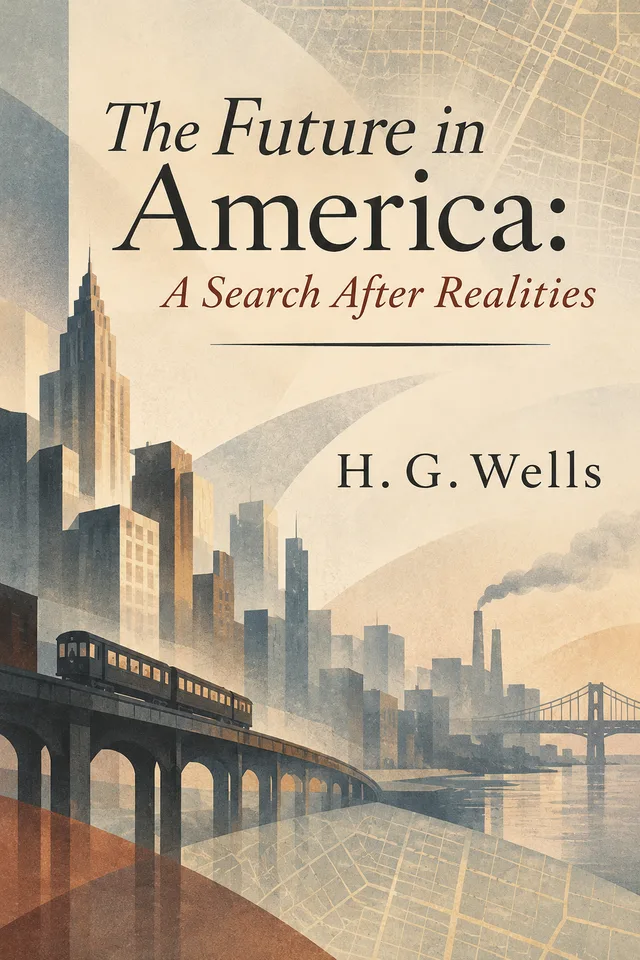
The Future in America: A Search After Realities
Edición BooksWhale en inglés de H. G. Wells
Wells travels through the United States and considers immigration, industrial growth, and American political life.
- Vista previa
- Muestra del texto preparado
- Formatos
- Lector online, EPUB, PDF
- Acceso
- Claim de Biblioteca
Introducción del libro
The Future in America: A Search After Realities
Wells travels through the United States and considers immigration, industrial growth, and American political life. The fifteen chapters move between personal impressions and questions about the country’s future, including education, migration, the position of Black Americans, and the experience of New York and Chicago.
Edición BooksWhale
Cómo se preparó esta edición
Esta edición se basa en un texto de dominio público y fue preparada por BooksWhale para lectura digital.
Base de dominio público
Por qué puede compartirse
The original work by H. G. Wells is in the public domain in the United States. This edition uses the historical English text from Project Gutenberg and excludes modern editorial material.
Leer vista previa
Muestra del texto preparado
Vista previa seleccionada del texto preparado.
Capítulo de vista previaCHAPTER I — THE PROPHETIC HABIT OF MINDLeer vista previa
(At a writing-desk in Sandgate)
I
The Question
"Are you a Polygamist?"
"Are you an Anarchist?"
The questions seem impertinent. They are part of a long paper of interrogations I must answer satisfactorily if I am to be regarded as a desirable alien to enter the United States of America. I want very much to pass that great statue of Liberty illuminating the World (from a central position in New York Harbor), in order to see things in its light, to talk to certain people, to appreciate certain atmospheres, and so I resist the provocation to answer impertinently. I do not even volunteer that I do not smoke and am a total abstainer; on which points it would seem the States as a whole still keep an open mind. I am full of curiosity about America, I am possessed by a problem I feel I cannot adequately discuss even with myself except over there, and I must go even at the price of coming to a decision upon the theoretically open questions these two inquiries raise.
My problem I know will seem ridiculous and monstrous when I give it in all its stark disproportions—attacked by me with my equipment it will call up an image of an elephant assailed by an ant who has not even mastered Jiu-jitsu—but at any rate I've come to it in a natural sort of way and it is one I must, for my own peace of mind, make some kind of attempt upon, even if at last it means no more than the ant crawling in an exploratory way hither and thither over that vast unconscious carcass and finally getting down and going away. That may be rather good for the ant, and the experience may be of interest to other ants, however infinitesimal from the point of view of the elephant, the final value of his investigation may be. And this tremendous problem in my case and now in this—simply; What is going to happen to the United States of America in the next thirty years or so?
I do not know if the reader has ever happened upon any books or writings of mine before, but if, what is highly probable, he has not, he may be curious to know how it is that any human being should be running about in so colossally an interrogative state of mind. (For even the present inquiry is by no means my maximum limit). And the explanation is to be found a little in a mental idiosyncrasy perhaps, but much more in the development of a special way of thinking, of a habit of mind.
That habit of mind may be indicated by a proposition that, with a fine air of discovery, I threw out some years ago, in a happy ignorance that I had been anticipated by no less a person than Heraclitus. "There is no Being but Becoming," that was what appeared to my unscholarly mind to be almost triumphantly new. I have since then informed myself more fully about Heraclitus, there are moments now when I more than half suspect that all the thinking I shall ever do will simply serve to illuminate my understanding of him, but at any rate that apothegm of his does exactly convey the intellectual attitude into which I fall. I am curiously not interested in things, and curiously interested in the consequences of things. I wouldn't for the world go to see the United States for what they are—if I had sound reason for supposing that the entire western hemisphere was to be destroyed next Christmas, I should not, I think, be among the multitude that would rush for one last look at that great spectacle,—from which it follows naturally that I don't propose to see Niagara. I should much more probably turn an inquiring visage eastward, with the west so certainly provided for. I have come to be, I am afraid, even a little insensitive to fine immediate things through this anticipatory habit.
Capítulo de vista previaCHAPTER II — MATERIAL PROGRESSVista previa
(On the "Carmania" going Americanward)
I
American Certitudes
When one talks to an American of his national purpose he seems a little at a loss; if one speaks of his national destiny, he responds with alacrity. I make this generalization on the usual narrow foundations, but so the impression comes to me.
Until this present generation, indeed until within a couple of decades, it is not very evident that Americans did envisage any national purpose at all, except in so far as there was a certain solicitude not to be cheated out of an assured destiny. A sort of optimistic fatalism possessed them. They had, and mostly it seems they still have, a tremendous sense of sustained and assured growth, and it is not altogether untrue that one is told—I have been told—such things as that "America is a great country, sir," that its future is gigantic and that it is already (and going to be more and more so) the greatest country on earth.
I am not the sort of Englishman who questions that. I do so regard that much as obvious and true that it seems to me even a little undignified, as well as a little overbearing, for Americans to insist upon it so; I try to go on as soon as possible to the question just how my interlocutor shapes that gigantic future and what that world predominance is finally to do for us in England and all about the world. So far, I must insist, I haven't found anything like an idea. I have looked for it in books, in papers, in speeches and now I am going to look for it in America. At the most I have found vague imaginings that correspond to that first or monstrous stage in the scheme of prophetic development I sketched in my opening.
There is often no more than a volley of rhetorical blank-cartridge. So empty is it of all but sound that I have usually been constrained by civility from going on to a third enquiry;—
"And what are you, sir, doing in particular, to assist and enrich this magnificent and quite indefinable Destiny of which you so evidently feel yourself a part?"...
That seems to be really no unjust rendering of the conscious element of the American outlook as one finds it, for example, in these nice-looking and pleasant-mannered fellow-passengers upon the Carmania upon whom I fasten with leading questions and experimental remarks. One exception I discover—a pleasant New York clubman who has doubts of this and that. The discipline and sense of purpose in Germany has laid hold upon him. He seems to be, in contrast with his fellow-countrymen, almost pessimistically aware that the American ship of state is after all a mortal ship and liable to leakages. There are certain problems and dangers he seems to think that may delay, perhaps even prevent, an undamaged arrival in that predestined port, that port too resplendent for the eye to rest upon; a Chinese peril, he thinks has not been finally dealt with, "race suicide" is not arrested for all that it is scolded in a most valiant and virile manner, and there are adverse possibilities in the immigrant, in the black, the socialist, against which he sees no guarantee. He sees huge danger in the development and organization of the new finance and no clear promise of a remedy. He finds the closest parallel between the American Republic and Rome before the coming of Imperialism. But these other Americans have no share in his pessimisms. They may confess to as much as he does in the way of dangers, admit there are occasions for calking, a need of stopping quite a number of possibilities if the American Idea is to make its triumphant entry at last into that port of blinding accomplishment, but, apart from a few necessary preventive proposals, I do not perceive any extensive sense of anything whatever to be done, anything to be shaped and thought out and made in the sense of a national determination to a designed and specified end.
Capítulo de vista previaCHAPTER III — NEW YORKVista previa
(In a room on the ninth floor in the sky-scraper hotel New York)
I
First Impressions
My first impressions of New York are enormously to enhance the effect of this Progress, this material progress, that is to say, as something inevitable and inhuman, as a blindly furious energy of growth that must go on. Against the broad and level gray contours of Liverpool one found the ocean liner portentously tall, but here one steams into the middle of a town that dwarfs the ocean liner. The sky-scrapers that are the New-Yorker's perpetual boast and pride rise up to greet one as one comes through the Narrows into the Upper Bay, stand out, in a clustering group of tall irregular crenellations, the strangest crown that ever a city wore. They have an effect of immense incompleteness; each one seems to await some needed terminal,—to be, by virtue of its woolly jets of steam, still as it were in process of eruption. One thinks of St. Peter's great blue dome, finished and done as one saw it from a vine-shaded wine-booth above the Milvian Bridge, one thinks of the sudden ascendency of St. Paul's dark grace, as it soars out over any one who comes up by the Thames towards it. These are efforts that have accomplished their ends, and even Paris illuminated under the tall stem of the Eiffel Tower looked completed and defined. But New York's achievement is a threatening promise, growth going on under a pressure that increases, and amidst a hungry uproar of effort.
One gets a measure of the quality of this force of mechanical, of inhuman, growth as one marks the great statue of Liberty on our larboard, which is meant to dominate and fails absolutely to dominate the scene. It gets to three hundred feet about, by standing on a pedestal of a hundred and fifty; and the uplifted torch, seen against the sky, suggests an arm straining upward, straining in hopeless competition with the fierce commercial altitudes ahead. Poor liberating Lady of the American ideal! One passes her and forgets.
Happy returning natives greet the great pillars of business by name, the St. Paul Building, the World, the Manhattan tower; the English new-comer notes the clear emphasis of the detail, the freedom from smoke and atmospheric mystery that New York gains from burning anthracite, the jetting white steam clouds that emphasize that freedom. Across the broad harbor plies an unfamiliar traffic of grotesque broad ferry-boats, black with people, glutted to the lips with vans and carts, each hooting and yelping its own distinctive note, and there is a wild hurrying up and down and to and fro of piping and bellowing tugs and barges; and a great floating platform, bearing a railway train, gets athwart our course as we ascend and evokes megatherial bellowings. Everything is moving at a great speed, and whistling and howling, it seems, and presently far ahead we make out our own pier, black with expectant people, and set up our own distinctive whoop, and with the help of half a dozen furiously noisy tugs are finally lugged and butted into dock. The tugs converse by yells and whistles, it is an affair of short-tempered mechanical monsters, amidst which one watches for one's opportunity to get ashore.
Noise and human hurry and a vastness of means and collective result, rather than any vastness of achievement, is the pervading quality of New York. The great thing is the mechanical thing, the unintentional thing which is speeding up all these people, driving them in headlong hurry this way and that, exhorting them by the voice of every car conductor to "step lively," aggregating them into shoving and elbowing masses, making them stand clinging to straps, jerking them up elevator shafts and pouring them on to the ferry-boats. But this accidental great thing is at times a very great thing. Much more impressive than the sky-scrapers to my mind is the large Brooklyn suspension-bridge. I have never troubled to ask who built that; its greatness is not in its design, but in the quality of necessity one perceives in its inanimate immensity. It tells, as one goes under it up the East River, but it is far more impressive to the stranger to come upon it by glimpses, wandering down to it through the ill-paved van-infested streets from Chatham Square. One sees parts of Cyclopean stone arches, one gets suggestive glimpses through the jungle growth of business now of the back, now of the flanks, of the monster; then, as one comes out on the river, one discovers far up in one's sky the long sweep of the bridge itself, foreshortened and with a maximum of perspective effect; the streams of pedestrians and the long line of carts and vans, quaintly microscopic against the blue, the creeping progress of the little cars on the lower edge of the long chain of netting; all these things dwindling indistinguishably before Brooklyn is reached. Thence, if it is late afternoon, one may walk back to City Hall Park and encounter and experience the convergent stream of clerks and workers making for the bridge, mark it grow denser and denser, until at last they come near choking even the broad approaches of the giant duct, until the congested multitudes jostle and fight for a way. They arrive marching afoot by every street in endless procession; crammed trolley-cars disgorge them; the Subway pours them out.... The individuals count for nothing, they are clerks and stenographers, shop-men, shop-girls, workers of innumerable types, black-coated men, hat-and-blouse girls, shabby and cheaply clad persons, such as one sees in London, in Berlin, anywhere. Perhaps they hurry more, perhaps they seem more eager. But the distinctive effect is the mass, the black torrent, rippled with unmeaning faces, the great, the unprecedented multitudinousness of the thing, the inhuman force of it all.
Índice
Dentro de esta edición
- 01CHAPTER I — THE PROPHETIC HABIT OF MIND
- 02CHAPTER II — MATERIAL PROGRESS
- 03CHAPTER III — NEW YORK
- 04CHAPTER IV — GROWTH INVINCIBLE
- 05CHAPTER V — THE ECONOMIC PROCESS
- 06CHAPTER VI — SOME ASPECTS OF AMERICAN WEALTH
- 07CHAPTER VII — CERTAIN WORKERS
- 08CHAPTER VIII — CORRUPTION
- 09CHAPTER IX — THE IMMIGRANT
- 10CHAPTER X — STATE-BLINDNESS
- 11CHAPTER XI — TWO STUDIES IN DISAPPOINTMENT
- 12CHAPTER XII — THE TRAGEDY OF COLOR
- 13CHAPTER XIII — THE MIND OF A MODERN STATE
- 14CHAPTER XIV — CULTURE
- 15CHAPTER XV — AT WASHINGTON
Disponibilidad de idiomas
Otros idiomas
Aún no hay otras ediciones lingüísticas publicadas. Esta sección enlazará las disponibles.
Solicitar otro idiomaThe Future in America: A Search After Realities
Membresía $9.99 / año · acceso claim