inglés Edición
Literatura
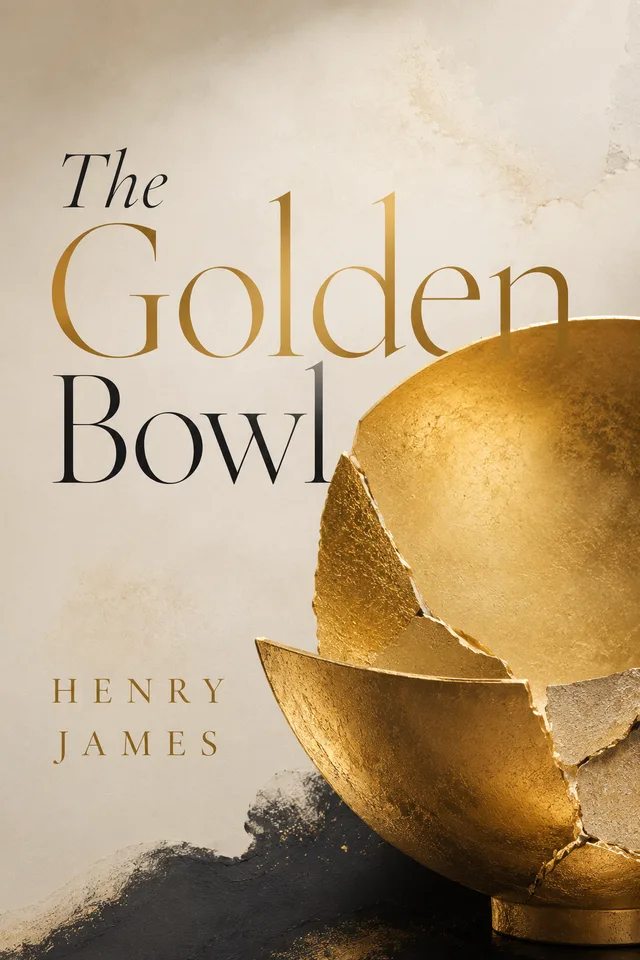
The Golden Bowl
Edición BooksWhale en inglés de Henry James
Henry James’s late novel of marriage, perception, hidden betrayal, and psychological strategy.
- Vista previa
- Muestra del texto preparado
- Formatos
- Lector online, EPUB, PDF
- Acceso
- Claim de Biblioteca
Introducción del libro
The Golden Bowl
The Golden Bowl centers on Maggie Verver, Prince Amerigo, Charlotte Stant, and a marriage plot built from silence, observation, and moral tension. Its intricate style makes it a key work for readers of Henry James, psychological realism, transatlantic fiction, and modern narrative technique.
Edición BooksWhale
Cómo se preparó esta edición
Esta edición se basa en un texto de dominio público y fue preparada por BooksWhale para lectura digital.
Base de dominio público
Por qué puede compartirse
Public-domain original text; author died more than 70 years ago or the edition is in the public domain.
Leer vista previa
Muestra del texto preparado
Vista previa seleccionada del texto preparado.
Capítulo de vista previaFull textLeer vista previa
The Golden Bowl
Volumes I and II, Complete
By Henry James
Capítulo de vista previaBOOK FIRST: THE PRINCEVista previa
BOOK FIRST: THE PRINCE
Capítulo de vista previaPART FIRSTVista previa
The Prince had always liked his London, when it had come to him; he was
one of the modern Romans who find by the Thames a more convincing image
of the truth of the ancient state than any they have left by the Tiber.
Brought up on the legend of the City to which the world paid tribute, he
recognised in the present London much more than in contemporary Rome the
real dimensions of such a case. If it was a question of an Imperium, he
said to himself, and if one wished, as a Roman, to recover a little the
sense of that, the place to do so was on London Bridge, or even, on a
fine afternoon in May, at Hyde Park Corner. It was not indeed to either
of those places that these grounds of his predilection, after all
sufficiently vague, had, at the moment we are concerned with him, guided
his steps; he had strayed, simply enough, into Bond Street, where his
imagination, working at comparatively short range, caused him now and
then to stop before a window in which objects massive and lumpish, in
silver and gold, in the forms to which precious stones contribute, or
in leather, steel, brass, applied to a hundred uses and abuses, were as
tumbled together as if, in the insolence of the Empire, they had been
the loot of far-off victories. The young man’s movements, however,
betrayed no consistency of attention—not even, for that matter, when
one of his arrests had proceeded from possibilities in faces shaded,
as they passed him on the pavement, by huge beribboned hats, or more
delicately tinted still under the tense silk of parasols held at
perverse angles in waiting victorias. And the Prince’s undirected
thought was not a little symptomatic, since, though the turn of
the season had come and the flush of the streets begun to fade, the
possibilities of faces, on the August afternoon, were still one of the
notes of the scene. He was too restless—that was the fact—for any
concentration, and the last idea that would just now have occurred to
him in any connection was the idea of pursuit.
He had been pursuing for six months as never in his life before, and
what had actually unsteadied him, as we join him, was the sense of how
he had been justified. Capture had crowned the pursuit—or success,
as he would otherwise have put it, had rewarded virtue; whereby the
consciousness of these things made him, for the hour, rather serious
than gay. A sobriety that might have consorted with failure sat in his
handsome face, constructively regular and grave, yet at the same time
oddly and, as might be, functionally almost radiant, with its dark
blue eyes, its dark brown moustache and its expression no more sharply
“foreign” to an English view than to have caused it sometimes to be
observed of him with a shallow felicity that he looked like a “refined”
Irishman. What had happened was that shortly before, at three o’clock,
his fate had practically been sealed, and that even when one pretended
to no quarrel with it the moment had something of the grimness of a
crunched key in the strongest lock that could be made. There was nothing
to do as yet, further, but feel what one had done, and our personage
felt it while he aimlessly wandered. It was already as if he were
married, so definitely had the solicitors, at three o’clock, enabled the
date to be fixed, and by so few days was that date now distant. He was
to dine at half-past eight o’clock with the young lady on whose behalf,
and on whose father’s, the London lawyers had reached an inspired
harmony with his own man of business, poor Calderoni, fresh from Rome
and now apparently in the wondrous situation of being “shown London,”
Índice
Dentro de esta edición
- 01Full text
- 02BOOK FIRST: THE PRINCE
- 03PART FIRST
- 04I SHALL.”
- 05PART SECOND
- 06MUCH.”
- 07PART THIRD
- 08BOOK SECOND: THE PRINCESS
- 09PART FOURTH
- 10WAS.”
- 11PART FIFTH
- 12MUST!”
- 13XXXVIII
- 14HIM.”
- 15PART SIXTH.
Disponibilidad de idiomas
Otros idiomas
Aún no hay otras ediciones lingüísticas publicadas. Esta sección enlazará las disponibles.
Solicitar otro idioma