inglés Edición
Ciencia
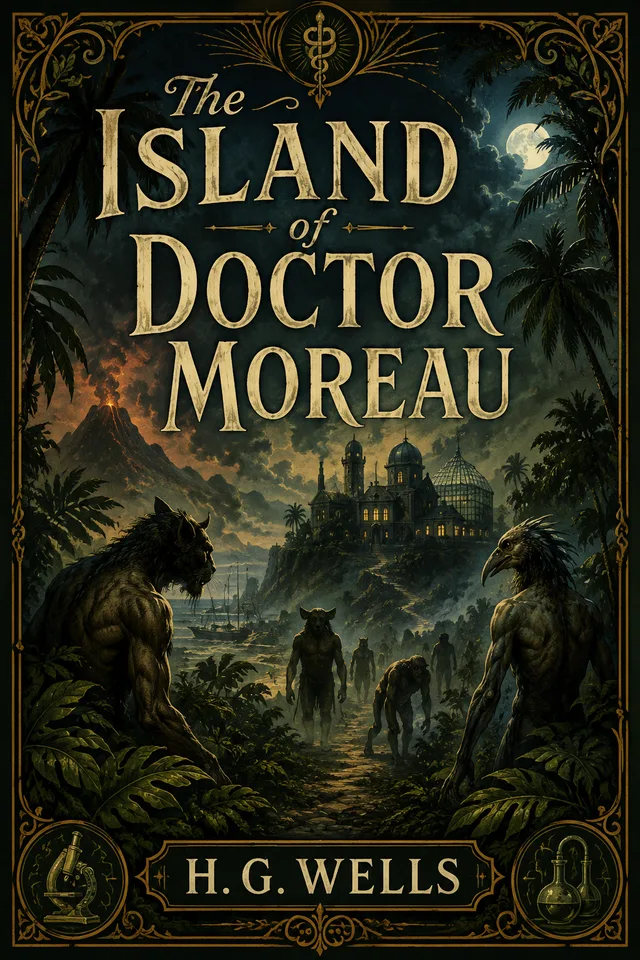
The Island of Doctor Moreau
Edición BooksWhale en inglés de H. G. Wells
A disturbing science-fiction classic about experiment, ethics, evolution, and humanity.
- Vista previa
- Muestra del texto preparado
- Formatos
- Lector online, EPUB, PDF
- Acceso
- Claim de Biblioteca
Introducción del libro
The Island of Doctor Moreau
The Island of Doctor Moreau follows a castaway who discovers a remote island shaped by scientific ambition and moral horror. This English edition presents the public-domain novel for clear digital reading.
Edición BooksWhale
Cómo se preparó esta edición
Esta edición se basa en un texto de dominio público y fue preparada por BooksWhale para lectura digital.
Base de dominio público
Por qué puede compartirse
H. G. Wells died in 1946, and The Island of Doctor Moreau was first published in 1896. These dates support the public-domain basis for the English source text used in this edition.
Leer vista previa
Muestra del texto preparado
Vista previa seleccionada del texto preparado.
Capítulo de vista previaFull textLeer vista previa
The Island of Doctor Moreau
H. G. Wells
Capítulo de vista previaIntroductionVista previa
On February the First 1887, the Lady Vain was lost by collision with a derelict when about the latitude 1° S. and longitude 107° W.
On January the Fifth, 1888—that is eleven months and four days after—my uncle, Edward Prendick, a private gentleman, who certainly went aboard the Lady Vain at Callao, and who had been considered drowned, was picked up in latitude 5° 3′ S. and longitude 101° W. in a small open boat of which the name was illegible, but which is supposed to have belonged to the missing schooner Ipecacuanha. He gave such a strange account of himself that he was supposed demented. Subsequently he alleged that his mind was a blank from the moment of his escape from the Lady Vain. His case was discussed among psychologists at the time as a curious instance of the lapse of memory consequent upon physical and mental stress. The following narrative was found among his papers by the undersigned, his nephew and heir, but unaccompanied by any definite request for publication.
The only island known to exist in the region in which my uncle was picked up is Noble’s Isle, a small volcanic islet and uninhabited. It was visited in 1891 by H. M. S. Scorpion. A party of sailors then landed, but found nothing living thereon except certain curious white moths, some hogs and rabbits, and some rather peculiar rats. So that this narrative is without confirmation in its most essential particular. With that understood, there seems no harm in putting this strange story before the public in accordance, as I believe, with my uncle’s intentions. There is at least this much in its behalf: my uncle passed out of human knowledge about latitude 5° S. and longitude 105° E., and reappeared in the same part of the ocean after a space of eleven months. In some way he must have lived during the interval. And it seems that a schooner called the Ipecacuanha with a drunken captain, John Davies, did start from Africa with a puma and certain other animals aboard in January, 1887, that the vessel was well known at several ports in the South Pacific, and that it finally disappeared from those seas (with a considerable amount of copra aboard), sailing to its unknown fate from Bayna in December, 1887, a date that tallies entirely with my uncle’s story.
CHARLES EDWARD PRENDICK.
I. IN THE DINGEY OF THE “LADY VAIN.”
I do not propose to add anything to what has already been written concerning the loss of the Lady Vain. As everyone knows, she collided with a derelict when ten days out from Callao. The longboat, with seven of the crew, was picked up eighteen days after by H. M. gunboat Myrtle, and the story of their terrible privations has become quite as well known as the far more horrible Medusa case. But I have to add to the published story of the Lady Vain another, possibly as horrible and far stranger. It has hitherto been supposed that the four men who were in the dingey perished, but this is incorrect. I have the best of evidence for this assertion: I was one of the four men.
But in the first place I must state that there never were four men in the dingey,—the number was three. Constans, who was “seen by the captain to jump into the gig,” luckily for us and unluckily for himself did not reach us. He came down out of the tangle of ropes under the stays of the smashed bowsprit, some small rope caught his heel as he let go, and he hung for a moment head downward, and then fell and struck a block or spar floating in the water. We pulled towards him, but he never came up.
I say luckily for us he did not reach us, and I might almost say luckily for himself; for we had only a small beaker of water and some soddened ship’s biscuits with us, so sudden had been the alarm, so unprepared the ship for any disaster. We thought the people on the launch would be better provisioned (though it seems they were not), and we tried to hail them. They could not have heard us, and the next morning when the drizzle cleared,—which was not until past midday,—we could see nothing of them. We could not stand up to look about us, because of the pitching of the boat. The two other men who had escaped so far with me were a man named Helmar, a passenger like myself, and a seaman whose name I don’t know,—a short sturdy man, with a stammer.
Capítulo de vista previaII. The Man Who Was Going NowhereVista previa
The cabin in which I found myself was small and rather untidy. A youngish man with flaxen hair, a bristly straw-coloured moustache, and a dropping nether lip, was sitting and holding my wrist. For a minute we stared at each other without speaking. He had watery grey eyes, oddly void of expression. Then just overhead came a sound like an iron bedstead being knocked about, and the low angry growling of some large animal. At the same time the man spoke. He repeated his question,—“How do you feel now?”
I think I said I felt all right. I could not recollect how I had got there. He must have seen the question in my face, for my voice was inaccessible to me.
“You were picked up in a boat, starving. The name on the boat was the Lady Vain, and there were spots of blood on the gunwale.”
At the same time my eye caught my hand, so thin that it looked like a dirty skin-purse full of loose bones, and all the business of the boat came back to me.
“Have some of this,” said he, and gave me a dose of some scarlet stuff, iced.
It tasted like blood, and made me feel stronger.
“You were in luck,” said he, “to get picked up by a ship with a medical man aboard.” He spoke with a slobbering articulation, with the ghost of a lisp.
“What ship is this?” I said slowly, hoarse from my long silence.
“It’s a little trader from Arica and Callao. I never asked where she came from in the beginning,—out of the land of born fools, I guess. I’m a passenger myself, from Arica. The silly ass who owns her,—he’s captain too, named Davies,—he’s lost his certificate, or something. You know the kind of man,—calls the thing the Ipecacuanha, of all silly, infernal names; though when there’s much of a sea without any wind, she certainly acts according.”
(Then the noise overhead began again, a snarling growl and the voice of a human being together. Then another voice, telling some “Heaven-forsaken idiot” to desist.)
“You were nearly dead,” said my interlocutor. “It was a very near thing, indeed. But I’ve put some stuff into you now. Notice your arm’s sore? Injections. You’ve been insensible for nearly thirty hours.”
I thought slowly. (I was distracted now by the yelping of a number of dogs.) “Am I eligible for solid food?” I asked.
“Thanks to me,” he said. “Even now the mutton is boiling.”
“Yes,” I said with assurance; “I could eat some mutton.”
“But,” said he with a momentary hesitation, “you know I’m dying to hear of how you came to be alone in that boat. Damn that howling!” I thought I detected a certain suspicion in his eyes.
He suddenly left the cabin, and I heard him in violent controversy with some one, who seemed to me to talk gibberish in response to him. The matter sounded as though it ended in blows, but in that I thought my ears were mistaken. Then he shouted at the dogs, and returned to the cabin.
“Well?” said he in the doorway. “You were just beginning to tell me.”
I told him my name, Edward Prendick, and how I had taken to Natural History as a relief from the dulness of my comfortable independence.
He seemed interested in this. “I’ve done some science myself. I did my Biology at University College,—getting out the ovary of the earthworm and the radula of the snail, and all that. Lord! It’s ten years ago. But go on! go on! tell me about the boat.”
He was evidently satisfied with the frankness of my story, which I told in concise sentences enough, for I felt horribly weak; and when it was finished he reverted at once to the topic of Natural History and his own biological studies. He began to question me closely about Tottenham Court Road and Gower Street. “Is Caplatzi still flourishing? What a shop that was!” He had evidently been a very ordinary medical student, and drifted incontinently to the topic of the music halls. He told me some anecdotes.
Índice
Dentro de esta edición
- 01Full text
- 02Introduction
- 03II. The Man Who Was Going Nowhere
- 04III. The Strange Face
- 05IV. At The Schooner’S Rail
- 06V. The Man Who Had Nowhere To Go
- 07VI. The Evil-Looking Boatmen
- 08VII. The Locked Door
- 09VIII. The Crying Of The Puma
- 10IX. The Thing In The Forest
- 11X. The Crying Of The Man
- 12XI. The Hunting Of The Man
- 13XII. The Sayers Of The Law
- 14XIII. A Parley
- 15XIV. Doctor Moreau Explains
- 16XV. Concerning The Beast Folk
- 17XVI. How The Beast Folk Taste Blood
- 18XVII. A Catastrophe
- 19XVIII. The Finding Of Moreau
- 20XX. Alone With The Beast Folk
- 21XXI. The Reversion Of The Beast Folk
- 22XXII. The Man Alone
Disponibilidad de idiomas
Otros idiomas
Aún no hay otras ediciones lingüísticas publicadas. Esta sección enlazará las disponibles.
Solicitar otro idioma