inglés Edición
Literatura
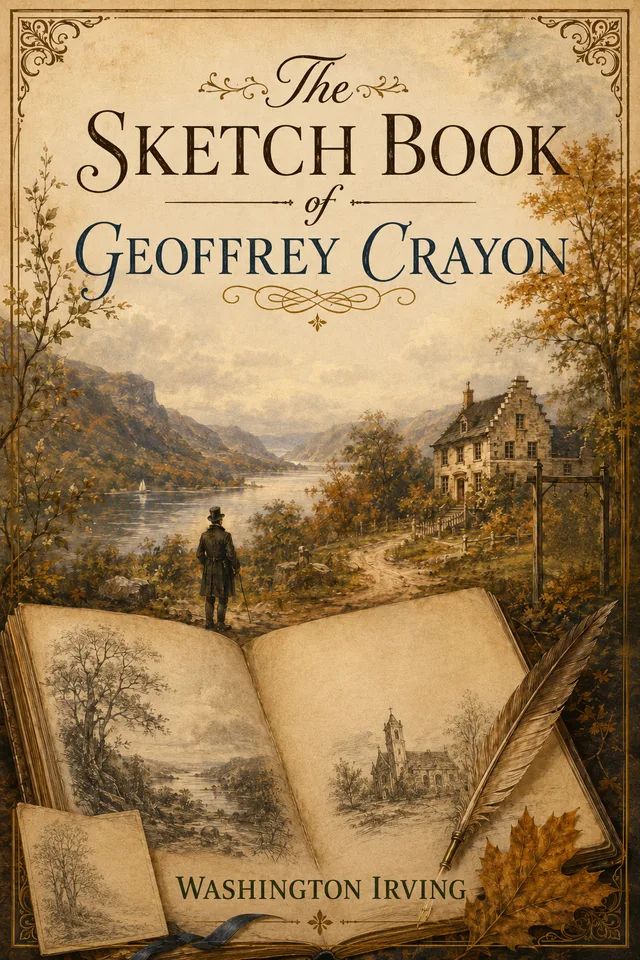
The Sketch Book of Geoffrey Crayon
Edición BooksWhale en inglés de Washington Irving
Classic essays and tales including Rip Van Winkle and The Legend of Sleepy Hollow.
- Vista previa
- Muestra del texto preparado
- Formatos
- Lector online, EPUB, PDF
- Acceso
- Claim de Biblioteca
Introducción del libro
The Sketch Book of Geoffrey Crayon
The Sketch Book of Geoffrey Crayon gathers Washington Irving’s celebrated sketches, travel pieces, and tales, including Rip Van Winkle and The Legend of Sleepy Hollow. This English original-language edition is prepared for BooksWhale reading formats.
Edición BooksWhale
Cómo se preparó esta edición
Esta edición se basa en un texto de dominio público y fue preparada por BooksWhale para lectura digital.
Base de dominio público
Por qué puede compartirse
Washington Irving died in 1859, and The Sketch Book of Geoffrey Crayon was first published in 1820. These dates support the public-domain basis for this English original-language edition.
Leer vista previa
Muestra del texto preparado
Vista previa seleccionada del texto preparado.
Capítulo de vista previaFull textLeer vista previa
The Sketch Book of Geoffrey Crayon, Gent.
Washington Irving
“I have no wife nor children, good or bad, to provide for. A mere spectator of other men’s fortunes and adventures, and how they play their parts; which, methinks, are diversely presented unto me, as from a common theatre or scene.”--BURTON.
Capítulo de vista previaPreface To The Revised Edition.Vista previa
THE following papers, with two exceptions, were written in England, and formed but part of an intended series for which I had made notes and memorandums. Before I could mature a plan, however, circumstances compelled me to send them piecemeal to the United States, where they were published from time to time in portions or numbers. It was not my intention to publish them in England, being conscious that much of their contents could be interesting only to American readers, and, in truth, being deterred by the severity with which American productions had been treated by the British press.
By the time the contents of the first volume had appeared in this occasional manner, they began to find their way across the Atlantic, and to be inserted, with many kind encomiums, in the London Literary Gazette. It was said, also, that a London bookseller intended to publish them in a collective form. I determined, therefore, to bring them forward myself, that they might at least have the benefit of my superintendence and revision. I accordingly took the printed numbers which I had received from the United States, to Mr. John Murray, the eminent publisher, from whom I had already received friendly attentions, and left them with him for examination, informing him that should he be inclined to bring them before the public, I had materials enough on hand for a second volume. Several days having elapsed without any communication from Mr. Murray, I addressed a note to him, in which I construed his silence into a tacit rejection of my work, and begged that the numbers I had left with him might be returned to me. The following was his reply:
MY DEAR SIR: I entreat you to believe that I feel truly obliged by your kind intentions towards me, and that I entertain the most unfeigned respect for your most tasteful talents. My house is completely filled with workpeople at this time, and I have only an office to transact business in; and yesterday I was wholly occupied, or I should have done myself the pleasure of seeing you.
If it would not suit me to engage in the publication of your present work, it is only because I do not see that scope in the nature of it which would enable me to make those satisfactory accounts between us, without which I really feel no satisfaction in engaging--but I will do all I can to promote their circulation, and shall be most ready to attend to any future plan of yours.
With much regard, I remain, dear sir, Your faithful servant, JOHN MURRAY.
This was disheartening, and might have deterred me from any further prosecution of the matter, had the question of republication in Great Britain rested entirely with me; but I apprehended the appearance of a spurious edition. I now thought of Mr. Archibald Constable as publisher, having been treated by him with much hospitality during a visit to Edinburgh; but first I determined to submit my work to Sir-Walter (then Mr.) Scott, being encouraged to do so by the cordial reception I had experienced from him at Abbotsford a few years previously, and by the favorable opinion he had expressed to others of my earlier writings. I accordingly sent him the printed numbers of the Sketch-Book in a parcel by coach, and at the same time wrote to him, hinting that since I had had the pleasure of partaking of his hospitality, a reverse had taken place in my affairs which made the successful exercise of my pen all-important to me; I begged him, therefore, to look over the literary articles I had forwarded to him, and, if he thought they would bear European republication, to ascertain whether Mr. Constable would be inclined to be the publisher.
The parcel containing my work went by coach to Scott’s address in Edinburgh; the letter went by mail to his residence in the country. By the very first post I received a reply, before he had seen my work.
Capítulo de vista previaThe Author’S Account Of HimselfVista previa
I am of this mind with Homer, that as the snaile that crept out of her shel was turned eftsoones into a toad, and thereby was forced to make a stoole to sit on; so the traveller that stragleth from his owne country is in a short time transformed into so monstrous a shape, that he is faine to alter his mansion with his manners, and to live where he can, not where he would.--LYLY’S EUPHUES.
I was always fond of visiting new scenes, and observing strange characters and manners. Even when a mere child I began my travels, and made many tours of discovery into foreign parts and unknown regions of my native city, to the frequent alarm of my parents, and the emolument of the town crier. As I grew into boyhood, I extended the range of my observations. My holiday afternoons were spent in rambles about the surrounding country. I made myself familiar with all its places famous in history or fable. I knew every spot where a murder or robbery had been committed, or a ghost seen. I visited the neighboring villages, and added greatly to my stock of knowledge, by noting their habits and customs, and conversing with their sages and great men. I even journeyed one long summer’s day to the summit of the most distant hill, whence I stretched my eye over many a mile of terra incognita, and was astonished to find how vast a globe I inhabited.
This rambling propensity strengthened with my years. Books of voyages and travels became my passion, and in devouring their contents, I neglected the regular exercises of the school. How wistfully would I wander about the pier-heads in fine weather, and watch the parting ships, bound to distant climes; with what longing eyes would I gaze after their lessening sails, and waft myself in imagination to the ends of the earth!
Further reading and thinking, though they brought this vague inclination into more reasonable bounds, only served to make it more decided. I visited various parts of my own country; and had I been merely a lover of fine scenery, I should have felt little desire to seek elsewhere its gratification, for on no country had the charms of nature been more prodigally lavished. Her mighty lakes, her oceans of liquid silver; her mountains, with their bright aerial tints; her valleys, teeming with wild fertility; her tremendous cataracts, thundering in their solitudes; her boundless plains, waving with spontaneous verdure; her broad, deep rivers, rolling in solemn silence to the ocean; her trackless forests, where vegetation puts forth all its magnificence; her skies, kindling with the magic of summer clouds and glorious sunshine;--no, never need an American look beyond his own country for the sublime and beautiful of natural scenery.
But Europe held forth all the charms of storied and poetical association. There were to be seen the masterpieces of art, the refinements of highly cultivated society, the quaint peculiarities of ancient and local custom. My native country was full of youthful promise; Europe was rich in the accumulated treasures of age. Her very ruins told the history of the times gone by, and every mouldering stone was a chronicle. I longed to wander over the scenes of renowned achievement--to tread, as it were, in the footsteps of antiquity--to loiter about the ruined castle--to meditate on the falling tower--to escape, in short, from the commonplace realities of the present, and lose myself among the shadowy grandeurs of the past.
I had, besides all this, an earnest desire to see the great men of the earth. We have, it is true, our great men in America: not a city but has an ample share of them. I have mingled among them in my time, and been almost withered by the shade into which they cast me; for there is nothing so baleful to a small man as the shade of a great one, particularly the great man of a city. But I was anxious to see the great men of Europe; for I had read in the works of various philosophers, that all animals degenerated in America, and man among the number. A great man of Europe, thought I, must therefore be as superior to a great man of America, as a peak of the Alps to a highland of the Hudson; and in this idea I was confirmed by observing the comparative importance and swelling magnitude of many English travellers among us, who, I was assured, were very little people in their own country. I will visit this land of wonders, thought I, and see the gigantic race from which I am degenerated.
Índice
Dentro de esta edición
- 01Full text
- 02Preface To The Revised Edition.
- 03The Author’S Account Of Himself
- 04The Voyage.
- 05Roscoe.
- 06To My Books
- 07The Wife.
- 08Rip Van Winkle.
- 09English Writers On America.
- 10Rural Life In England.
- 11The Broken Heart.
- 12The Art Of Book-Making.
- 13A Royal Poet.
- 14The Country Church.
- 15The Widow And Her Son.
- 16A Sunday In London.
- 17The Mutability Of Literature.
- 18Rural Funerals.
- 19The Inn Kitchen.
- 20The Spectre Bridegroom.
- 21Westminster Abbey.
- 22Christmas.
- 23The Stage-Coach.
- 24Christmas Eve.
- 25Christmas Day.
- 26The Christmas Dinner.
- 27London Antiques.
- 28Little Britain.
- 29Stratford-On-Avon.
- 30Traits Of Indian Character.
- 31Philip Of Pokanoket.
- 32John Bull.
- 33The Pride Of The Village.
- 34The Angler.
- 35The Legend Of Sleepy Hollow.
- 36L’Envoy.
Disponibilidad de idiomas
Otros idiomas
Aún no hay otras ediciones lingüísticas publicadas. Esta sección enlazará las disponibles.
Solicitar otro idioma