inglés Edición
Literatura
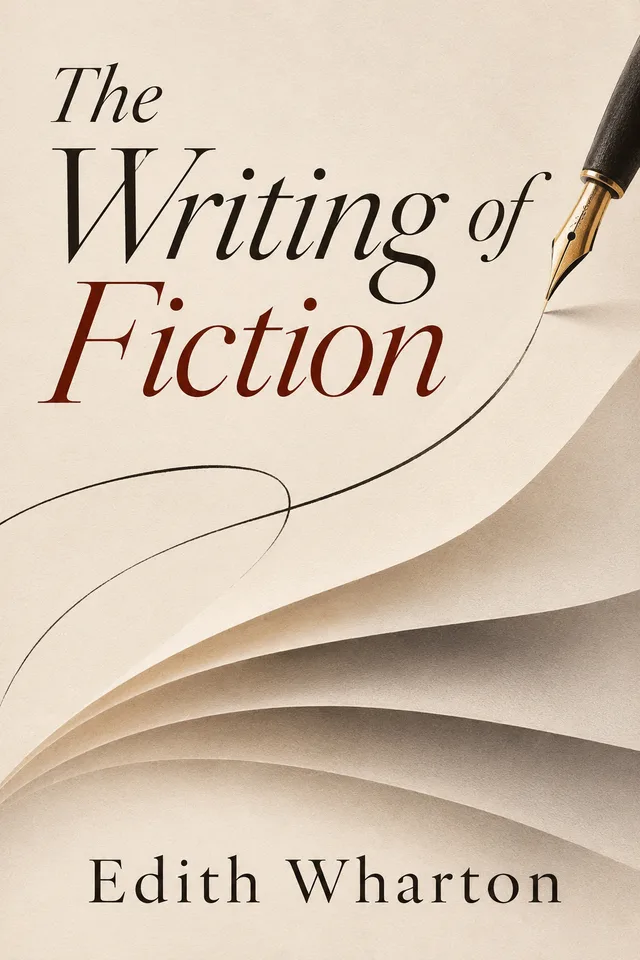
The Writing of Fiction
Edición BooksWhale en inglés de Edith Wharton
Edith Wharton explores short stories, novel construction, character, narrative situation, and Marcel Proust in five groups of literary essays.
- Vista previa
- Muestra del texto preparado
- Formatos
- Lector online, EPUB, PDF
- Acceso
- Claim de Biblioteca
Introducción del libro
The Writing of Fiction
The Writing of Fiction sets out Edith Wharton’s reflections on how imagined experience becomes convincing narrative. Five groups of essays move from general principles to short-story design, the construction of novels, the relationship between character and situation, and the achievement of Marcel Proust. Wharton combines practical judgment with close attention to form, proportion, and emotional truth.
Edición BooksWhale
Cómo se preparó esta edición
Esta edición se basa en un texto de dominio público y fue preparada por BooksWhale para lectura digital.
Base de dominio público
Por qué puede compartirse
Edith Wharton died in 1937. This edition uses the original English text of The Writing of Fiction from Project Gutenberg, which identifies this source as public domain in the United States; later editorial notes and illustrations are excluded.
Leer vista previa
Muestra del texto preparado
Vista previa seleccionada del texto preparado.
Capítulo de vista previaFull textLeer vista previa
The Writing of Fiction
Edith Wharton
Order the beauty even of Beauty is. —Thomas Traherne.
TO GAILLARD LAPSLEY
Capítulo de vista previaI IN GENERALVista previa
I IN GENERAL
Capítulo de vista previaIVista previa
To treat of the practice of fiction is to deal with the newest, most fluid and least formulated of the arts. The exploration of origins is always fascinating; but the attempt to relate the modern novel to the tale of Joseph and his Brethren is of purely historic interest.
Modern fiction really began when the “action” of the novel was transferred from the street to the soul; and this step was probably first taken when Madame de La Fayette, in the seventeenth century, wrote a little story called “La Princesse de Clèves,” a story of hopeless love and mute renunciation in which the stately tenor of the lives depicted is hardly ruffled by the exultations and agonies succeeding each other below the surface.
The next advance was made when the protagonists of this new inner drama were transformed from conventionalized puppets—the hero, the heroine, the villain, the heavy father and so on—into breathing and recognizable human beings. Here again a French novelist—the Abbé Prévost—led the way with “Manon Lescaut”; but his drawing of character seems summary and schematic when his people are compared with the first great figure in modern fiction—the appalling “Neveu de Rameau.” It was not till long after Diderot’s death that the author of so many brilliant tales peopled with eighteenth century puppets was found, in the creation of that one sordid, cynical and desolately human figure, to have anticipated not only Balzac but Dostoievsky.
But even from “Manon Lescaut” and the “Neveu de Rameau,” even from Lesage, Defoe, Fielding, Smollett, Richardson, and Scott, modern fiction is differentiated by the great dividing geniuses of Balzac and Stendhal. Save for that one amazing accident of Diderot’s, Balzac was the first not only to see his people, physically and morally, in their habit as they lived, with all their personal hobbies and infirmities, and make the reader see them, but to draw his dramatic action as much from the relation of his characters to their houses, streets, towns, professions, inherited habits and opinions, as from their fortuitous contacts with each other.
Balzac himself ascribed the priority in this kind of realism to Scott, from whom the younger novelist avowedly derived his chief inspiration. But, as Balzac observed, Scott, so keen and direct in surveying the rest of his field of vision, became conventional and hypocritical when he touched on love and women. In deference to the wave of prudery which overswept England after the vulgar excesses of the Hanoverian court he substituted sentimentality for passion, and reduced his heroines to “Keepsake” insipidities; whereas in the firm surface of Balzac’s realism there is hardly a flaw, and his women, the young as well as the old, are living people, as much compact of human contradictions and torn with human passions as his misers, his financiers, his priests or his doctors.
Stendhal, though as indifferent as any eighteenth century writer to atmosphere and “local colour,” is intensely modern and realistic in the individualizing of his characters, who were never types (to the extent even of some of Balzac’s) but always sharply differentiated and particular human beings. More distinctively still does he represent the new fiction by his insight into the springs of social action. No modern novelist has ever gone nearer than Racine did in his tragedies to the sources of personal, of individual feeling; and some of the French novelists of the eighteenth century are still unsurpassed (save by Racine) in the last refinements of individual soul-analysis. What was new in both Balzac and Stendhal was the fact of their viewing each character first of all as a product of particular material and social conditions, as being thus or thus because of the calling he pursued or the house he lived in (Balzac), or the society he wanted to get into (Stendhal), or the acre of ground he coveted, or the powerful or fashionable personage he aped or envied (both Balzac and Stendhal). These novelists (with the solitary exception of Defoe, when he wrote “Moll Flanders”) are the first to seem continuously aware that the bounds of a personality are not reproducible by a sharp black line, but that each of us flows imperceptibly into adjacent people and things.
Índice
Dentro de esta edición
- 01Full text
- 02I IN GENERAL
- 03I
- 04II
- 05III
- 06IV
- 07II TELLING A SHORT STORY
- 08I
- 09II
- 10III
- 11IV
- 12V
- 13VI
- 14III CONSTRUCTING A NOVEL
- 15I
- 16II
- 17III
- 18IV
- 19V
- 20VI
- 21VII
- 22VIII
- 23IV CHARACTER AND SITUATION IN THE NOVEL
- 24I
- 25II
- 26III
- 27IV
- 28V MARCEL PROUST
- 29I
- 30II
- 31III
- 32IV
Disponibilidad de idiomas
Otros idiomas
Aún no hay otras ediciones lingüísticas publicadas. Esta sección enlazará las disponibles.
Solicitar otro idioma