inglés Edición
Filosofía
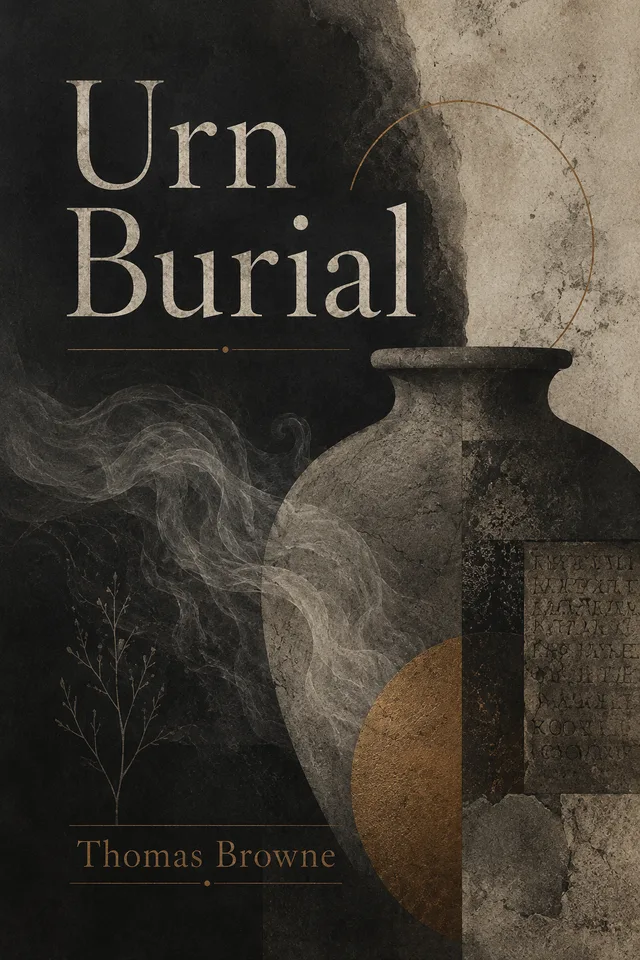
Urn Burial
Edición BooksWhale en inglés de Thomas Browne
A compact English classic on mortality, burial customs, memory, antiquity, and metaphysical prose.
- Vista previa
- Muestra del texto preparado
- Formatos
- Lector online, EPUB, PDF
- Acceso
- Claim de Biblioteca
Introducción del libro
Urn Burial
Urn Burial turns archaeological curiosity into a profound meditation on death, fame, memory, and the fragility of human monuments. Thomas Browne’s English original is a durable classic for readers of philosophical prose, seventeenth-century style, religious reflection, and literary essays.
Edición BooksWhale
Cómo se preparó esta edición
Esta edición se basa en un texto de dominio público y fue preparada por BooksWhale para lectura digital.
Base de dominio público
Por qué puede compartirse
Thomas Browne died in 1682, and Urn Burial was first published in 1658. These dates support the public-domain basis for this English original edition.
Leer vista previa
Muestra del texto preparado
Vista previa seleccionada del texto preparado.
Capítulo de vista previaFull textLeer vista previa
Urn Burial
Thomas Browne
Capítulo de vista previaCHAPTER IVista previa
IN the deep discovery of the Subterranean world, a shallow part would satisfie some enquirers, who, if two or three yards were open about the surface, would not care to wrack the bowels of ^otosi,* and regions towards *The ruh mountain of the Centre. Nature hath furnished one part of the Earth, and man another. The treasures of time lie high, in Urnes, Coynes, and Monuments, scarce below the roots of some vegetables. Time hath endlesse rarities, and showes of all varieties ; which reveals old things in heaven, makes new discoveries in earth, and even earth it self a discovery. That great antiquity (^America lay buried for a thousand years ;
and a large part of the earth is still in the Urne unto us.
Though if Q_y4dam were made out of an extract of the earth, all parts might challenge a restitution, yet few have returned their bones far lower than they might receive them, not affecting the graves of Giants under hilly and heavy coverings, but content with lesse then their own depth, have wished their bones might lie soft, and the earth be light upon them. Even such as hope to rise again, would
Hydriotaphia
not be content with central interment, or so desperately to place their refiques as to lie beyond discovery, and in no way to be seen again ; which happy contrivance hath made communication with our fore-fathers, and left unto our view some parts, which they never beheld themselves.
Though earth hath engrossed the name yet water hath proved the smartest grave; which in fourty dayes swallowed almost mankinde, and the living creation ; fishes not wholly escaping, except the salt Ocean were handsomely contempered by a mixture of the fresh Element.
Many have taken voluminous pains to determine the state of the soul upon disunion ; but men have been most phantastical in the singular contrivances of their corporal dissolution : whilest the soberest Nations have rested in two wayes, of simple inhumation and burning.
That carnal interment or burying was of the elder date, the old examples o^ay^braham and the Patriarches are sufficient to illustrate, and were v^thout competition, if it could be made out, that a^dam was buried near to Damascus, or Mount Calvary, according to some Tradition, God himself that buried but one, was pleased to make choice of this way, collectible from Scripture-expression, and the hot contest between Satan and the Arch- Angel, about discovering the body o{ (looses. But the practice of burning was also of great Antiquity, and of no slender extent. For (not to derive the fame from Hercules) noble descriptions there are hereof in the Qrecian Funeral of Homer, in the formal Obsequies of ^atroclus, and d/fchilles ; and somewhat elder in the Thehan
Urne-Buriall
war, and solemn combustion of zyideneceuSy and a^rchemoruSy contemporary unto Jair the Eighth Judge of Israel.
Confirmable also among the Trojans, from the Funeral Pyre of Hector, burnt before the gates of Troy,* and the burning of ^enthesilea the o^mazonian Queen, and long continuance of that practice in the inward Countries oi(*yIsia; while as low as the Reign of Julian,yve finde that the King ofChionia-f burnt the body of his Son, and interred the ashes in a silver Urne.
The same practice extended also far West,]; and besides Herulians, Q-etes, and Thracians, was in use with most of the Celtce, Sarmatians, Qermans, Qauls, T>anes, Swedes, 1{orwegians ; not to omit some use thereof among Carthaginians and Qy4mericans : of greater antiquity among the 'Romanes then most opinion, or *P/mjv seems to allow. For ( beside the old Table Laws of burning § or burying within the City, of making the Funeral fire with plained wood, or quenching the fire with wine) ^^JManlius the Consul burnt the body of his son ; ^I{uma by special clause of his will, was not burnt but buried ; And T^emus was solemnly buried, according to the description of Ovid. \ \
Capítulo de vista previaCHAPTER IIVista previa
THE Solemnities, Ceremonies, Rites of their cremation or interment, so solemnly delivered by Authours, we shall not disparage our Reader to repeat. Only the last and lasting part of their Urnes, collected bones and Ashes, we cannot wholly omit, or decline that Subject, which occasion lately presented, in some discovered among us.
In a Field of old Walsingham, not many months past, were digged up between forty and fifty Urnes, deposited in a dry and sandy soile, not a yard deep, not far from one another : not all strictly of one figure, but most answering these described ; some containing two pounds of bones, distinguishable in skulls, ribs, jawes, thigh-bones, and teeth, with fresh impressions of their combustion. Besides the extraneous substances, like pieces of small boxes, or combs handsomely wrought, handles of small brasse instruments, brazen nippers, and in one some kind of Opale.* */« one sent me by my
Near the same plot of ground, for about six yards com-
worthy friend Dr.
Thomas Whitherley
passe were digged up coals and incinerated substances, ofWaUmgham.
lO
Hydriotaphia
which begat conjecture that this was the Ustrina or place of burning their bodies, or some sacrificing place unto the Manes, which was properly below the surface of the ground, as the Arae and Altars unto the gods and Heroes above it.
That these were the Urnes of T(omanes from the common custome and place where they were found, is no obscure conjecture, not far from a ^^^mane Garrison, and but five mile from Brancaster, set down by ancient Record under the name of Brannodunum. And where the adjoyning Town, containing seven Parishes, in no very different sound, but Saxon termination, still retaines the Name of Burnham, which being an early station, it is not improbable the neighbour parts were filled with habitations, either of 'Komanes themselves, or Brittains Romanised, which observed the '^omane customes.
Nor is it improbable that the T(omanes early possessed this Country ; for though we meet not with such strict particulars of these parts, before the new Institution of Constantine, and military charge of the Count of the Saxon shore, and that about the Saxon Invasions, the 1)almatian Horsemen were in the Garrison of Branchaster, yet in the time of Claudius, Vespasian, and Severus, we finde no lesse then three Legions dispersed through the Province of Brittain. And as high as the Reign of Claudius a great overthrow was given unto the Iceni, by the '\l^omane Lieutenant Ostorius. Not long after the Country was so molested, that in hope of a better state Trasutagus bequeathed his King-
Urne-Buriall
dom unto ISlero and his Daughters ; and Boadicea his Queen fought the last decisive Battle with Taulinus. After which time and Conquest o^oyTgricola the Lieutenant of Vespasian, probable it is they wholly possessed this Countrey, ordering it into Garrisons or Habitations, best suitable with their securities. And so some ^^^omane habitations not improbable in these parts, as high as the time of Vespasian, where the Saxons after seated, in whose thin-fill'd Mappes we yet finde the Name of fValsingham. Now if the Iceni were but Cf-ammadims, (^Anconians, or men that lived in an Angle wedge or Elbow of Brittain, according to the Original Etymologic, this countrey will challenge the Emphatical appellation, as most properly making the Elbow or Iken of Icenia.
That Brittain was notably populous is undeniable, from that expression of Caesar.* That the '^^omanes themselves were early in no small numbers. Seventy Thousand with their associates slain by Boadicea, affords a sure account.
And though many '\^omane habitations are now known, yet some by old works, Rampiers, Coynes, and Umes do testifie their possessions. Some Urnes have been found at Castor, some also about South-creeke and not many years past, no lesse then ten in a field at Buxtone,-^ not nere any recorded Garrison. Nor is it strange to finde '^^omane Coynes of Copper and Silver among us ; of Vespasian, Trajan, (^Adrian, Commodus, oytntoninus, Severus, &c. But the greater number of 'Dioclesian, Constantine, Constans, Valens, with many of Victorinus Tosthumius, Tetricus, and the thirty Tyrants
Índice
Dentro de esta edición
- 01Full text
- 02CHAPTER I
- 03CHAPTER II
- 04Liv.
- 05CHAPTER III
- 06CHAPTER IV
- 07CHAPTER V
Disponibilidad de idiomas
Otros idiomas
Aún no hay otras ediciones lingüísticas publicadas. Esta sección enlazará las disponibles.
Solicitar otro idioma