anglais Édition
Littérature
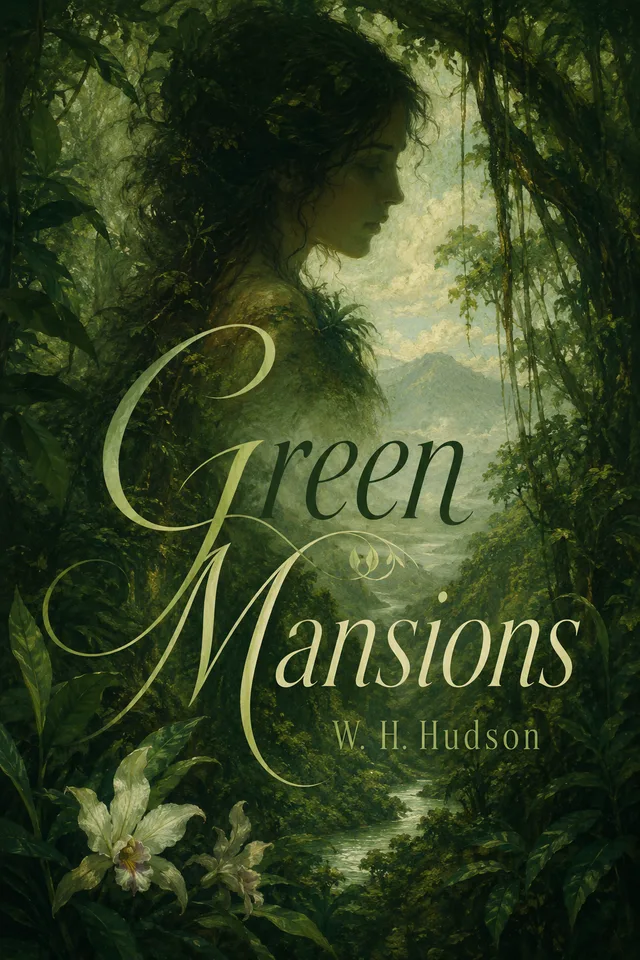
Green Mansions
Édition BooksWhale en anglais par W. H. Hudson
Hudson’s romantic forest novel of exile, mystery, nature, and the unforgettable Rima.
- Aperçu
- Extrait du texte préparé
- Formats
- Lecteur en ligne, EPUB, PDF
- Accès
- Claim Bibliothèque
Introduction du livre
Green Mansions
Green Mansions follows Abel through the forests of South America, where encounter, exile, natural wonder, and impossible love shape a haunting romance. This original English edition serves readers of adventure, ecological imagination, and classic nature-infused fiction.
Édition BooksWhale
Préparation de cette édition
Cette édition repose sur un texte du domaine public et a été préparée par BooksWhale pour la lecture numérique.
Base du domaine public
Pourquoi cette édition peut être partagée
W. H. Hudson died in 1922, and Green Mansions was first published in 1904; these dates support the public-domain basis for this original English edition.
Lire l'aperçu
Extrait du texte préparé
Aperçu sélectionné depuis le texte de lecture préparé.
Chapitre d'aperçuPart 1Lire l'aperçu
Green Mansions
W. H. Hudson
GREEN MANSIONS
A Romance of the Tropical Forest
by W. H. Hudson
FOREWORD
I take up pen for this foreword with the fear of one who knows that he cannot do justice to his subject, and the trembling of one who would not, for a good deal, set down words unpleasing to the eye of him who wrote Green Mansions, The Purple Land, and all those other books which have meant so much to me. For of all living authors--now that Tolstoi has gone I could least dispense with W. H. Hudson. Why do I love his writing so? I think because he is, of living writers that I read, the rarest spirit, and has the clearest gift of conveying to me the nature of that spirit. Writers are to their readers little new worlds to be explored; and each traveller in the realms of literature must needs have a favourite hunting-ground, which, in his good will--or perhaps merely in his egoism--he would wish others to share with him.
The great and abiding misfortunes of most of us writers are twofold: We are, as worlds, rather common tramping-ground for our readers, rather tame territory; and as guides and dragomans thereto we are too superficial, lacking clear intimacy of expression; in fact--like guide or dragoman--we cannot let folk into the real secrets, or show them the spirit, of the land.
Now, Hudson, whether in a pure romance like this Green Mansions, or in that romantic piece of realism The Purple Land, or in books like Idle Days in Patagonia, Afoot in England, The Land’s End, Adventures among Birds, A Shepherd’s Life, and all his other nomadic records of communings with men, birds, beasts, and Nature, has a supreme gift of disclosing not only the thing he sees but the spirit of his vision.
Without apparent effort he takes you with him into a rare, free, natural world, and always you are refreshed, stimulated, enlarged, by going there.
He is of course a distinguished naturalist, probably the most acute, broad-minded, and understanding observer of Nature living. And this, in an age of specialism, which loves to put men into pigeonholes and label them, has been a misfortune to the reading public, who seeing the label Naturalist, pass on, and take down the nearest novel. Hudson has indeed the gifts and knowledge of a Naturalist, but that is a mere fraction of his value and interest. A really great writer such as this is no more to be circumscribed by a single word than America by the part of it called New York. The expert knowledge which Hudson has of Nature gives to all his work backbone and surety of fibre, and to his sense of beauty an intimate actuality. But his real eminence and extraordinary attraction lie in his spirit and philosophy. We feel from his writings that he is nearer to Nature than other men, and yet more truly civilized. The competitive, towny culture, the queer up-to-date commercial knowingness with which we are so busy coating ourselves simply will not stick to him. A passage in his Hampshire Days describes him better than I can: “The blue sky, the brown soil beneath, the grass, the trees, the animals, the wind, and rain, and stars are never strange to me; for I am in and of and am one with them; and my flesh and the soil are one, and the heat in my blood and in the sunshine are one, and the winds and the tempests and my passions are one. I feel the ‘strangeness’ only with regard to my fellow men, especially in towns, where they exist in conditions unnatural to me, but congenial to them.... In such moments we sometimes feel a kinship with, and are strangely drawn to, the dead, who were not as these; the long, long dead, the men who knew not life in towns, and felt no strangeness in sun and wind and rain.” This unspoiled unity with Nature pervades all his writings; they are remote from the fret and dust and pettiness of town life; they are large, direct, free.
Chapitre d'aperçuPart 2Aperçu
It grieved me to note this, but I dropped no hint of such a feeling, and would never have spoken about it but for a quarrel which came at last to make the one brief solitary break in that close friendship of years.
I got into a bad state of health, and Abel was not only much concerned about it, but annoyed, as if I had not treated him well by being ill, and he would even say that I could get well if I wished to. I did not take this seriously, but one morning, when calling to see me at the office, he attacked me in a way that made me downright angry with him.
He told me that indolence and the use of stimulants was the cause of my bad health. He spoke in a mocking way, with a presence of not quite meaning it, but the feeling could not be wholly disguised. Stung by his reproaches, I blurted out that he had no right to talk to me, even in fun, in such a way. Yes, he said, getting serious, he had the best right--that of our friendship. He would be no true friend if he kept his peace about such a matter. Then, in my haste, I retorted that to me the friendship between us did not seem so perfect and complete as it did to him. One condition of friendship is that the partners in it should be known to each other. He had had my whole life and mind open to him, to read it as in a book. HIS life was a closed and clasped volume to me.
His face darkened, and after a few moments’ silent reflection he got up and left me with a cold good-bye, and without that hand-grasp which had been customary between us.
After his departure I had the feeling that a great loss, a great calamity, had befallen me, but I was still smarting at his too candid criticism, all the more because in my heart I acknowledged its truth.
And that night, lying awake, I repented of the cruel retort I had made, and resolved to ask his forgiveness and leave it to him to determine the question of our future relations. But he was beforehand with me, and with the morning came a letter begging my forgiveness and asking me to go that evening to dine with him.
We were alone, and during dinner and afterwards, when we sat smoking and sipping black coffee in the veranda, we were unusually quiet, even to gravity, which caused the two white-clad servants that waited on us--the brown-faced subtle-eyed old Hindu butler and an almost blue-black young Guiana Negro--to direct many furtive glances at their master’s face.
They were accustomed to see him in a more genial mood when he had a friend to dine. To me the change in his manner was not surprising: from the moment of seeing him I had divined that he had determined to open the shut and clasped volume of which I had spoken--that the time had now come for him to speak.
CHAPTER I
Now that we are cool, he said, and regret that we hurt each other, I am not sorry that it happened. I deserved your reproach: a hundred times I have wished to tell you the whole story of my travels and adventures among the savages, and one of the reasons which prevented me was the fear that it would have an unfortunate effect on our friendship. That was precious, and I desired above everything to keep it. But I must think no more about that now. I must think only of how I am to tell you my story. I will begin at a time when I was twenty-three. It was early in life to be in the thick of politics, and in trouble to the extent of having to fly my country to save my liberty, perhaps my life.
Chapitre d'aperçuPart 3Aperçu
During the tedious interval of waiting on the Chunapay I was told a flattering tale by the village Indians, which eventually caused me to abandon the proposed journey to the Rio Negro. These Indians wore necklets, like nearly all the Guayana savages; but one, I observed, possessed a necklet unlike that of the others, which greatly aroused my curiosity. It was made of thirteen gold plates, irregular in form, about as broad as a man’s thumb-nail, and linked together with fibres. I was allowed to examine it, and had no doubt that the pieces were of pure gold, beaten flat by the savages. When questioned about it, they said it was originally obtained from the Indians of Parahuari, and Parahuari, they further said, was a mountainous country west of the Orinoco. Every man and woman in that place, they assured me, had such a necklet. This report inflamed my mind to such a degree that I could not rest by night or day for dreaming golden dreams, and considering how to get to that rich district, unknown to civilized men. The Indians gravely shook their heads when I tried to persuade them to take me. They were far enough from the Orinoco, and Parahuari was ten, perhaps fifteen, days’ journey further on--a country unknown to them, where they had no relations.
In spite of difficulties and delays, however, and not without pain and some perilous adventures, I succeeded at last in reaching the upper Orinoco, and, eventually, in crossing to the other side. With my life in my hand I struggled on westward through an unknown difficult country, from Indian village to village, where at any moment I might have been murdered with impunity for the sake of my few belongings. It is hard for me to speak a good word for the Guayana savages; but I must now say this of them, that they not only did me no harm when I was at their mercy during this long journey, but they gave me shelter in their villages, and fed me when I was hungry, and helped me on my way when I could make no return. You must not, however, run away with the idea that there is any sweetness in their disposition, any humane or benevolent instincts such as are found among the civilized nations: far from it. I regard them now, and, fortunately for me, I regarded them then, when, as I have said, I was at their mercy, as beasts of prey, plus a cunning or low kind of intelligence vastly greater than that of the brute; and, for only morality, that respect for the rights of other members of the same family, or tribe, without which even the rudest communities cannot hold together. How, then, could I do this thing, and dwell and travel freely, without receiving harm, among tribes that have no peace with and no kindly feelings towards the stranger, in a district where the white man is rarely or never seen? Because I knew them so well. Without that knowledge, always available, and an extreme facility in acquiring new dialects, which had increased by practice until it was almost like intuition, I should have fared badly after leaving the Maquiritari tribe. As it was, I had two or three very narrow escapes.
To return from this digression. I looked at last on the famous Parahuari mountains, which, I was greatly surprised to find, were after all nothing but hills, and not very high ones. This, however, did not impress me. The very fact that Parahuari possessed no imposing feature in its scenery seemed rather to prove that it must be rich in gold: how else could its name and the fame of its treasures be familiar to people dwelling so far away as the Cunucumana?
But there was no gold. I searched through the whole range, which was about seven leagues long, and visited the villages, where I talked much with the Indians, interrogating them, and they had no necklets of gold, nor gold in any form; nor had they ever heard of its presence in Parahuari or in any other place known to them.
Table des matières
Dans cette édition
- 01Part 1
- 02Part 2
- 03Part 3
- 04Part 4
- 05Part 5
- 06Part 6
- 07Part 7
- 08Part 8
- 09Part 9
- 10Part 10
- 11Part 11
- 12Part 12
- 13Part 13
- 14Part 14
- 15Part 15
- 16Part 16
- 17Part 17
- 18Part 18
- 19Part 19
- 20Part 20
- 21Part 21
- 22Part 22
- 23Part 23
- 24Part 24
- 25Part 25
- 26Part 26
- 27Part 27
- 28Part 28
- 29Part 29
Disponibilité linguistique
Autres langues
Aucune autre édition linguistique n'est encore publiée. Cette section les reliera lorsqu'elles seront disponibles.
Demander une autre langue