anglais Édition
Littérature
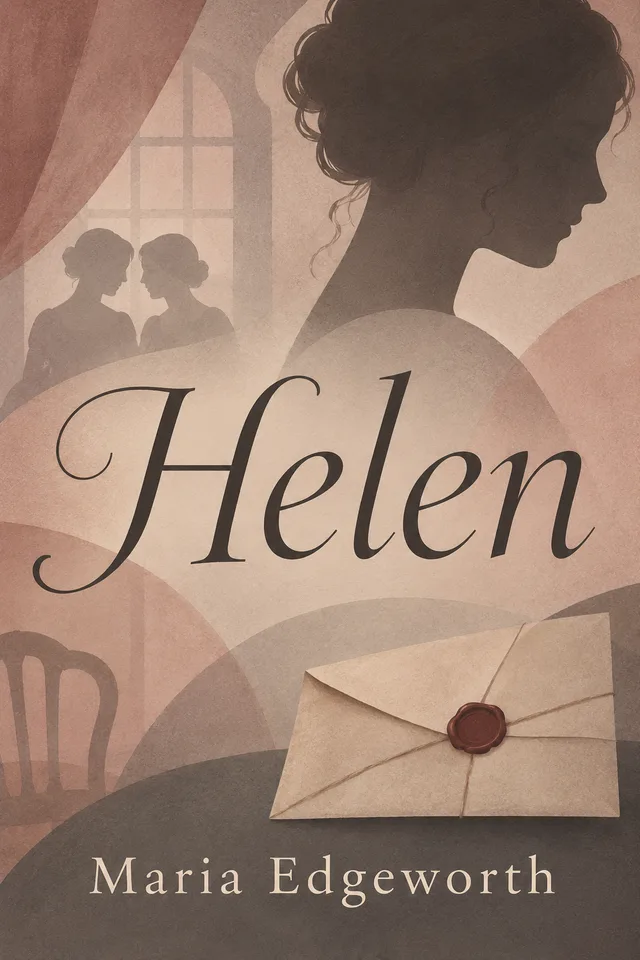
Helen
Édition BooksWhale en anglais par Maria Edgeworth
A young woman’s loyalty to her closest friend exposes her to gossip and tests the price of telling the truth.
- Aperçu
- Extrait du texte préparé
- Formats
- Lecteur en ligne, EPUB, PDF
- Accès
- Claim Bibliothèque
Introduction du livre
Helen
After losing her uncle and guardian, Helen Stanley joins the household of her friend Cecilia. Requests for discretion soon draw her into secrets that threaten her reputation and test her friendship with Cecilia and Lady Davenant. Edgeworth uses dinners, letters, and private conversations to show how deception gathers force. The edition includes all forty-seven chapters across the three volumes.
Édition BooksWhale
Préparation de cette édition
Cette édition repose sur un texte du domaine public et a été préparée par BooksWhale pour la lecture numérique.
Base du domaine public
Pourquoi cette édition peut être partagée
Maria Edgeworth died in 1849. The original English text was published in 1834.
Lire l'aperçu
Extrait du texte préparé
Aperçu sélectionné depuis le texte de lecture préparé.
Chapitre d'aperçuFull textLire l'aperçu
Helen
Chapitre d'aperçuCHAPTER I · Volume the FirstAperçu
“There is Helen in the lime-walk,” said Mrs. Collingwood to her husband, as she looked out of the window. The slight figure of a young person in deep mourning appeared between the trees,—“How slowly she walks! She looks very unhappy!”
“Yes,” said Mr. Collingwood, with a sigh, “she is young to know sorrow, and to struggle with difficulties to which she is quite unsuited both by nature and by education, difficulties which no one could ever have foreseen. How changed are all her prospects!”
“Changed indeed!” said Mrs. Collingwood, “pretty young creature!—Do you recollect how gay she was when first we came to Cecilhurst? and even last year, when she had hopes of her uncle’s recovery, and when he talked of taking her to London, how she enjoyed the thoughts of going there! The world was bright before her then. How cruel of that uncle, with all his fondness for her, never to think what was to become of her the moment he was dead: to breed her up as an heiress, and leave her a beggar!”
“But what is to be done, my dear?” said her husband.
“I am sure I do not know; I can only feel for her, you must think for her.”
“Then I think I must tell her directly of the state in which her uncle’s affairs are left, and that there is no provision for her.”
“Not yet, my dear,” said Mrs. Collingwood: “I don’t mean about there being no provision for herself, that would not strike her, but her uncle’s debts,—there is the point: she would feel dreadfully the disgrace to his memory—she loved him so tenderly!”
“Yet it must be told,” said Mr. Collingwood, resolutely “and perhaps it will be better now; she will feel it less, while her mind is absorbed by grief for him.”
Helen was the only daughter of colonel and Lady Anne Stanley; her parents had both died when she was too young to know her loss, nor had she ever felt till now that she was an orphan, for she had been adopted and brought up with the greatest tenderness by her uncle, Dean Stanley, a man of genius, learning, and sincere piety, with the most affectionate heart, and a highly cultivated understanding. But on one subject he really had not common sense; in money matters he was inconceivably imprudent and extravagant; extravagant from charity, from taste, from habit. He possessed rich benefices in the church, and an ample private fortune, and it was expected that his niece would be a great heiress—he had often said so himself, and his fondness for her confirmed every one in this belief. But the dean’s taste warred against his affection: his too hospitable, magnificent establishment had exceeded his income; he had too much indulged his passion for all the fine arts, of which he was a liberal patron: he had collected a magnificent library, and had lavished immense sums of money on architectural embellishments. Cursed with too fine a taste, and with too soft a heart—a heart too well knowing how to yield, never could he deny himself, much less any other human being, any gratification which money could command; and soon the necessary consequence was, that he had no money to command, his affairs fell into embarrassment—his estate was sold; but, as he continued to live with his accustomed hospitality and splendour, the world believed him to be as rich as ever.
Some rise superior from the pressure of pecuniary difficulties, but that was not the case with Dean Stanley, not from want of elasticity of mind; but perhaps because his ingenuity continually suggested resources, and his sanguine character led him to plunge into speculations—they failed, and in the anxiety and agitation which his embarrassments occasioned him, he fell into bad health, his physicians ordered him to Italy. Helen, his devoted nurse, the object upon which all his affections centered, accompanied him to Florence. There his health and spirits seemed at first, by the change of climate, to be renovated; but in Italy he found fresh temptations to extravagance, his learning and his fancy combined to lead him on from day to day to new expense, and he satisfied his conscience by saying to himself that all the purchases which he now made were only so much capital, which would, when sold in England, bring more than their original price, and would, he flattered himself, increase the fortune he intended for his niece. But one day, while he was actually bargaining for an antique, he was seized with a fit of apoplexy. From this fit he recovered, and was able to return to England with his niece. Here he found his debts and difficulties had been increasing; he was harassed with doubts as to the monied value of his last-chosen chef-d’oeuvres; his mind preyed upon his weakened frame, he was seized with another fit, lost his speech, and, after struggles the most melancholy for Helen to see, conscious as she was that she could do nothing for him—he expired—his eyes fixed on her face, and his powerless hand held between both hers.
Chapitre d'aperçuCHAPTER II · Volume the FirstAperçu
Some time after this, Mr. Collingwood, rising from the breakfast-table, threw down the day’s paper, saying there was nothing in it; Mrs. Collingwood glancing her eye over it exclaimed—
“Do you call this nothing? Helen, hear this!
“Marriage in high life—At the ambassador’s chapel, Paris, on the 16th instant, General Clarendon to Lady Cecilia Davenant, only daughter of Earl and Countess Davenant.”
“Married! absolutely married!” exclaimed Helen: “I knew it was to be, but so soon I did not expect. Ambassador’s chapel—where did you say?—Paris? No, that must be a mistake, they are all at Florence—settled there, I thought their letters said.”
Mrs. Collingwood pointed to the paragraph, and Helen saw it was certainly Paris—there could be no mistake. Here was a full account of the marriage, and a list of all “the fashionables who attended the fair bride to the hymeneal altar. Her father gave her away.”
“Then certainly it is so,” said Helen; and she came to the joyful conclusion that they must all be on their way home:—“Dear Lady Davenant coming to Cecilhurst again!”
Lady Cecilia, “the fair bride,” had been Helen’s most intimate friend; they had been when children much together, for the deanery was so close to Cecilhurst, that the shrubbery opened into the park. “But is it not rather extraordinary, my dear. Helen,” said Mrs. Collingwood, “that you should see this account of your dear Lady Cecilia’s marriage in the public papers only, without having heard of it from any of your friends themselves—not one letter, not one line from any of them?”
A cloud came over Helen’s face, but it passed quickly, and she was sure they had written—something had delayed their letters. She was certain Lady Davenant or Lady Cecilia had written; or, if they had not, it was because they could not possibly, in such a hurry, such agitation as they must have been in. At all events, whether they had written or not, she was certain they could not mean anything unkind; she could not change her opinion of her friend for a letter more or less. “Indeed!” said Mrs. Collingwood, “how long is it since you have seen them?”
“About two years; just two years it is since I parted from them at Florence.”
“And you have corresponded with Lady Cecilia constantly ever since?” asked Mrs. Collingwood.
“Not constantly.”
“Not constantly—oh!” said Mrs. Collingwood, in a prolonged and somewhat sarcastic tone.
“Not constantly—so much the better,” said her husband: “a constant correspondence is always a great burthen, and moreover, sometimes a great evil, between young ladies especially—I hate the sight of ladies’ long cross-barred letters.”
Helen said that Lady Cecilia’s letters were never cross-barred, always short and far between.
“You seem wonderfully fond of Lady Cecilia,” said Mrs. Collingwood.
“Not wonderfully,” replied Helen, “but very fond, and no wonder, we were bred up together. And”—continued she, after a little pause, “and if Lady Cecilia had not been so generous as she is, she might have been—she must have been, jealous of the partiality, the fondness, which her mother always showed me.”
“But was not Lady Davenant’s heart large enough to hold two?” asked Mrs. Collingwood. “Was not she fond of her daughter?”
“Yes, as far as she knew her, but she did not know Lady Cecilia.”
“Not know her own daughter!” Mr. and Mrs. Collingwood both at once exclaimed, “How could that possibly be?”
“Very easily,” Helen said, “because she saw so little of her.”
“Was not Lady Cecilia educated at home?”
“Yes, but still Lady Cecilia, when a child, was all day long with her governess, and at Cecilhurst the governess’s apartments were quite out of the way, in one of the wings at the end of a long corridor, with a separate staircase; she might as well have been in another house.”
Table des matières
Dans cette édition
- 01Full text
- 02CHAPTER I · Volume the First
- 03CHAPTER II · Volume the First
- 04CHAPTER III · Volume the First
- 05CHAPTER IV · Volume the First
- 06CHAPTER V · Volume the First
- 07CHAPTER VI · Volume the First
- 08CHAPTER VII · Volume the First
- 09CHAPTER VIII · Volume the First
- 10CHAPTER IX · Volume the First
- 11CHAPTER X · Volume the First
- 12CHAPTER XI · Volume the First
- 13CHAPTER XII · Volume the First
- 14CHAPTER XIII · Volume the First
- 15CHAPTER XIV · Volume the First
- 16CHAPTER XV · Volume the First
- 17CHAPTER XVI · Volume the First
- 18CHAPTER I · Volume the Second
- 19CHAPTER II · Volume the Second
- 20CHAPTER III · Volume the Second
- 21CHAPTER IV · Volume the Second
- 22CHAPTER V · Volume the Second
- 23CHAPTER VI · Volume the Second
- 24CHAPTER VII · Volume the Second
- 25CHAPTER VIII · Volume the Second
- 26CHAPTER IX · Volume the Second
- 27CHAPTER X · Volume the Second
- 28CHAPTER XI · Volume the Second
- 29CHAPTER XII · Volume the Second
- 30CHAPTER XIII · Volume the Second
- 31CHAPTER XIV · Volume the Second
- 32CHAPTER XV · Volume the Second
- 33CHAPTER XVI · Volume the Second
- 34CHAPTER I · Volume the Third
- 35CHAPTER II · Volume the Third
- 36CHAPTER III · Volume the Third
- 37CHAPTER IV · Volume the Third
- 38CHAPTER V · Volume the Third
- 39CHAPTER VI · Volume the Third
- 40CHAPTER VII · Volume the Third
- 41CHAPTER VIII · Volume the Third
- 42CHAPTER IX · Volume the Third
- 43CHAPTER X · Volume the Third
- 44CHAPTER XI · Volume the Third
- 45CHAPTER XII · Volume the Third
- 46CHAPTER XIII · Volume the Third
- 47CHAPTER XIV · Volume the Third
- 48CHAPTER XV · Volume the Third
Disponibilité linguistique
Autres langues
Aucune autre édition linguistique n'est encore publiée. Cette section les reliera lorsqu'elles seront disponibles.
Demander une autre langue