anglais Édition
Littérature
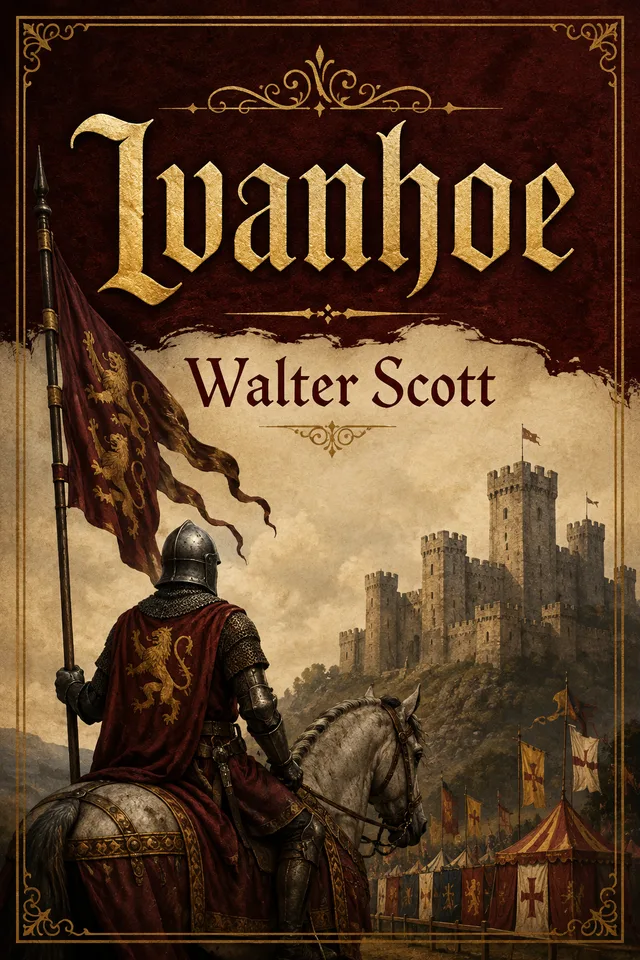
Ivanhoe
Édition BooksWhale en anglais par Walter Scott
Walter Scott’s medieval romance of knights, Saxons, Normans, tournaments, outlaw bands, and the return of Richard the Lionheart.
- Aperçu
- Extrait du texte préparé
- Formats
- Lecteur en ligne, EPUB, PDF
- Accès
- Claim Bibliothèque
Introduction du livre
Ivanhoe
Ivanhoe is one of Walter Scott’s best-known historical novels, set in twelfth-century England amid conflict between Saxon and Norman society. Its tournaments, sieges, disguises, Robin Hood episodes, and figures such as Rebecca, Rowena, and Richard the Lionheart helped shape the modern medieval romance and the popular image of chivalric England.
Édition BooksWhale
Préparation de cette édition
Cette édition repose sur un texte du domaine public et a été préparée par BooksWhale pour la lecture numérique.
Base du domaine public
Pourquoi cette édition peut être partagée
Author died in 1832; original English text is in the public domain.
Lire l'aperçu
Extrait du texte préparé
Aperçu sélectionné depuis le texte de lecture préparé.
Chapitre d'aperçuIvanhoeLire l'aperçu
Now fitted the halter, now traversed the cart,
And often took leave,—but seemed loath to depart! 1
—Prior.
INTRODUCTION TO IVANHOE.
The Author of the Waverley Novels had hitherto proceeded in an unabated
course of popularity, and might, in his peculiar district of
literature, have been termed _L’Enfant Gâté_ of success. It was plain,
however, that frequent publication must finally wear out the public
favour, unless some mode could be devised to give an appearance of
novelty to subsequent productions. Scottish manners, Scottish dialect,
and Scottish characters of note, being those with which the author was
most intimately, and familiarly acquainted, were the groundwork upon
which he had hitherto relied for giving effect to his narrative. It
was, however, obvious, that this kind of interest must in the end
occasion a degree of sameness and repetition, if exclusively resorted
to, and that the reader was likely at length to adopt the language of
Edwin, in Parnell’s Tale:
“‘Reverse the spell,’ he cries,
‘And let it fairly now suffice.
The gambol has been shown.’”
Nothing can be more dangerous for the fame of a professor of the fine
arts, than to permit (if he can possibly prevent it) the character of a
mannerist to be attached to him, or that he should be supposed capable
of success only in a particular and limited style. The public are, in
general, very ready to adopt the opinion, that he who has pleased them
in one peculiar mode of composition, is, by means of that very talent,
rendered incapable of venturing upon other subjects. The effect of this
disinclination, on the part of the public, towards the artificers of
their pleasures, when they attempt to enlarge their means of amusing,
may be seen in the censures usually passed by vulgar criticism upon
actors or artists who venture to change the character of their efforts,
that, in so doing, they may enlarge the scale of their art.
There is some justice in this opinion, as there always is in such as
attain general currency. It may often happen on the stage, that an
actor, by possessing in a preeminent degree the external qualities
necessary to give effect to comedy, may be deprived of the right to
aspire to tragic excellence; and in painting or literary composition,
an artist or poet may be master exclusively of modes of thought, and
powers of expression, which confine him to a single course of subjects.
But much more frequently the same capacity which carries a man to
popularity in one department will obtain for him success in another,
and that must be more particularly the case in literary composition,
than either in acting or painting, because the adventurer in that
department is not impeded in his exertions by any peculiarity of
features, or conformation of person, proper for particular parts, or,
by any peculiar mechanical habits of using the pencil, limited to a
particular class of subjects.
Whether this reasoning be correct or otherwise, the present author
felt, that, in confining himself to subjects purely Scottish, he was
not only likely to weary out the indulgence of his readers, but also
greatly to limit his own power of affording them pleasure. In a highly
polished country, where so much genius is monthly employed in catering
for public amusement, a fresh topic, such as he had himself had the
happiness to light upon, is the untasted spring of the desert;—
“Men bless their stars and call it luxury.”
But when men and horses, cattle, camels, and dromedaries, have poached
the spring into mud, it becomes loathsome to those who at first drank
of it with rapture; and he who had the merit of discovering it, if he
would preserve his reputation with the tribe, must display his talent
by a fresh discovery of untasted fountains.
If the author, who finds himself limited to a particular class of
Chapitre d'aperçuvolume of my Tale, in case the printer’s devil should continueAperçu
impatient for copy, when the whole of my narrative has been imposed.
Adieu, my dear friend; I have said enough to explain, if not to
vindicate, the attempt which I have made, and which, in spite of your
doubts, and my own incapacity, I am still willing to believe has not
been altogether made in vain.
I hope you are now well recovered from your spring fit of the gout, and
shall be happy if the advice of your learned physician should recommend
a tour to these parts. Several curiosities have been lately dug up near
the wall, as well as at the ancient station of Habitancum. Talking of
the latter, I suppose you have long since heard the news, that a sulky
churlish boor has destroyed the ancient statue, or rather bas-relief,
popularly called Robin of Redesdale. It seems Robin’s fame attracted
more visitants than was consistent with the growth of the heather, upon
a moor worth a shilling an acre. Reverend as you write yourself, be
revengeful for once, and pray with me that he may be visited with such
a fit of the stone, as if he had all the fragments of poor Robin in
that region of his viscera where the disease holds its seat. Tell this
not in Gath, lest the Scots rejoice that they have at length found a
parallel instance among their neighbours, to that barbarous deed which
demolished Arthur’s Oven. But there is no end to lamentation, when we
betake ourselves to such subjects. My respectful compliments attend
Miss Dryasdust; I endeavoured to match the spectacles agreeable to her
commission, during my late journey to London, and hope she has received
them safe, and found them satisfactory. I send this by the blind
carrier, so that probably it may be some time upon its journey. 6
The last news which I hear from Edinburgh is, that the gentleman who
fills the situation of Secretary to the Society of Antiquaries of
Scotland, 7 is the best amateur draftsman in that kingdom, and that
much is expected from his skill and zeal in delineating those specimens
of national antiquity, which are either mouldering under the slow touch
of time, or swept away by modern taste, with the same besom of
destruction which John Knox used at the Reformation. Once more adieu;
“vale tandem, non immemor mei”. Believe me to be,
Reverend, and very dear Sir,
Your most faithful humble Servant.
Laurence Templeton.
Toppingwold, near Egremont, Cumberland, Nov. 17, 1817.
IVANHOE.
Chapitre d'aperçuCHAPTER IAperçu
Thus communed these; while to their lowly dome,
The full-fed swine return’d with evening home;
Compell’d, reluctant, to the several sties,
With din obstreperous, and ungrateful cries.
POPE’S ODYSSEY
In that pleasant district of merry England which is watered by the
river Don, there extended in ancient times a large forest, covering the
greater part of the beautiful hills and valleys which lie between
Sheffield and the pleasant town of Doncaster. The remains of this
extensive wood are still to be seen at the noble seats of Wentworth, of
Warncliffe Park, and around Rotherham. Here haunted of yore the
fabulous Dragon of Wantley; here were fought many of the most desperate
battles during the Civil Wars of the Roses; and here also flourished in
ancient times those bands of gallant outlaws, whose deeds have been
rendered so popular in English song.
Such being our chief scene, the date of our story refers to a period
towards the end of the reign of Richard I., when his return from his
long captivity had become an event rather wished than hoped for by his
despairing subjects, who were in the meantime subjected to every
species of subordinate oppression. The nobles, whose power had become
exorbitant during the reign of Stephen, and whom the prudence of Henry
the Second had scarce reduced to some degree of subjection to the
crown, had now resumed their ancient license in its utmost extent;
despising the feeble interference of the English Council of State,
fortifying their castles, increasing the number of their dependants,
reducing all around them to a state of vassalage, and striving by every
means in their power, to place themselves each at the head of such
forces as might enable him to make a figure in the national convulsions
which appeared to be impending.
The situation of the inferior gentry, or Franklins, as they were
called, who, by the law and spirit of the English constitution, were
entitled to hold themselves independent of feudal tyranny, became now
unusually precarious. If, as was most generally the case, they placed
themselves under the protection of any of the petty kings in their
vicinity, accepted of feudal offices in his household, or bound
themselves by mutual treaties of alliance and protection, to support
him in his enterprises, they might indeed purchase temporary repose;
but it must be with the sacrifice of that independence which was so
dear to every English bosom, and at the certain hazard of being
involved as a party in whatever rash expedition the ambition of their
protector might lead him to undertake. On the other hand, such and so
multiplied were the means of vexation and oppression possessed by the
great Barons, that they never wanted the pretext, and seldom the will,
to harass and pursue, even to the very edge of destruction, any of
their less powerful neighbours, who attempted to separate themselves
from their authority, and to trust for their protection, during the
dangers of the times, to their own inoffensive conduct, and to the laws
of the land.
A circumstance which greatly tended to enhance the tyranny of the
nobility, and the sufferings of the inferior classes, arose from the
consequences of the Conquest by Duke William of Normandy. Four
generations had not sufficed to blend the hostile blood of the Normans
and Anglo-Saxons, or to unite, by common language and mutual interests,
two hostile races, one of which still felt the elation of triumph,
while the other groaned under all the consequences of defeat. The power
had been completely placed in the hands of the Norman nobility, by the
event of the battle of Hastings, and it had been used, as our histories
assure us, with no moderate hand. The whole race of Saxon princes and
nobles had been extirpated or disinherited, with few or no exceptions;
nor were the numbers great who possessed land in the country of their
Table des matières
Dans cette édition
- 01Ivanhoe
- 02volume of my Tale, in case the printer’s devil should continue
- 03CHAPTER I
- 04CHAPTER II
- 05CHAPTER III
- 06part of the Saxon, with the addition, “I wish her devotion may choose
- 07Palestine.”
- 08CHAPTER IV
- 09Rowena.”
- 10Saladin.”
- 11Oswald.”
- 12CHAPTER V
- 13Sepulchre?”
- 14Jew.”
- 15Cross!”
- 16Europe.”
- 17Father Aymer?”
- 18CHAPTER VI
- 19part of the sentence, his original terror appeared to revive in full
- 20CHAPTER VII
- 21Montdidier?”
- 22Alderman.”
- 23CHAPTER VIII
- 24CHAPTER IX
- 25Beauty.”
- 26CHAPTER X
- 27part at least to his benefactor, or as a donation to his agent. His
- 28CHAPTER XI
- 29CHAPTER XII
- 30part of the conflict, their efforts to meet were unavailing, and they
- 31CHAPTER XIII
- 32part,” he said, “and in the land where he was bred, men would as soon
- 33CHAPTER XIV
- 34CHAPTER XV
- 35Saracens?”
- 36Companions.”
- 37Rowena.”
- 38Chapter of his Order in his single person, he dared not do me such an
- 39CHAPTER XVI
- 40part of the day, the spectators had entitled, “Le Noir Faineant”. This
- 41CHAPTER XVII
- 42CHAPTER XVIII
- 43CHAPTER XIX
- 44CHAPTER XX
- 45Jorvaulx.”
- 46Friar?”
- 47CHAPTER XXI
- 48Norway?’
- 49CHAPTER XXII
- 50CHAPTER XXIII
- 51CHAPTER XXIV
- 52Temple.”
- 53CHAPTER XXV
- 54Copmanhurst.”
- 55Christian.”
- 56CHAPTER XXVI
- 57England!”
- 58part of a friar to accept refreshment, if you are offered any.”
- 59CHAPTER XXVII
- 60Dei’—-”
- 61CHAPTER XXVIII
- 62CHAPTER XXIX
- 63CHAPTER XXX
- 64CHAPTER XXXI
- 65Bracy.”
- 66CHAPTER XXXII.
- 67part of the booty, which was brought into one common mass, to be at the
- 68CHAPTER XXXIII
- 69Prior.”
- 70Jew.”
- 71Egypt.”
- 72CHAPTER XXXIV
- 73Spyinghow.”
- 74CHAPTER XXXV
- 75Rebecca.”
- 76Order!”
- 77Temple.”
- 78Bois-Guilbert?”
- 79Jorvaulx.”
- 80CHAPTER XXXVI
- 81Preceptor.”
- 82Preceptory?”
- 83CHAPTER XXXVII
- 84part, who had been inclined to smile at the statute ‘De osculis
- 85CHAPTER XXXVIII
- 86God.”
- 87CHAPTER XXXIX
- 88part in what is to follow.”
- 89CHAPTER XL
- 90Nicholas.”
- 91CHAPTER XLI
- 92CHAPTER XLII
- 93Hengist!”
- 94CHAPTER XLIII
- 95Dunstan.”
- 96Friar.’”
- 97CHAPTER XLIV
- 98High Treason.”
- 99Templars!”
- 100volume), by Richard Thomson.
- 101Note F.—Heraldry
- 102Additional Note
- 103[ Note B. Negro Slaves.]
- 104[ Pillage.]
- 105L. T.]
- 106Abbey.]
- 107[ Note C. Minstrelsy.]
- 108T.]
- 109[ Note F. Heraldry]
- 110[ Note I. Hedge-Priests.]
- 111T.]
- 112[ Infamous.]
Disponibilité linguistique
Autres langues
Aucune autre édition linguistique n'est encore publiée. Cette section les reliera lorsqu'elles seront disponibles.
Demander une autre langue