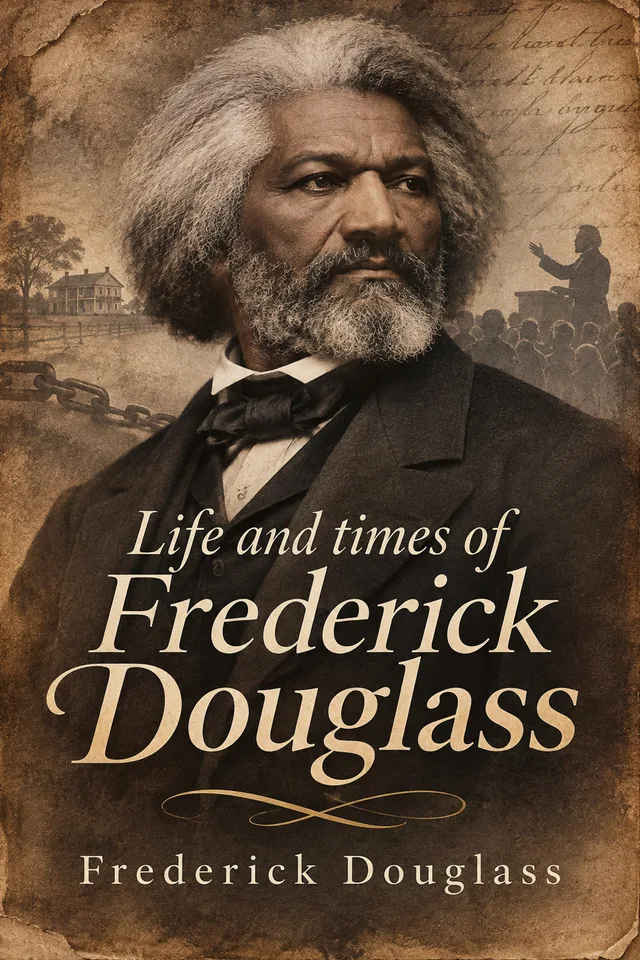
anglais Édition
Histoire
Life and times of Frederick Douglass
Édition BooksWhale en anglais par Frederick Douglass
Douglass recounts enslavement, his escape, his work in the abolitionist movement, and his public life after emancipation.
- Aperçu
- Extrait du texte préparé
- Formats
- Lecteur en ligne, EPUB, PDF
- Accès
- Claim Bibliothèque
Introduction du livre
Life and times of Frederick Douglass
Douglass recounts enslavement, his escape, his work in the abolitionist movement, and his public life after emancipation. This edition follows the historical 1881 text, with two parts and an appendix. The narrative moves from childhood in Maryland to escape, public speaking, political disputes, and the difficult struggle to make freedom effective.
Édition BooksWhale
Préparation de cette édition
Cette édition repose sur un texte du domaine public et a été préparée par BooksWhale pour la lecture numérique.
Base du domaine public
Pourquoi cette édition peut être partagée
The original work by Frederick Douglass is in the public domain in the United States. This edition uses the historical English text from Project Gutenberg and excludes modern editorial material.
Lire l'aperçu
Extrait du texte préparé
Aperçu sélectionné depuis le texte de lecture préparé.
Chapitre d'aperçuLIFE AS A SLAVE.Lire l'aperçu
LIFE AS A SLAVE.
Chapitre d'aperçuCHAPTER I. AUTHOR’S BIRTH.Aperçu
Author’s place of birth—Description of country—Its Inhabitants—Genealogical trees—Method of counting time in slave districts—Date of author’s birth—Names of grandparents—Their cabin—Home with them—Slave practice of separating mothers from their children—Author’s recollections of his mother—Who was his father?
In Talbot County, Eastern Shore, State of Maryland, near Easton, the county town, there is a small district of country, thinly populated, and remarkable for nothing that I know of more than for the worn-out, sandy, desert-like appearance of its soil, the general dilapidation of its farms and fences, the indigent and spiritless character of its inhabitants, and the prevalence of ague and fever. It was in this dull, flat, and unthrifty district or neighborhood, bordered by the Choptank river, among the laziest and muddiest of streams surrounded by a white population of the lowest order, indolent and drunken to a proverb, and among slaves who, in point of ignorance and indolence, were fully in accord with their surroundings, that I, without any fault of my own, was born, and spent the first years of my childhood.
The reader must not expect me to say much of my family. Genealogical trees did not flourish among slaves. A person of some consequence in civilized society, sometimes designated as father, was literally unknown to slave law and slave practice. I never met with a slave in that part of the country who could tell me with any certainty how old he was. Few at that time knew anything of the months of the year or of the days of the month. They measured the ages of their children by spring-time, winter-time, harvest-time, planting-time, and the like. Masters allowed no questions to be put to them by slaves concerning their ages. Such questions were regarded by the masters as evidence of an impudent curiosity. From certain events, however, the dates of which I have since learned, I suppose myself to have been born in February, 1817.
My first experience of life, as I now remember it, and I remember it but hazily, began in the family of my grandmother and grandfather, Betsey and Isaac Bailey. They were considered old settlers in the neighborhood, and from certain circumstances I infer that my grandmother, especially, was held in high esteem, far higher than was the lot of most colored persons in that region. She was a good nurse, and a capital hand at making nets used for catching shad and herring, and was, withal, somewhat famous as a fisherwoman. I have known her to be in the water waist deep, for hours, seine-hauling. She was a gardener as well as a fisherwoman, and remarkable for her success in keeping her seedling sweet potatoes through the months of winter, and easily got the reputation of being born to “good luck.” In planting time Grandmother Betsey was sent for in all directions, simply to place the seedling potatoes in the hills or drills; for superstition had it that her touch was needed to make them grow. This reputation was full of advantage to her and her grandchildren, for a good crop, after her planting for the neighbors, brought her a share of the harvest.
Whether because she was too old for field service, or because she had so faithfully discharged the duties of her station in early life, I know not, but she enjoyed the high privilege of living in a cabin separate from the quarters, having only the charge of the young children and the burden of her own support imposed upon her. She esteemed it great good fortune to live so, and took much comfort in having the children. The practice of separating mothers from their children and hiring them out at distances too great to admit of their meeting, save at long intervals, was a marked feature of the cruelty and barbarity of the slave system; but it was in harmony with the grand aim of that system, which always and everywhere sought to reduce man to a level with the brute. It had no interest in recognizing or preserving any of the ties that bind families together or to their homes.
Chapitre d'aperçuCHAPTER II. REMOVAL FROM GRANDMOTHER’S.Aperçu
Author’s early home—Its charms—Author’s ignorance of “old master”—His gradual perception of the truth concerning him—His relations to Col. Edward Lloyd—Author’s removal to “old master’s” home—His journey thence—His separation from his grandmother—His grief.
Living thus with my grandmother, whose kindness and love stood in place of my mother’s, it was some time before I knew myself to be a slave. I knew many other things before I knew that. Her little cabin had to me the attractions of a palace. Its fence-railed floor—which was equally floor and bedstead—up stairs, and its clay floor down stairs, its dirt and straw chimney, and windowless sides, and that most curious piece of workmanship, the ladder stairway, and the hole so strangely dug in front of the fire-place, beneath which grandmamma placed her sweet potatoes, to keep them from frost in winter, were full of interest to my childish observation. The squirrels, as they skipped the fences, climbed the trees, or gathered their nuts, were an unceasing delight to me. There, too, right at the side of the hut, stood the old well, with its stately and skyward-pointing beam, so aptly placed between the limbs of what had once been a tree, and so nicely balanced, that I could move it up and down with only one hand, and could get a drink myself without calling for help. Nor were these all the attractions of the place. At a little distance stood Mr. Lee’s mill, where the people came in large numbers to get their corn ground. I can never tell the many things thought and felt, as I sat on the bank and watched that mill, and the turning of its ponderous wheel. The mill-pond, too, had its charms; and with my pin-hook and thread line I could get amusing nibbles if I could catch no fish.
It was not long, however, before I began to learn the sad fact that this house of my childhood belonged not to my dear old grandmother, but to some one I had never seen, and who lived a great distance off. I learned, too, the sadder fact, that not only the home and lot, but that grandmother herself and all the little children around her belonged to a mysterious personage, called by grandmother, with every mark of reverence, “Old Master.” Thus early did clouds and shadows begin to fall upon my path.
I learned that this old master, whose name seemed ever to be mentioned with fear and shuddering, only allowed the little children to live with grandmother for a limited time, and that as soon as they were big enough they were promptly taken away to live with the said old master. These were distressing revelations indeed. My grandmother was all the world to me, and the thought of being separated from her was a most unwelcome suggestion to my affections and hopes. This mysterious old master was really a man of some consequence. He owned several farms in Tuckahoe, was the chief clerk and butler on the home plantation of Colonel Lloyd, had overseers as well as slaves on his own farms, and gave directions to the overseers on the farms owned by Colonel Lloyd. Captain Aaron Anthony, for such is the name and title of my old master, lived on Colonel Lloyd’s plantation, which was situated on the Wye river, and which was one of the largest, most fertile, and best appointed in the State.
About this plantation and this old master I was most eager to know everything which could be known; and, unhappily for me, all the information I could get concerning him increased my dread of being separated from my grandmother and grandfather. I wished it was possible I could remain small all my life, knowing that the sooner I grew large the shorter would be my time to remain with them. Everything about the cabin became doubly dear, and I was sure there could be no other spot equal to it on earth. But the time came when I must go, and my grandmother, knowing my fears, in pity for them, kindly kept me ignorant of the dreaded moment up to the morning (a beautiful summer morning) when we were to start, and, indeed, during the whole journey, which, child as I was, I remember as well as if it were yesterday, she kept the unwelcome truth hidden from me. The distance from Tuckahoe to Colonel Lloyd’s, where my old master lived, was full twelve miles, and the walk was quite a severe test of the endurance of my young legs. The journey would have proved too severe for me, but that my dear old grandmother (blessings on her memory) afforded occasional relief by “toteing” me on her shoulder. Advanced in years as she was, as was evident from the more than one gray hair which peeped from between the ample and graceful folds of her newly and smoothly ironed bandana turban, grandmother was yet a woman of power and spirit. She was remarkably straight in figure, elastic and muscular in movement. I seemed hardly to be a burden to her. She would have “toted” me farther, but I felt myself too much of a man to allow it. Yet while I walked I was not independent of her. She often found me holding her skirts lest something should come out of the woods and eat me up. Several old logs and stumps imposed upon me, and got themselves taken for enormous animals. I could plainly see their legs, eyes, ears, and teeth, till I got close enough to see that the eyes were knots, washed white with rain, and the legs were broken limbs, and the ears and teeth only such because of the point from which they were seen.
Table des matières
Dans cette édition
- 01LIFE AS A SLAVE.
- 02CHAPTER I. AUTHOR’S BIRTH.
- 03CHAPTER II. REMOVAL FROM GRANDMOTHER’S.
- 04CHAPTER III. TROUBLES OF CHILDHOOD.
- 05CHAPTER IV. A GENERAL SURVEY OF THE SLAVE PLANTATION.
- 06CHAPTER V. A SLAVEHOLDER’S CHARACTER.
- 07CHAPTER VI. A CHILD’S REASONING.
- 08CHAPTER VII. LUXURIES AT THE GREAT HOUSE.
- 09CHAPTER VIII CHARACTERISTICS OF OVERSEERS.
- 10CHAPTER IX. CHANGE OF LOCATION.
- 11CHAPTER X. LEARNING TO READ.
- 12CHAPTER XI. GROWING IN KNOWLEDGE.
- 13CHAPTER XII. RELIGIOUS NATURE AWAKENED.
- 14CHAPTER XIII. THE VICISSITUDES OF SLAVE LIFE.
- 15CHAPTER XIV. EXPERIENCE IN ST. MICHAELS.
- 16CHAPTER XV. COVEY, THE NEGRO BREAKER.
- 17CHAPTER XVI. ANOTHER PRESSURE OF THE TYRANT’S VICE.
- 18CHAPTER XVII. THE LAST FLOGGING.
- 19CHAPTER XVIII. NEW RELATIONS AND DUTIES.
- 20CHAPTER XIX. THE RUNAWAY PLOT.
- 21CHAPTER XX. APPRENTICESHIP LIFE.
- 22CHAPTER XXI. ESCAPE FROM SLAVERY.
- 23SECOND PART
- 24CHAPTER I. ESCAPE FROM SLAVERY.
- 25CHAPTER II. LIFE AS A FREEMAN.
- 26CHAPTER III. INTRODUCED TO THE ABOLITIONISTS.
- 27CHAPTER IV. RECOLLECTIONS OF OLD FRIENDS.
- 28CHAPTER V. ONE HUNDRED CONVENTIONS.
- 29CHAPTER VI. IMPRESSIONS ABROAD.
- 30CHAPTER VII. TRIUMPHS AND TRIALS.
- 31CHAPTER VIII. JOHN BROWN AND MRS. STOWE.
- 32CHAPTER IX. INCREASING DEMANDS OF THE SLAVE POWER.
- 33CHAPTER X. THE BEGINNING OF THE END.
- 34CHAPTER XI. SECESSION AND WAR
- 35CHAPTER XII. HOPE FOR THE NATION.
- 36CHAPTER XIII. VAST CHANGES.
- 37CHAPTER XIV. LIVING AND LEARNING.
- 38CHAPTER XV. WEIGHED IN THE BALANCE.
- 39CHAPTER XVI. “TIME MAKES ALL THINGS EVEN.”
- 40CHAPTER XVII. INCIDENTS AND EVENTS.
- 41CHAPTER XVIII. “HONOR TO WHOM HONOR.”
- 42CHAPTER XIX. RETROSPECTION.
- 43CONCLUSION.
- 44APPENDIX.
- 45WEST INDIA EMANCIPATION.
Disponibilité linguistique
Autres langues
Aucune autre édition linguistique n'est encore publiée. Cette section les reliera lorsqu'elles seront disponibles.
Demander une autre langue