anglais Édition
Littérature
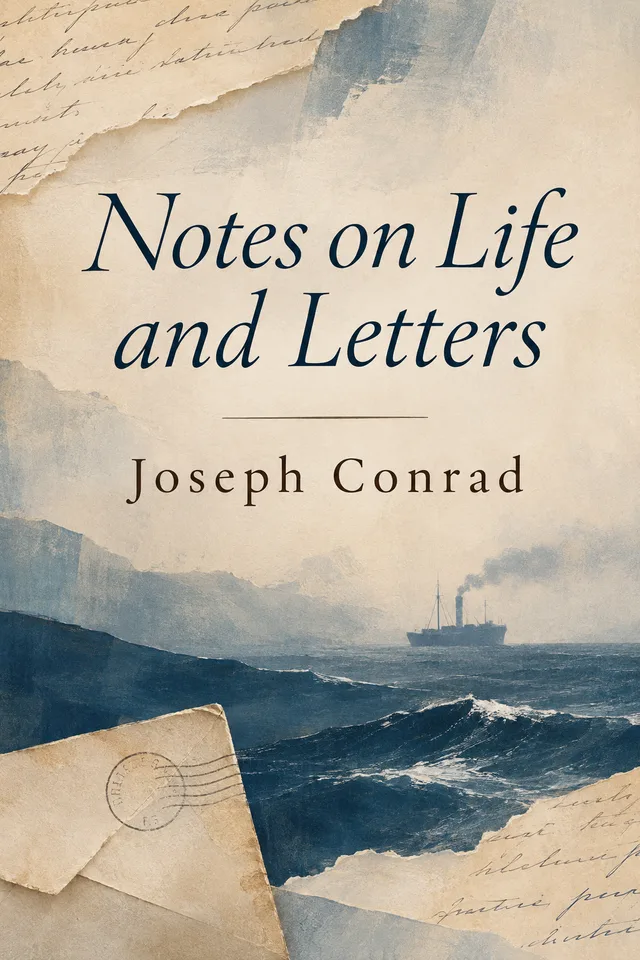
Notes on Life and Letters
Édition BooksWhale en anglais par Joseph Conrad
Conrad reflects on fellow writers, seafaring, war, Poland, and public life in twenty-six essays across two complementary sections.
- Aperçu
- Extrait du texte préparé
- Formats
- Lecteur en ligne, EPUB, PDF
- Accès
- Claim Bibliothèque
Introduction du livre
Notes on Life and Letters
Joseph Conrad’s collection divides into Letters and Life, bringing together literary appreciations and reflections on the world beyond books. Essays on writers sit beside accounts of the sea, the First World War, and Poland’s historical experience. Across twenty-six pieces, Conrad examines artistic responsibility, national identity, memory, and the pressures that shape individual judgment.
Édition BooksWhale
Préparation de cette édition
Cette édition repose sur un texte du domaine public et a été préparée par BooksWhale pour la lecture numérique.
Base du domaine public
Pourquoi cette édition peut être partagée
Joseph Conrad died in 1924. This edition uses the original English text supplied by Project Gutenberg, identified there as public domain in the United States, without added illustrations or editorial notes.
Lire l'aperçu
Extrait du texte préparé
Aperçu sélectionné depuis le texte de lecture préparé.
Chapitre d'aperçuFull textLire l'aperçu
Notes on Life and Letters
Joseph Conrad
Chapitre d'aperçuAUTHOR’S NOTEAperçu
I don’t know whether I ought to offer an apology for this collection which has more to do with life than with letters. Its appeal is made to orderly minds. This, to be frank about it, is a process of tidying up, which, from the nature of things, cannot be regarded as premature. The fact is that I wanted to do it myself because of a feeling that had nothing to do with the considerations of worthiness or unworthiness of the small (but unbroken) pieces collected within the covers of this volume. Of course it may be said that I might have taken up a broom and used it without saying anything about it. That, certainly, is one way of tidying up.
But it would have been too much to have expected me to treat all this matter as removable rubbish. All those things had a place in my life. Whether any of them deserve to have been picked up and ranged on the shelf—this shelf—I cannot say, and, frankly, I have not allowed my mind to dwell on the question. I was afraid of thinking myself into a mood that would hurt my feelings; for those pieces of writing, whatever may be the comment on their display, appertain to the character of the man.
And so here they are, dusted, which was but a decent thing to do, but in no way polished, extending from the year ’98 to the year ’20, a thin array (for such a stretch of time) of really innocent attitudes: Conrad literary, Conrad political, Conrad reminiscent, Conrad controversial. Well, yes! A one-man show—or is it merely the show of one man?
The only thing that will not be found amongst those Figures and Things that have passed away, will be Conrad en pantoufles. It is a constitutional inability. Schlafrock und pantoffeln! Not that! Never! . . . I don’t know whether I dare boast like a certain South American general who used to say that no emergency of war or peace had ever found him “with his boots off”; but I may say that whenever the various periodicals mentioned in this book called on me to come out and blow the trumpet of personal opinions or strike the pensive lute that speaks of the past, I always tried to pull on my boots first. I didn’t want to do it, God knows! Their Editors, to whom I beg to offer my thanks here, made me perform mainly by kindness but partly by bribery. Well, yes! Bribery? What can you expect? I never pretended to be better than the people in the next street, or even in the same street.
This volume (including these embarrassed introductory remarks) is as near as I shall ever come to dêshabillé in public; and perhaps it will do something to help towards a better vision of the man, if it gives no more than a partial view of a piece of his back, a little dusty (after the process of tidying up), a little bowed, and receding from the world not because of weariness or misanthropy but for other reasons that cannot be helped: because the leaves fall, the water flows, the clock ticks with that horrid pitiless solemnity which you must have observed in the ticking of the hall clock at home. For reasons like that. Yes! It recedes. And this was the chance to afford one more view of it—even to my own eyes.
The section within this volume called Letters explains itself, though I do not pretend to say that it justifies its own existence. It claims nothing in its defence except the right of speech which I believe belongs to everybody outside a Trappist monastery. The part I have ventured, for shortness’ sake, to call Life, may perhaps justify itself by the emotional sincerity of the feelings to which the various papers included under that head owe their origin. And as they relate to events of which everyone has a date, they are in the nature of sign-posts pointing out the direction my thoughts were compelled to take at the various cross-roads. If anybody detects any sort of consistency in the choice, this will be only proof positive that wisdom had nothing to do with it. Whether right or wrong, instinct alone is invariable; a fact which only adds a deeper shade to its inherent mystery. The appearance of intellectuality these pieces may present at first sight is merely the result of the arrangement of words. The logic that may be found there is only the logic of the language. But I need not labour the point. There will be plenty of people sagacious enough to perceive the absence of all wisdom from these pages. But I believe sufficiently in human sympathies to imagine that very few will question their sincerity. Whatever delusions I may have suffered from I have had no delusions as to the nature of the facts commented on here. I may have misjudged their import: but that is the sort of error for which one may expect a certain amount of toleration.
Chapitre d'aperçuPART I—LETTERSAperçu
PART I—LETTERS
Table des matières
Dans cette édition
- 01Full text
- 02AUTHOR’S NOTE
- 03PART I—LETTERS
- 04BOOKS—1905.
- 05I.
- 06II.
- 07III.
- 08HENRY JAMES—AN APPRECIATION—1905
- 09ALPHONSE DAUDET—1898
- 10GUY DE MAUPASSANT—1904
- 11ANATOLE FRANCE—1904
- 12I.—“CRAINQUEBILLE”
- 13II.—“L’ÎLE DES PINGOUINS”
- 14TURGENEV —1917
- 15STEPHEN CRANE—A NOTE WITHOUT DATES—1919
- 16TALES OF THE SEA—1898
- 17AN OBSERVER IN MALAYA —1898
- 18A HAPPY WANDERER—1910
- 19THE LIFE BEYOND—1910
- 20THE ASCENDING EFFORT—1910
- 21THE CENSOR OF PLAYS—AN APPRECIATION—1907
- 22PART II—LIFE
- 23AUTOCRACY AND WAR—1905
- 24THE CRIME OF PARTITION—1919
- 25A NOTE ON THE POLISH PROBLEM—1916
- 26POLAND REVISITED—1915
- 27I.
- 28II.
- 29III.
- 30IV.
- 31FIRST NEWS—1918
- 32WELL DONE—1918
- 33I.
- 34II.
- 35III.
- 36TRADITION—1918
- 37CONFIDENCE—1919
- 38I.
- 39II.
- 40III.
- 41FLIGHT—1917
- 42SOME REFLECTIONS ON THE LOSS OF THE TITANIC—1912
- 43CERTAIN ASPECTS OF THE ADMIRABLE INQUIRY INTO THE LOSS OF THE TITANIC—1912
- 44PROTECTION OF OCEAN LINERS —1914
- 45A FRIENDLY PLACE
Disponibilité linguistique
Autres langues
Aucune autre édition linguistique n'est encore publiée. Cette section les reliera lorsqu'elles seront disponibles.
Demander une autre langue