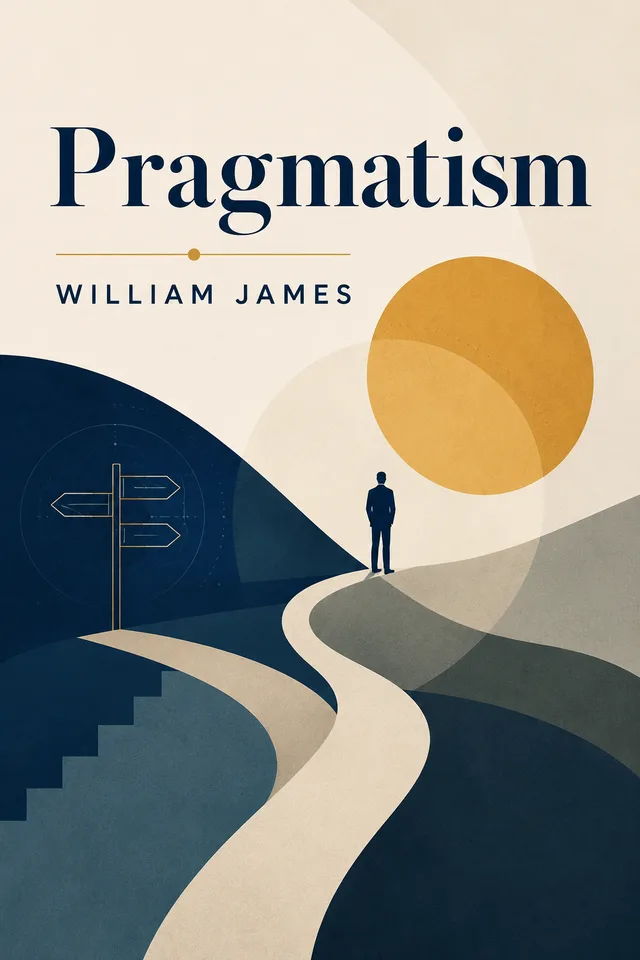
anglais Édition
Philosophie
Pragmatism
Édition BooksWhale en anglais par William James
James’s accessible lectures on truth, belief, experience, pluralism, religion, and practical consequences.
- Aperçu
- Extrait du texte préparé
- Formats
- Lecteur en ligne, EPUB, PDF
- Accès
- Claim Bibliothèque
Introduction du livre
Pragmatism
Pragmatism presents William James’s influential account of ideas as instruments tested by experience and consequences. Written as public lectures, it connects truth, belief, temperament, religion, science, and pluralism, making the book a central entry point for American philosophy and modern debates about meaning.
Édition BooksWhale
Préparation de cette édition
Cette édition repose sur un texte du domaine public et a été préparée par BooksWhale pour la lecture numérique.
Base du domaine public
Pourquoi cette édition peut être partagée
William James died in 1910, and Pragmatism was first published in 1907. These dates support the public-domain basis for this English original edition.
Lire l'aperçu
Extrait du texte préparé
Aperçu sélectionné depuis le texte de lecture préparé.
Chapitre d'aperçuFull textLire l'aperçu
Pragmatism
William James
Chapitre d'aperçuPRAGMATISMAperçu
A New Name for Some Old Ways of Thinking
By William James
To the Memory of John Stuart Mill
from whom I first learned the pragmatic openness of mind and whom my
fancy likes to picture as our leader were he alive to-day.
Chapitre d'aperçuPrefaceAperçu
The lectures that follow were delivered at the Lowell Institute in
Boston in November and December, 1906, and in January, 1907, at
Columbia University, in New York. They are printed as delivered, without
developments or notes. The pragmatic movement, so-called--I do not like
the name, but apparently it is too late to change it--seems to have
rather suddenly precipitated itself out of the air. A number of
tendencies that have always existed in philosophy have all at once
become conscious of themselves collectively, and of their combined
mission; and this has occurred in so many countries, and from so many
different points of view, that much unconcerted statement has resulted.
I have sought to unify the picture as it presents itself to my own eyes,
dealing in broad strokes, and avoiding minute controversy. Much futile
controversy might have been avoided, I believe, if our critics had been
willing to wait until we got our message fairly out.
If my lectures interest any reader in the general subject, he will
doubtless wish to read farther. I therefore give him a few references.
In America, John Dewey's 'Studies in Logical Theory' are the foundation.
Read also by Dewey the articles in the Philosophical Review, vol.
xv, pp. 113 and 465, in Mind, vol. xv, p. 293, and in the Journal of
Philosophy, vol. iv, p. 197.
Probably the best statements to begin with however, are F. C. S.
Schiller's in his 'Studies in Humanism,' especially the essays numbered
i, v, vi, vii, xviii and xix. His previous essays and in general
the polemic literature of the subject are fully referred to in his
footnotes.
Furthermore, see G. Milhaud: le Rationnel, 1898, and the fine articles
by Le Roy in the Revue de Metaphysique, vols. 7, 8 and 9. Also articles
by Blondel and de Sailly in the Annales de Philosophie Chretienne, 4me
Serie, vols. 2 and 3. Papini announces a book on Pragmatism, in the
French language, to be published very soon.
To avoid one misunderstanding at least, let me say that there is no
logical connexion between pragmatism, as I understand it, and a doctrine
which I have recently set forth as 'radical empiricism.' The latter
stands on its own feet. One may entirely reject it and still be a
pragmatist.
Harvard University, April, 1907.
Table des matières
Dans cette édition
- 01Full text
- 02PRAGMATISM
- 03Preface
- 04Lecture I
- 05PRAGMATISM
- 06Lecture I
- 07THE TENDER-MINDED
- 08THE TOUGH-MINDED
- 09THEM. ...
- 10Lecture II
- 11THEORIES THUS BECOME INSTRUMENTS, NOT ANSWERS TO ENIGMAS, IN WHICH
- 12LOOKING TOWARDS LAST THINGS, FRUITS, CONSEQUENCES, FACTS.
- 13PARTS OF OUR EXPERIENCE) BECOME TRUE JUST IN SO FAR AS THEY HELP US TO
- 14THEY WILL BE TRUE, FOR PRAGMATISM, IN THE SENSE OF BEING GOOD FOR SO
- 15MUCH. FOR HOW MUCH MORE THEY ARE TRUE, WILL DEPEND ENTIRELY ON THEIR
- 16RELATIONS TO THE OTHER TRUTHS THAT ALSO HAVE TO BE ACKNOWLEDGED.
- 17INDEED, BELIEF IN IT INCIDENTALLY CLASHED WITH OTHER GREATER VITAL
- 18BENEFITS.
- 19Lecture III
- 20Lecture IV
- 21US?
- 22Lecture V
- 23Lecture VI
- 24ARE THOSE THAT WE CAN ASSIMILATE, VALIDATE, CORROBORATE AND VERIFY.
- 25INTO SUCH WORKING TOUCH WITH IT AS TO HANDLE EITHER IT OR SOMETHING
- 26THAT THEY HAVE NOTHING TO DO WITH OUR PRACTICAL INTERESTS OR PERSONAL
- 27Lecture VII
- 28THE ALTERNATIVE BETWEEN PRAGMATISM AND RATIONALISM, IN THE SHAPE IN
- 29KNOWLEDGE, IT CONCERNS THE STRUCTURE OF THE UNIVERSE ITSELF.
- 30Lecture VIII
Disponibilité linguistique
Autres langues
Aucune autre édition linguistique n'est encore publiée. Cette section les reliera lorsqu'elles seront disponibles.
Demander une autre langue