anglais Édition
Littérature
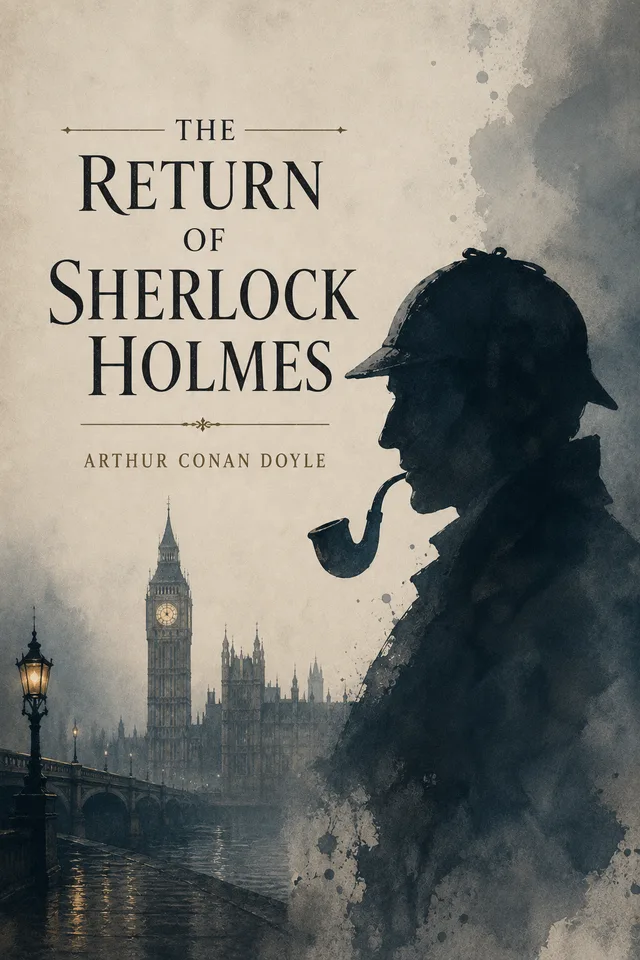
The Return of Sherlock Holmes
Édition BooksWhale en anglais par Arthur Conan Doyle
A collection of Sherlock Holmes stories marking the detective’s dramatic return.
- Aperçu
- Extrait du texte préparé
- Formats
- Lecteur en ligne, EPUB, PDF
- Accès
- Claim Bibliothèque
Introduction du livre
The Return of Sherlock Holmes
The Return of Sherlock Holmes gathers cases of disguise, danger, deduction, and criminal ingenuity after Holmes’s apparent death. The collection helped renew one of fiction’s most enduring detectives.
Édition BooksWhale
Préparation de cette édition
Cette édition repose sur un texte du domaine public et a été préparée par BooksWhale pour la lecture numérique.
Base du domaine public
Pourquoi cette édition peut être partagée
Arthur Conan Doyle died in 1930, and The Return of Sherlock Holmes was first published in 1905; these dates support the public-domain basis for this English edition.
Lire l'aperçu
Extrait du texte préparé
Aperçu sélectionné depuis le texte de lecture préparé.
Chapitre d'aperçuFull textLire l'aperçu
The Return of Sherlock Holmes
Arthur Conan Doyle
Chapitre d'aperçuThe Adventure Of The Empty HouseAperçu
It was in the spring of the year 1894 that all London was interested, and the fashionable world dismayed, by the murder of the Honourable Ronald Adair under most unusual and inexplicable circumstances. The public has already learned those particulars of the crime which came out in the police investigation, but a good deal was suppressed upon that occasion, since the case for the prosecution was so overwhelmingly strong that it was not necessary to bring forward all the facts. Only now, at the end of nearly ten years, am I allowed to supply those missing links which make up the whole of that remarkable chain. The crime was of interest in itself, but that interest was as nothing to me compared to the inconceivable sequel, which afforded me the greatest shock and surprise of any event in my adventurous life. Even now, after this long interval, I find myself thrilling as I think of it, and feeling once more that sudden flood of joy, amazement, and incredulity which utterly submerged my mind. Let me say to that public, which has shown some interest in those glimpses which I have occasionally given them of the thoughts and actions of a very remarkable man, that they are not to blame me if I have not shared my knowledge with them, for I should have considered it my first duty to do so, had I not been barred by a positive prohibition from his own lips, which was only withdrawn upon the third of last month.
It can be imagined that my close intimacy with Sherlock Holmes had interested me deeply in crime, and that after his disappearance I never failed to read with care the various problems which came before the public. And I even attempted, more than once, for my own private satisfaction, to employ his methods in their solution, though with indifferent success. There was none, however, which appealed to me like this tragedy of Ronald Adair. As I read the evidence at the inquest, which led up to a verdict of willful murder against some person or persons unknown, I realized more clearly than I had ever done the loss which the community had sustained by the death of Sherlock Holmes. There were points about this strange business which would, I was sure, have specially appealed to him, and the efforts of the police would have been supplemented, or more probably anticipated, by the trained observation and the alert mind of the first criminal agent in Europe. All day, as I drove upon my round, I turned over the case in my mind and found no explanation which appeared to me to be adequate. At the risk of telling a twice-told tale, I will recapitulate the facts as they were known to the public at the conclusion of the inquest.
The Honourable Ronald Adair was the second son of the Earl of Maynooth, at that time governor of one of the Australian colonies. Adair’s mother had returned from Australia to undergo the operation for cataract, and she, her son Ronald, and her daughter Hilda were living together at 427, Park Lane. The youth moved in the best society—had, so far as was known, no enemies and no particular vices. He had been engaged to Miss Edith Woodley, of Carstairs, but the engagement had been broken off by mutual consent some months before, and there was no sign that it had left any very profound feeling behind it. For the rest, the man’s life moved in a narrow and conventional circle, for his habits were quiet and his nature unemotional. Yet it was upon this easy-going young aristocrat that death came, in most strange and unexpected form, between the hours of ten and eleven-twenty on the night of March 30, 1894.
Ronald Adair was fond of cards—playing continually, but never for such stakes as would hurt him. He was a member of the Baldwin, the Cavendish, and the Bagatelle card clubs. It was shown that, after dinner on the day of his death, he had played a rubber of whist at the latter club. He had also played there in the afternoon. The evidence of those who had played with him—Mr. Murray, Sir John Hardy, and Colonel Moran—showed that the game was whist, and that there was a fairly equal fall of the cards. Adair might have lost five pounds, but not more. His fortune was a considerable one, and such a loss could not in any way affect him. He had played nearly every day at one club or other, but he was a cautious player, and usually rose a winner. It came out in evidence that, in partnership with Colonel Moran, he had actually won as much as four hundred and twenty pounds in a sitting, some weeks before, from Godfrey Milner and Lord Balmoral. So much for his recent history as it came out at the inquest.
Chapitre d'aperçuThe Adventure Of The Norwood BuilderAperçu
“From the point of view of the criminal expert,” said Mr. Sherlock Holmes, “London has become a singularly uninteresting city since the death of the late lamented Professor Moriarty.”
“I can hardly think that you would find many decent citizens to agree with you,” I answered.
“Well, well, I must not be selfish,” said he, with a smile, as he pushed back his chair from the breakfast-table. “The community is certainly the gainer, and no one the loser, save the poor out-of-work specialist, whose occupation has gone. With that man in the field, one’s morning paper presented infinite possibilities. Often it was only the smallest trace, Watson, the faintest indication, and yet it was enough to tell me that the great malignant brain was there, as the gentlest tremors of the edges of the web remind one of the foul spider which lurks in the centre. Petty thefts, wanton assaults, purposeless outrage—to the man who held the clue all could be worked into one connected whole. To the scientific student of the higher criminal world, no capital in Europe offered the advantages which London then possessed. But now——” He shrugged his shoulders in humorous deprecation of the state of things which he had himself done so much to produce.
At the time of which I speak, Holmes had been back for some months, and I at his request had sold my practice and returned to share the old quarters in Baker Street. A young doctor, named Verner, had purchased my small Kensington practice, and given with astonishingly little demur the highest price that I ventured to ask—an incident which only explained itself some years later, when I found that Verner was a distant relation of Holmes, and that it was my friend who had really found the money.
Our months of partnership had not been so uneventful as he had stated, for I find, on looking over my notes, that this period includes the case of the papers of ex-President Murillo, and also the shocking affair of the Dutch steamship _Friesland_, which so nearly cost us both our lives. His cold and proud nature was always averse, however, from anything in the shape of public applause, and he bound me in the most stringent terms to say no further word of himself, his methods, or his successes—a prohibition which, as I have explained, has only now been removed.
Mr. Sherlock Holmes was leaning back in his chair after his whimsical protest, and was unfolding his morning paper in a leisurely fashion, when our attention was arrested by a tremendous ring at the bell, followed immediately by a hollow drumming sound, as if someone were beating on the outer door with his fist. As it opened there came a tumultuous rush into the hall, rapid feet clattered up the stair, and an instant later a wild-eyed and frantic young man, pale, disheveled, and palpitating, burst into the room. He looked from one to the other of us, and under our gaze of inquiry he became conscious that some apology was needed for this unceremonious entry.
“I’m sorry, Mr. Holmes,” he cried. “You mustn’t blame me. I am nearly mad. Mr. Holmes, I am the unhappy John Hector McFarlane.”
He made the announcement as if the name alone would explain both his visit and its manner, but I could see, by my companion’s unresponsive face, that it meant no more to him than to me.
“Have a cigarette, Mr. McFarlane,” said he, pushing his case across. “I am sure that, with your symptoms, my friend Dr. Watson here would prescribe a sedative. The weather has been so very warm these last few days. Now, if you feel a little more composed, I should be glad if you would sit down in that chair, and tell us very slowly and quietly who you are, and what it is that you want. You mentioned your name, as if I should recognize it, but I assure you that, beyond the obvious facts that you are a bachelor, a solicitor, a Freemason, and an asthmatic, I know nothing whatever about you.”
Table des matières
Dans cette édition
- 01Full text
- 02The Adventure Of The Empty House
- 03The Adventure Of The Norwood Builder
- 04The Adventure Of The Dancing Men
- 05The Adventure Of The Solitary Cyclist
- 06The Adventure Of The Priory School
- 07The Adventure Of Black Peter
- 08The Adventure Of Charles Augustus Milverton
- 09The Adventure Of The Six Napoleons
- 10The Adventure Of The Three Students
- 11The Adventure Of The Golden Pince-Nez
- 12The Adventure Of The Missing Three-Quarter
- 13The Adventure Of The Abbey Grange
- 14The Adventure Of The Second Stain
Disponibilité linguistique
Autres langues
Aucune autre édition linguistique n'est encore publiée. Cette section les reliera lorsqu'elles seront disponibles.
Demander une autre langue