anglais Édition
Histoire
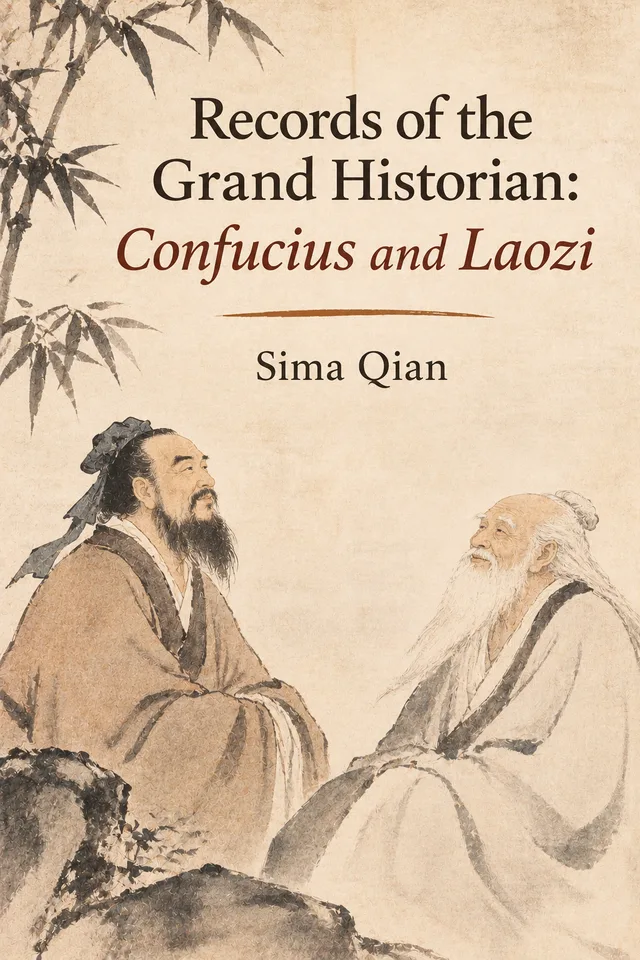
Records of the Grand Historian: Confucius and Laozi
Édition BooksWhale en anglais par Sima Qian
Titre original: 史记:孔子与老子
Five selections from Sima Qian follow Confucius and his disciples, Laozi, strategists and philosophers of early China.
- Aperçu
- Extrait du texte préparé
- Formats
- Lecteur en ligne, EPUB, PDF
- Accès
- Claim Bibliothèque
Introduction du livre
Records of the Grand Historian: Confucius and Laozi
This selection from the Records of the Grand Historian begins with Confucius and continues with Laozi and Han Feizi, Sun Tzu and Wu Qi, the disciples of Confucius, and Mencius and Xun Qing. Sima Qian puts ideas in the context of travel, patronage, war and political rivalry. The five selections bring together lives from distinct parts of the original work.
Édition BooksWhale
Préparation de cette édition
Cette édition est une traduction assistée par IA et revue par des humains, préparée par BooksWhale pour la lisibilité, la mise en forme et la cohérence.
Base du domaine public
Pourquoi cette édition peut être partagée
The historical Chinese text by Sima Qian is in the public domain. This English translation was commissioned for this edition and has been reviewed by the commissioning editor.
Lire l'aperçu
Extrait du texte préparé
Aperçu sélectionné depuis le texte de lecture préparé.
Chapitre d'aperçuConfuciusLire l'aperçu
Confucius was born in Zouyi, Changping Township, in the state of Lu. His ancestors came from the state of Song. One of them was named Kong Fangshu. Fangshu fathered Boxia, and Boxia fathered Shuliang He. When Shuliang He was already advanced in years, he entered into an irregular union with a young woman of the Yan family, and Confucius was born. Before his birth, his parents had gone to Mount Niqiu to pray to the spirits for a child. Confucius was born in the twenty-second year of Duke Xiang of Lu. At birth, the center of the top of his head was depressed, while the surrounding area was raised. He was therefore named Qiu. His courtesy name was Zhongni, and his family name was Kong.
Not long after Kong Qiu was born, Shuliang He died and was buried at Mount Fang. Mount Fang lay in the eastern part of Lu. Confucius did not know precisely where his father's grave was, because his mother had never told him its location. As a child, Confucius often played by arranging sacrificial vessels such as stands and ceremonial containers, imitating the movements and procedures of ritual offerings. After his mother died, he temporarily placed her coffin beside the road at Wufuqu in Qufu, refraining from immediate burial out of caution. The mother of Wanfu, a man from Zouyi, told Confucius where his father was buried. Only then did he move his mother's coffin to Mount Fang and bury her beside his father.
While Confucius was still wearing the hempen mourning sash, the Ji family held a banquet to entertain distinguished scholars. Confucius went to attend, but Yang Hu stopped him, saying, "The Ji family is entertaining distinguished gentlemen. We cannot allow you to take a seat." Confucius therefore withdrew.
When Confucius was seventeen, Meng Yizi, a high official of Lu, became seriously ill. He admonished his heir, Yizi, saying:
"Kong Qiu is descended from a sage, although his ancestors fell into misfortune in the state of Song. His ancestor Fufu He was originally the designated heir, but yielded the throne to his younger brother, Duke Li. Later, Zheng Kaofu served Duke Dai, Duke Wu, and Duke Xuan in succession. He received appointments on three occasions, becoming more respectful each time. Thus the inscription on his tripod reads:
"'When I received my first appointment, I bowed my head. When I received my second, I bent at the waist. When I received my third, I bowed deeply. I walked close to the walls, and no one dared to slight me. With this tripod I cook thin porridge to sustain myself.'
"Such was his reverence and frugality. I have heard that among the descendants of sages, even if they do not become rulers, there will certainly arise men of outstanding talent and virtue. Kong Qiu is young, yet he loves ritual propriety. Is he not destined to become such a distinguished man? I am near death. You must take him as your teacher."
After Meng Yizi died, his son Yizi and Nangong Jingshu of Lu went to Confucius to study ritual propriety. That same year, Ji Wuzi died, and Ji Pingzi succeeded him.
Confucius came from a poor family and occupied a humble position in society. After reaching adulthood, he served as a minor official in charge of the Ji family's granaries, where he kept accurate and fair accounts of receipts and disbursements of money and grain. He later served as an official supervising livestock, and the animals multiplied under his care. Consequently, he was promoted to the office of Sikong, responsible for construction works.
Not long afterward, he left Lu. He was rejected in Qi, driven out of Song and Wei, and surrounded and trapped between Chen and Cai. Eventually, he returned to Lu.
Confucius stood nine feet and six inches tall. People called him "the Tall Man" and regarded him as unusually different from ordinary men. Because Lu once again treated him favorably, he returned to his native state.
Chapitre d'aperçuLaozi and Han FeiziAperçu
Laozi was a native of Quren Village, Li Township, Ku County, in the state of Chu.
His family name was Li, his personal name was Er, and his courtesy name was Dan.
He served as an archivist in charge of the royal library of the Zhou dynasty.
When Confucius went to the Zhou capital, he sought Laozi's instruction concerning ritual propriety.
Laozi said:
"The people of whom you speak have long since died, and their bones have decayed. Only their words remain.
"Moreover, when a gentleman encounters favorable circumstances, he rides in a carriage and enters official service. When circumstances are unfavorable, he accepts his situation and lives accordingly.
"I have heard that a skillful merchant keeps his merchandise so carefully concealed that he appears to possess nothing.
"A gentleman of lofty virtue likewise appears outwardly dull and foolish.
"Cast aside your arrogance, excessive desires, affected manner, and extravagant ambitions. None of these things benefits you.
"That is all I have to tell you."
After Confucius left the Zhou capital, he said to his disciples:
"Birds—I know that they can fly.
"Fish—I know that they can swim.
"Beasts—I know that they can run.
"Running beasts can be caught in nets, swimming fish can be caught with fishing lines, and flying birds can be shot with arrows.
"But as for the dragon, I cannot understand how it rides the winds and clouds and ascends into Heaven.
"Today I have seen Laozi. He is probably like a dragon!"
Laozi studied the principles of the Way and virtue.
His teaching emphasized concealment of the self and freedom from the pursuit of fame and official rank.
He lived in the Zhou capital for a long time.
When he saw the Zhou dynasty declining, he decided to depart.
Upon reaching San Pass, the keeper of the pass, Yin Xi, said:
"You are about to withdraw from the world. Please make an effort to write a book for me."
Laozi then wrote a work in two parts, an upper and a lower section, containing more than five thousand characters concerning the Way and virtue.
After completing it, he departed.
No one knew where he ultimately went.
Some people say that Lao Laizi was also a native of Chu.
He wrote a book in fifteen chapters discussing the applications of Daoist teachings.
It is said that he lived during the same period as Confucius.
Laozi may have lived to be more than 160 years old.
Some say that he lived for more than 200 years.
Because he studied the Way and virtue, his health was strengthened and his life prolonged.
One hundred and twenty-nine years after Confucius died, historical records state that a Grand Historian of Zhou named Dan met Duke Xian of Qin.
He said:
"Originally, Qin and Zhou were united. After five hundred years of union, they separated. Seventy years after their separation, a hegemon and king would arise."
Some say that this Dan was Laozi; others say that he was not.
No one in the world knows which opinion is correct.
Laozi was a gentleman who lived in retirement.
Laozi had a son named Zong.
Li Zong became a general in Wei and received a fief at Duangan.
Li Zong's son was named Zhu, and Zhu's son was named Gong.
Gong's great-great-grandson was named Jia.
Jia held office during the reign of Emperor Wen of Han.
Jia's son Jie served as Grand Tutor to Liu Ang, king of Jiaoxi, and consequently settled in the territory of Qi.
Those who study Laozi's teachings reject Confucianism, while Confucian scholars likewise reject Laozi's teachings.
Does not the saying "Those whose views and principles differ cannot work together" refer precisely to such a situation?
Li Er advocated governing through nonaction, allowing the people to transform themselves naturally.
He advocated tranquility and few desires, allowing the people to return to what is right of their own accord.
Chapitre d'aperçuSun Tzu and Wu QiAperçu
Sun Tzu's personal name was Wu, and he was a native of the state of Qi. Because of his knowledge of military strategy, he was granted an audience with King Helü of Wu.
Helü said, "I have read all thirteen chapters of your treatise on warfare. Could you demonstrate your methods by training some troops?"
Sun Wu replied, "Yes."
Helü asked, "Could you conduct the experiment with women?"
Sun Wu replied, "Yes."
Helü immediately agreed and ordered the beautiful women of his palace to assemble. There were 180 women in all.
Sun Wu divided them into two companies and appointed two of the king's favorite concubines as their respective commanders. He instructed all the women to hold halberds.
Sun Wu addressed them, saying, "Do you know where your heart, your left and right hands, and your back are?"
The women answered, "Yes."
Sun Wu said, "When I command you to face forward, you must face the direction of your chest. When I command you to turn left, you must turn toward your left hand. When I command you to turn right, you must turn toward your right hand. When I command you to turn about, you must turn toward your back."
The women replied, "Yes."
After announcing the rules, Sun Wu set out the ceremonial axes used to enforce military discipline. He then repeated his instructions several times to make them perfectly clear.
He beat the drum and commanded the women to turn right.
The women burst into laughter.
Sun Wu said, "If the rules are unclear and the soldiers are unfamiliar with the commands, the fault lies with the general."
He repeated his instructions several more times and then beat the drum, ordering the women to turn left.
Again, they burst into laughter.
Sun Wu then ordered the execution of the two company commanders.
King Helü was watching from a raised platform. When he saw that his two favorite concubines were about to be executed, he was greatly alarmed.
He hurriedly sent a messenger with the following order:
"I already know that the general is skilled in the art of warfare. But without these two concubines, my food would lose its flavor. I hope you will spare their lives."
Sun Wu replied:
"Since I have already received my appointment as general, there are certain commands from the sovereign that a general in the field need not obey."
He therefore executed the two commanders as a warning to the others.
He appointed two other women to command the companies and once again sounded the drum.
This time, whether the women were ordered to turn left or right, advance or retreat, kneel or stand, every movement conformed precisely to the prescribed rules. Not one of them dared utter a sound.
Sun Wu then sent a messenger to report to the king:
"The companies have been properly trained and brought into perfect order. Your Majesty may now come down and inspect them. You may employ them however you please. Even if ordered to pass through boiling water or walk through fire, they will obey."
The king replied:
"Let the general stop the training and return to his lodging. I do not wish to come down and inspect them."
Sun Wu said:
"Your Majesty delights in my theories but is unwilling to put them into practice."
From that time onward, Helü understood that Sun Wu was truly skilled in warfare and eventually appointed him a general.
The state of Wu attacked westward and defeated the powerful state of Chu, occupying its capital at Ying. To the north, Wu overawed Qi and Jin, becoming famous among the feudal states.
Sun Wu played an important and highly effective part in these achievements.
More than a hundred years after Sun Wu's death, there appeared a man named Sun Bin.
Sun Bin was born in the region between the cities of A and Juan. He was a descendant of Sun Wu.
Table des matières
Dans cette édition
- 01Confucius
- 02Laozi and Han Feizi
- 03Sun Tzu and Wu Qi
- 04The Disciples of Confucius
- 05Mencius and Xun Qing