anglais Édition
Littérature
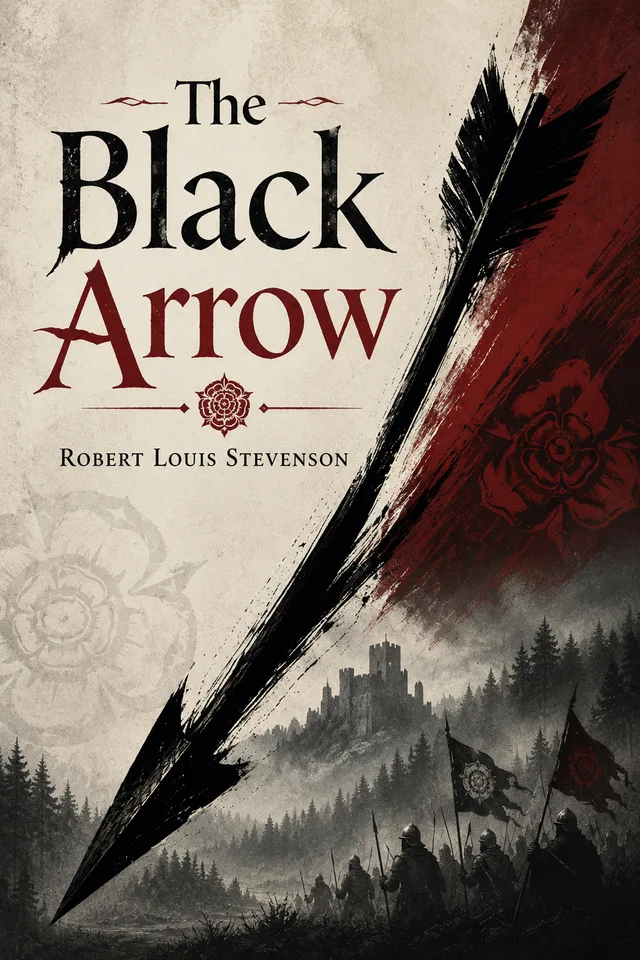
The Black Arrow
Édition BooksWhale en anglais par Robert Louis Stevenson
A swift historical adventure of disguise, rebellion, revenge, and divided loyalties during the Wars of the Roses.
- Aperçu
- Extrait du texte préparé
- Formats
- Lecteur en ligne, EPUB, PDF
- Accès
- Claim Bibliothèque
Introduction du livre
The Black Arrow
The Black Arrow brings Robert Louis Stevenson’s gift for pursuit, betrayal, and youthful courage into fifteenth-century England. Richard Shelton’s search for truth about his father’s death leads through outlaw bands, shifting noble alliances, imprisonment, disguise, and romance amid the Wars of the Roses.
Édition BooksWhale
Préparation de cette édition
Cette édition repose sur un texte du domaine public et a été préparée par BooksWhale pour la lecture numérique.
Base du domaine public
Pourquoi cette édition peut être partagée
Author died in 1894; original text first published in 1888. These dates support the public-domain basis for this original-language edition.
Lire l'aperçu
Extrait du texte préparé
Aperçu sélectionné depuis le texte de lecture préparé.
Chapitre d'aperçuFull textLire l'aperçu
The Black Arrow
Chapitre d'aperçuTHE BLACK ARROW--A TALE OF THE TWO ROSESAperçu
Critic on the Hearth:
No one but myself knows what I have suffered, nor what my books have gained, by your unsleeping watchfulness and admirable pertinacity. And now here is a volume that goes into the world and lacks your _imprimatur_: a strange thing in our joint lives; and the reason of it stranger still! I have watched with interest, with pain, and at length with amusement, your unavailing attempts to peruse _The Black Arrow_; and I think I should lack humour indeed, if I let the occasion slip and did not place your name in the fly-leaf of the only book of mine that you have never read--and never will read.
That others may display more constancy is still my hope. The tale was written years ago for a particular audience and (I may say) in rivalry with a particular author; I think I should do well to name him, Mr. Alfred R. Phillips. It was not without its reward at the time. I could not, indeed, displace Mr. Phillips from his well-won priority; but in the eyes of readers who thought less than nothing of _Treasure Island_, _The Black Arrow_ was supposed to mark a clear advance. Those who read volumes and those who read story papers belong to different worlds. The verdict on _Treasure Island_ was reversed in the other court; I wonder, will it be the same with its successor?
SARANAC LAKE, April 8, 1888.
On a certain afternoon, in the late springtime, the bell upon Tunstall Moat House was heard ringing at an unaccustomed hour. Far and near, in the forest and in the fields along the river, people began to desert their labours and hurry towards the sound; and in Tunstall hamlet a group of poor country-folk stood wondering at the summons.
Tunstall hamlet at that period, in the reign of old King Henry VI., wore much the same appearance as it wears to-day. A score or so of houses, heavily framed with oak, stood scattered in a long green valley ascending from the river. At the foot, the road crossed a bridge, and mounting on the other side, disappeared into the fringes of the forest on its way to the Moat House, and further forth to Holywood Abbey. Half-way up the village, the church stood among yews. On every side the slopes were crowned and the view bounded by the green elms and greening oak-trees of the forest.
Hard by the bridge, there was a stone cross upon a knoll, and here the group had collected--half a dozen women and one tall fellow in a russet smock--discussing what the bell betided. An express had gone through the hamlet half an hour before, and drunk a pot of ale in the saddle, not daring to dismount for the hurry of his errand; but he had been ignorant himself of what was forward, and only bore sealed letters from Sir Daniel Brackley to Sir Oliver Oates, the parson, who kept the Moat House in the master's absence.
But now there was the noise of a horse; and soon, out of the edge of the wood and over the echoing bridge, there rode up young Master Richard Shelton, Sir Daniel's ward. He, at the least, would know, and they hailed him and begged him to explain. He drew bridle willingly enough--a young fellow not yet eighteen, sun-browned and grey-eyed, in a jacket of deer's leather, with a black velvet collar, a green hood upon his head, and a steel cross-bow at his back. The express, it appeared, had brought great news. A battle was impending. Sir Daniel had sent for every man that could draw a bow or carry a bill to go post-haste to Kettley, under pain of his severe displeasure; but for whom they were to fight, or of where the battle was expected, Dick knew nothing. Sir Oliver would come shortly himself, and Bennet Hatch was arming at that moment, for he it was who should lead the party.
Chapitre d'aperçu"JON AMEND-ALLAperçu
of the Green Wood, And his jolly fellaweship.
"Item, we have mo arrowes and goode hempen cord for otheres of your following."
"Now, well-a-day for charity and the Christian graces!" cried Sir Oliver, lamentably. "Sirs, this is an ill world, and groweth daily worse. I will swear upon the cross of Holywood I am as innocent of that good knight's hurt, whether in act or purpose, as the babe unchristened. Neither was his throat cut; for therein they are again in error, as there still live credible witnesses to show."
"It boots not, sir parson," said Bennet. "Here is unseasonable talk."
"Nay, Master Bennet, not so. Keep ye in your due place, good Bennet," answered the priest. "I shall make mine innocence appear. I will, upon no consideration, lose my poor life in error. I take all men to witness that I am clear of this matter. I was not even in the Moat House. I was sent of an errand before nine upon the clock"--
"Sir Oliver," said Hatch, interrupting, "since it please you not to stop this sermon, I will take other means. Goffe, sound to horse."
And while the tucket was sounding, Bennet moved close to the bewildered parson, and whispered violently in his ear.
Dick Shelton saw the priest's eye turned upon him for an instant in a startled glance. He had some cause for thought; for this Sir Harry Shelton was his own natural father. But he said never a word, and kept his countenance unmoved.
Hatch and Sir Oliver discussed together for a while their altered situation; ten men, it was decided between them, should be reserved, not only to garrison the Moat House, but to escort the priest across the wood. In the meantime, as Bennet was to remain behind, the command of the reinforcement was given to Master Shelton. Indeed, there was no choice; the men were loutish fellows, dull and unskilled in war, while Dick was not only popular, but resolute and grave beyond his age. Although his youth had been spent in these rough, country places, the lad had been well taught in letters by Sir Oliver, and Hatch himself had shown him the management of arms and the first principles of command. Bennet had always been kind and helpful; he was one of those who are cruel as the grave to those they call their enemies, but ruggedly faithful and well willing to their friends; and now, while Sir Oliver entered the next house to write, in his swift, exquisite penmanship, a
memorandum of the last occurrences to his master, Sir Daniel Brackley, Bennet came up to his pupil to wish him God-speed upon his enterprise.
"Ye must go the long way about, Master Shelton," he said; "round by the bridge, for your life! Keep a sure man fifty paces afore you, to draw shots; and go softly till y' are past the wood. If the rogues fall upon you, ride for 't; ye will do naught by standing. And keep ever forward, Master Shelton; turn me not back again, an ye love your life; there is no help in Tunstall, mind ye that. And now, since ye go to the great wars about the king, and I continue to dwell here in extreme jeopardy of my life, and the saints alone can certify if we shall meet again below, I give you my last counsels now at your riding. Keep an eye on Sir Daniel; he is unsure. Put not your trust in the jack-priest; he intendeth not amiss, but doth the will of others; it is a hand-gun for Sir Daniel! Get your good lordship where ye go; make you strong friends; look to it. And think ever a pater-noster-while on Bennet Hatch. There are worse rogues
afoot than Bennet. So, God-speed!"
"And Heaven be with you, Bennet!" returned Dick. "Ye were a good friend to me-ward, and so I shall say ever."
Table des matières
Dans cette édition
- 01Full text
- 02THE BLACK ARROW--A TALE OF THE TWO ROSES
- 03"JON AMEND-ALL
- 04CHAPTER I--AT THE SIGN OF THE SUN IN KETTLEY
- 05CHAPTER V--"BLOODY AS THE HUNTER"
- 06CHAPTER VI--TO THE DAY'S END
- 07CHAPTER III--THE ROOM OVER THE CHAPEL
- 08CHAPTER III--ST. BRIDE'S CROSS
- 09CHAPTER V--THE GOOD HOPE (continued)
- 10CHAPTER VI--THE GOOD HOPE (concluded)
- 11part of its course, kept near along the margin or the forest, coming
- 12CHAPTER II--"IN MINE ENEMIES' HOUSE"
- 13part, gossip Arblaster, methinks there is some sense in this young man.
- 14CHAPTER III--THE BATTLE OF SHOREBY (Concluded)
- 15CHAPTER V--NIGHT IN THE WOODS: ALICIA RISINGHAM
- 16CHAPTER VI--NIGHT IN THE WOODS (concluded): DICK AND JOAN
- 17CHAPTER VII--DICK'S REVENGE
Disponibilité linguistique
Autres langues
Aucune autre édition linguistique n'est encore publiée. Cette section les reliera lorsqu'elles seront disponibles.
Demander une autre langue