anglais Édition
Science
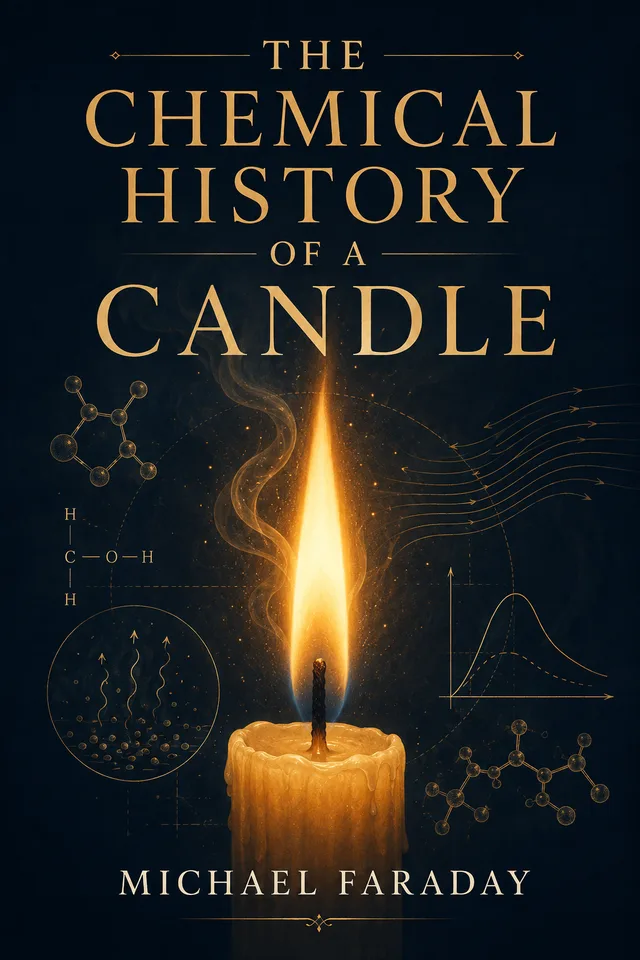
The Chemical History of a Candle
Édition BooksWhale en anglais par Michael Faraday
Faraday’s famous lectures explain flame, combustion, air, water, carbon, and scientific observation through a candle.
- Aperçu
- Extrait du texte préparé
- Formats
- Lecteur en ligne, EPUB, PDF
- Accès
- Claim Bibliothèque
Introduction du livre
The Chemical History of a Candle
The Chemical History of a Candle turns a familiar object into a complete lesson in experimental science. Michael Faraday explains flame, wax, gases, oxygen, carbon dioxide, water, and the method of inquiry with clarity that has made the lectures a lasting classic of science education.
Édition BooksWhale
Préparation de cette édition
Cette édition repose sur un texte du domaine public et a été préparée par BooksWhale pour la lecture numérique.
Base du domaine public
Pourquoi cette édition peut être partagée
Michael Faraday died in 1867, and The Chemical History of a Candle was first published or composed in 1861; these dates support the public-domain basis for this edition.
Lire l'aperçu
Extrait du texte préparé
Aperçu sélectionné depuis le texte de lecture préparé.
Chapitre d'aperçuFull textLire l'aperçu
The Chemical History of a Candle
Michael Faraday
Chapitre d'aperçuLECTURE I.Aperçu
LECTURE I.
Chapitre d'aperçuA CANDLE: THE FLAME--ITS SOURCES--STRUCTURE--MOBILITY--BRIGHTNESS.Aperçu
I purpose, in return for the honour you do us by coming to see what are our proceedings here, to bring before you, in the course of these lectures, the Chemical History of a Candle. I have taken this subject on a former occasion; and were it left to my own will, I should prefer to repeat it almost every year--so abundant is the interest that attaches itself to the subject, so wonderful are the varieties of outlet which it offers into the various departments of philosophy. There is not a law under which any part of this universe is governed which does not come into play, and is touched upon in these phenomena. There is no better, there is no more open door by which you can enter into the study of natural philosophy, than by considering the physical phenomena of a candle. I trust, therefore, I shall not disappoint you in choosing this for my subject rather than any newer topic, which could not be better, were it
even so good.
And before proceeding, let me say this also--that though our subject be so great, and our intention that of treating it honestly, seriously, and philosophically, yet I mean to pass away from all those who are seniors amongst us. I claim the privilege of speaking to juveniles as a juvenile myself. I have done so on former occasions--and, if you please, I shall do so again. And though I stand here with the knowledge of having the words I utter given to the world, yet that shall not deter me from speaking in the same familiar way to those whom I esteem nearest to me on this occasion.
natural candle.
But we must speak of candles as they are in commerce. Here are a couple of candles commonly called dips. They are made of lengths of cotton cut off, hung up by a loop, dipped into melted tallow, taken out again and cooled, then re-dipped until there is an accumulation of tallow round the cotton.
In order that you may have an idea of the various characters of these candles, you see these which I hold in my hand--they are very small, and very curious. They are, or were, the candles used by the miners in coal mines. In olden times the miner had to find his own candles; and it was supposed that a small candle would not so soon set fire to the fire-damp in the coal mines as a large one; and for that reason, as well as for economy's sake, he had candles made of this sort--20, 30, 40, or 60 to the pound. They have been replaced since then by the steel-mill, and then by the Davy-lamp, and other safety-lamps of various kinds. I have here a candle that was taken out of the _Royal George_, it is said, by Colonel Pasley. It has been sunk in the sea for many years, subject to the action of salt water. It shews you how well candles may be preserved; for though it is cracked about and broken a good deal, yet, when lighted, it goes on
burning regularly, and the tallow resumes its natural condition as soon as it is fused.
Mr. Field, of Lambeth, has supplied me abundantly with beautiful illustrations of the candle and its materials. I shall therefore now refer to them. And, first, there is the suet--the fat of the ox--Russian tallow, I believe, employed in the manufacture of these dips, which Gay Lussac, or some one who entrusted him with his knowledge, converted into that beautiful substance, stearin, which you see lying beside it. A candle, you know, is not now a greasy thing like an ordinary tallow candle, but a clean thing, and you may almost scrape off and pulverise the drops which fall from it without soiling anything. This is the process he adopted:--The fat or tallow is first boiled with quick-lime, and made into a soap, and then the soap is decomposed by sulphuric acid, which takes away the lime, and leaves the fat re-arranged as stearic acid, whilst a quantity of glycerin is produced at the same time.
Table des matières
Dans cette édition
- 01Full text
- 02LECTURE I.
- 03A CANDLE: THE FLAME--ITS SOURCES--STRUCTURE--MOBILITY--BRIGHTNESS.
- 04LECTURE II.
- 05A CANDLE: BRIGHTNESS OF THE FLAME--AIR NECESSARY FOR
- 06COMBUSTION--PRODUCTION OF WATER.
- 07LECTURE III.
- 08PRODUCTS: WATER FROM THE COMBUSTION--NATURE OF WATER--A
- 09COMPOUND--HYDROGEN.
- 10LECTURE IV.
- 11HYDROGEN IN THE CANDLE--BURNS INTO WATER--THE OTHER PART OF WATER--OXYGEN.
- 12LECTURE V.
- 13OXYGEN PRESENT IN THE AIR--NATURE OF THE ATMOSPHERE--ITS PROPERTIES--OTHER
- 14PRODUCTS FROM THE CANDLE--CARBONIC ACID--ITS PROPERTIES.
- 15LECTURE VI.
- 16CARBON OR CHARCOAL--COAL GAS--RESPIRATION AND ITS ANALOGY TO THE BURNING
- 17OF A CANDLE--CONCLUSION.
- 18SUGAR.
- 19LECTURE ON PLATINUM.
Disponibilité linguistique
Autres langues
Aucune autre édition linguistique n'est encore publiée. Cette section les reliera lorsqu'elles seront disponibles.
Demander une autre langue