anglais Édition
Politique
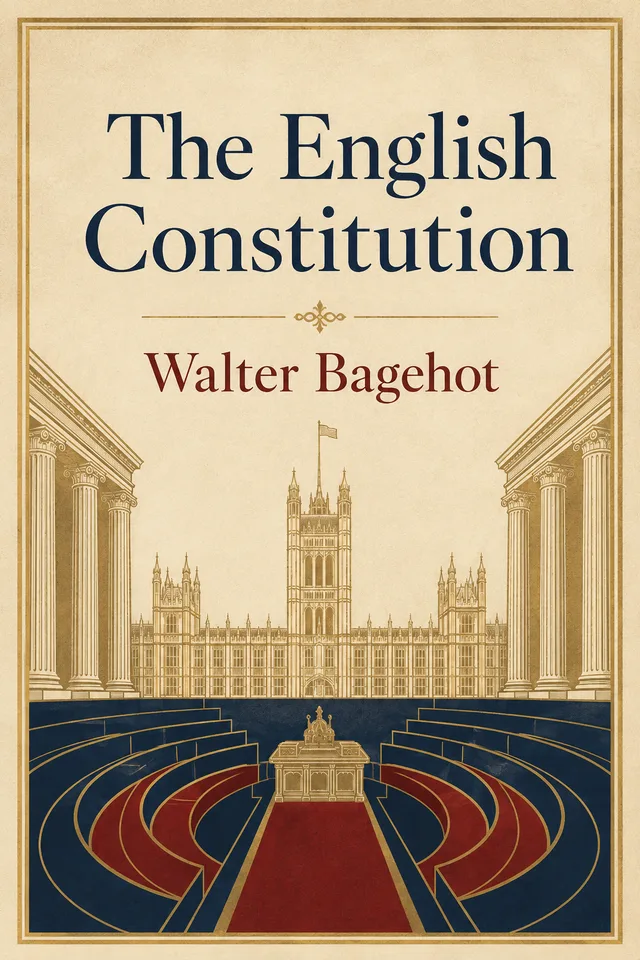
The English Constitution
Édition BooksWhale en anglais par Walter Bagehot
A lucid analysis of cabinet government, monarchy, parliament, and Victorian political institutions.
- Aperçu
- Extrait du texte préparé
- Formats
- Lecteur en ligne, EPUB, PDF
- Accès
- Claim Bibliothèque
Introduction du livre
The English Constitution
The English Constitution explains how Britain’s political system actually worked behind its formal appearances. Bagehot’s account of cabinet government, parliamentary power, monarchy, public opinion, and constitutional habit remains a classic of political science and institutional analysis.
Édition BooksWhale
Préparation de cette édition
Cette édition repose sur un texte du domaine public et a été préparée par BooksWhale pour la lecture numérique.
Base du domaine public
Pourquoi cette édition peut être partagée
The English Constitution is a public-domain work: the author died in 1877, and the text was first published in 1867. This edition uses the original English text.
Lire l'aperçu
Extrait du texte préparé
Aperçu sélectionné depuis le texte de lecture préparé.
Chapitre d'aperçuThe English ConstitutionLire l'aperçu
Distributed Proofreading Team. HTML version by Al Haines.
THE ENGLISH CONSTITUTION
By
Walter Bagehot
I. INTRODUCTION TO THE SECOND EDITION.
II. THE CABINET.
III. THE MONARCHY.
IV. THE HOUSE OF LORDS.
V. THE HOUSE OF COMMONS.
VI. ON CHANGES OF MINISTRY.
VII. ITS SUPPOSED CHECKS AND BALANCES.
VIII. THE PREREQUISITES OF CABINET GOVERNMENT, AND THE PECULIAR
FORM WHICH THEY HAVE ASSUMED IN ENGLAND.
IX. ITS HISTORY, AND THE EFFECTS OF THAT HISTORY.--CONCLUSION.
NO. I.
INTRODUCTION TO THE SECOND EDITION.
There is a great difficulty in the way of a writer who attempts to
sketch a living Constitution--a Constitution that is in actual work and
power. The difficulty is that the object is in constant change. An
historical writer does not feel this difficulty: he deals only with the
past; he can say definitely, the Constitution worked in such and such a
manner in the year at which he begins, and in a manner in such and such
respects different in the year at which he ends; he begins with a
definite point of time and ends with one also. But a contemporary
writer who tries to paint what is before him is puzzled and a
perplexed: what he sees is changing daily. He must paint it as it stood
at some one time, or else he will be putting side by side in his
representations things which never were contemporaneous in reality. The
difficulty is the greater because a writer who deals with a living
Government naturally compares it with the most important other living
Governments, and these are changing too; what he illustrates are
altered in one way, and his sources of illustration are altered
probably in a different way. This difficulty has been constantly in my
way in preparing a second edition of this book. It describes the
English Constitution as it stood in the years 1865 and 1866. Roughly
speaking, it describes its working as it was in the time of Lord
Palmerston; and since that time there have been many changes, some of
spirit and some of detail. In so short a period there have rarely been
more changes. If I had given a sketch of the Palmerston time as a
sketch of the present time, it would have been in many points untrue;
and if I had tried to change the sketch of seven years since into a
sketch of the present time, I should probably have blurred the picture
and have given something equally unlike both.
The best plan in such a case is, I think, to keep the original sketch
in all essentials as it was at first written, and to describe shortly
such changes either in the Constitution itself, or in the Constitutions
compared with it, as seem material. There are in this book various
expressions which allude to persons who were living and to events which
were happening when it first appeared; and I have carefully preserved
these. They will serve to warn the reader what time he is reading
about, and to prevent his mistaking the date at which the likeness was
attempted to be taken. I proceed to speak of the changes which have
taken place either in the Constitution itself or in the competing
institutions which illustrate it.
It is too soon as yet to attempt to estimate the effect of the Reform
Act of 1867. The people enfranchised under it do not yet know their
own power; a single election, so far from teaching us how they will use
that power, has not been even enough to explain to them that they have
such power. The Reform Act of 1832 did not for many years disclose its
real consequences; a writer in 1836, whether he approved or disapproved
of them, whether he thought too little of or whether he exaggerated
them, would have been sure to be mistaken in them. A new Constitution
does not produce its full effect as long as all its subjects were
Chapitre d'aperçuII.Aperçu
This is all which I think I need say on the domestic events which have
changed, or suggested changes, in the English Constitution since this
Chapitre d'aperçubook was written. But there are also some foreign events which haveAperçu
illustrated it, and of these I should like to say a few words.
Naturally, the most striking of these illustrative changes comes from
France. Since 1789 France has always been trying political experiments,
from which others may profit much, though as yet she herself has
profited little. She is now trying one singularly illustrative of the
English Constitution. When the first edition of this book was published
I had great difficulty in persuading many people that it was possible
in a non-monarchical State, for the real chief of the practical
executive--the Premier as we should call him--to be nominated and to be
removable by the vote of the National Assembly. The United States and
its copies were the only present and familiar Republics, and in these
the system was exactly opposite. The executive was there appointed by
the people as the legislature was too. No conspicuous example of any
other sort of Republic then existed. But now France has given an
example--M. Thiers is (with one exception) just the chef du pouvoir
executif that I endeavoured more than once in this book to describe. He
is appointed by and is removable by the Assembly. He comes down and
speaks in it just as our Premier does; he is responsible for managing
it just as our Premier is. No one can any longer doubt the possibility
of a republic in which the executive and the legislative authorities
were united and fixed; no one can assert such union to be the
incommunicable attribute of a Constitutional Monarchy. But,
unfortunately, we can as yet only infer from this experiment that such
a Constitution is possible; we cannot as yet say whether it will be bad
or good. The circumstances are very peculiar, and that in three ways.
First, the trial of a specially Parliamentary Republic, of a Republic
where Parliament appoints the Minister, is made in a nation which has,
to say the least of it, no peculiar aptitude for Parliamentary
Government; which has possibly a peculiar inaptitude for it. In the
last but one of these essays I have tried to describe one of the mental
conditions of Parliamentary Government, which I call "rationality," by
which I do not mean reasoning power, but rather the power of hearing
the reasons of others, of comparing them quietly with one's own
reasons, and then being guided by the result. But a French Assembly is
not easy to reason with. Every assembly is divided into parties and
into sections of parties, and in France each party, almost every
section of a party, begins not to clamour but to scream, and to scream
as only Frenchmen can, as soon as it hears anything which it
particularly dislikes. With an Assembly in this temper, real discussion
is impossible, and Parliamentary government is impossible too, because
the Parliament can neither choose men nor measures. The French
assemblies under the Restored Monarchy seem to have been quieter,
probably because being elected from a limited constituency they did not
contain so many sections of opinion; they had fewer irritants and fewer
species of irritability. But the assemblies of the '48 Republic were
disorderly in the extreme. I saw the last myself, and can certify that
steady discussion upon a critical point was not possible in it. There
was not an audience willing to hear. The Assembly now sitting at
Versailles is undoubtedly also, at times, most tumultuous, and a
Parliamentary government in which it governs must be under a peculiar
difficulty, because as a sovereign it is unstable, capricious, and
unruly.
The difficulty is the greater because there is no check, or little,
from the French nation upon the Assembly. The French, as a nation, do
not care for or appreciate Parliamentary government. I have endeavoured
to explain how difficult it is for inexperienced mankind to take to
such a government; how much more natural, that is, how much more easy
Table des matières
Dans cette édition
- 01The English Constitution
- 02II.
- 03book was written. But there are also some foreign events which have
- 04I.
- 05II.
- 06book can teach the practice of either.
Disponibilité linguistique
Autres langues
Aucune autre édition linguistique n'est encore publiée. Cette section les reliera lorsqu'elles seront disponibles.
Demander une autre langue