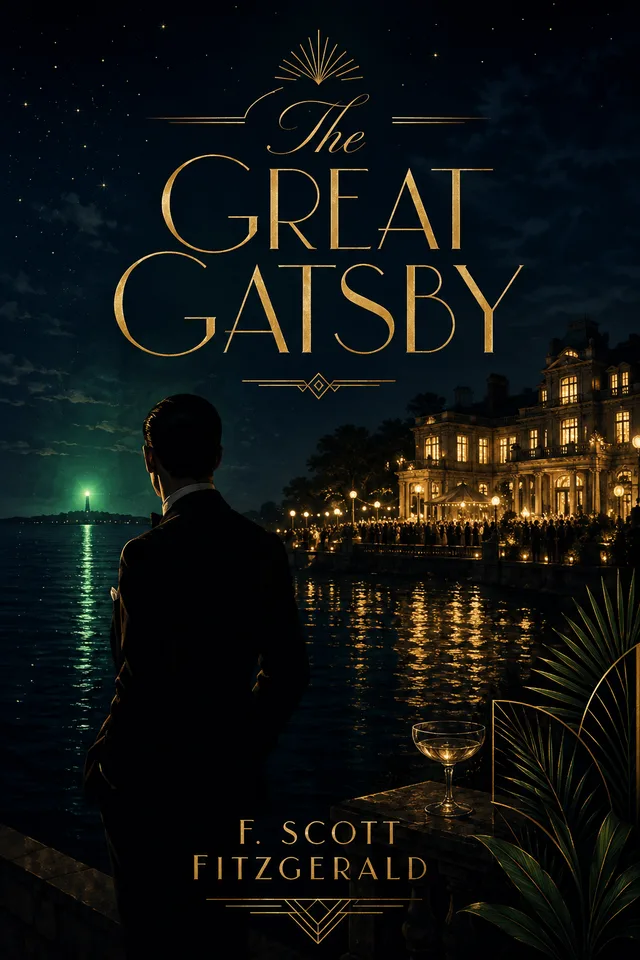
anglais Édition
Littérature
The Great Gatsby
Édition BooksWhale en anglais par F. Scott Fitzgerald
A glittering American tragedy of wealth, desire, reinvention, illusion, and loss.
- Aperçu
- Extrait du texte préparé
- Formats
- Lecteur en ligne, EPUB, PDF
- Accès
- Claim Bibliothèque
Introduction du livre
The Great Gatsby
The Great Gatsby follows Nick Carraway into the world of Jay Gatsby, Daisy Buchanan, parties, money, and longing. Fitzgerald’s novel turns the American dream into a fragile light across the water, beautiful because it is already receding.
Édition BooksWhale
Préparation de cette édition
Cette édition repose sur un texte du domaine public et a été préparée par BooksWhale pour la lecture numérique.
Base du domaine public
Pourquoi cette édition peut être partagée
F. Scott Fitzgerald died in 1940, and The Great Gatsby was first published in 1925. These dates support the public-domain basis for this English original edition.
Lire l'aperçu
Extrait du texte préparé
Aperçu sélectionné depuis le texte de lecture préparé.
Chapitre d'aperçuFull textLire l'aperçu
The Great Gatsby
F. Scott Fitzgerald
Chapitre d'aperçuCHAPTER IAperçu
IN MY YOUNGER and more vulnerable years my father gave me some advice that I’ve been turning over in my mind ever since.
“Whenever you feel like criticizing any one,” he told me, “just remember that all the people in this world haven’t had the advantages that you’ve had.”
He didn’t say any more, but we’ve always been unusually communicative in a reserved way, and I understood that he meant a great deal more than that. In consequence, I’m inclined to reserve all judgments, a habit that has opened up many curious natures to me and also made me the victim of not a few veteran bores. The abnormal mind is quick to detect and attach itself to this quality when it appears in a normal person, and so it came about that in college I was unjustly accused of being a politician, because I was privy to the secret griefs of wild, unknown men. Most of the confidences were unsought—frequently I have feigned sleep, preoccupation, or a hostile levity when I realized by some unmistakable sign that an intimate revelation was quivering on the horizon; for the intimate revelations of young men, or at least the terms in which they express them, are usually plagiaristic and marred by obvious suppressions. Reserving judgments is a matter of infinite hope. I am still a little afraid of missing something if I forget that, as my father snobbishly suggested, and I snobbishly repeat, a sense of the fundamental decencies is parcelled out unequally at birth.
And, after boasting this way of my tolerance, I come to the admission that it has a limit. Conduct may be founded on the hard rock or the wet marshes, but after a certain point I don’t care what it’s founded on. When I came back from the East last autumn I felt that I wanted the world to be in uniform and at a sort of moral attention forever; I wanted no more riotous excursions with privileged glimpses into the human heart. Only Gatsby, the man who gives his name to this book, was exempt from my reaction—Gatsby, who represented everything for which I have an unaffected scorn. If personality is an unbroken series of successful gestures, then there was something gorgeous about him, some heightened sensitivity to the promises of life, as if he were related to one of those intricate machines that register earthquakes ten thousand miles away. This responsiveness had nothing to do with that flabby impressionability which is dignified under the name of the “creative temperament”—it was an extraordinary gift for hope, a romantic readiness such as I have never found in any other person and which it is not likely I shall ever find again. No—Gatsby turned out all right at the end; it is what preyed on Gatsby, what foul dust floated in the wake of his dreams that temporarily closed out my interest in the abortive sorrows and short-winded elations of men.
* * *
My family have been prominent, well-to-do people in this Middle Western city for three generations. The Carraways are something of a clan, and we have a tradition that we’re descended from the Dukes of Buccleuch, but the actual founder of my line was my grandfather’s brother, who came here in fifty-one, sent a substitute to the Civil War, and started the wholesale hardware business that my father carries on to-day.
I never saw this great-uncle, but I’m supposed to look like him—with special reference to the rather hard-boiled painting that hangs in father’s office. I graduated from New Haven in 1915, just a quarter of a century after my father, and a little later I participated in that delayed Teutonic migration known as the Great War. I enjoyed the counter-raid so thoroughly that I came back restless. Instead of being the warm center of the world, the Middle West now seemed like the ragged edge of the universe—so I decided to go East and learn the bond business. Everybody I knew was in the bond business, so I supposed it could support one more single man. All my aunts and uncles talked it over as if they were choosing a prep school for me, and finally said, “Why—ye-es,” with very grave, hesitant faces. Father agreed to finance me for a year, and after various delays I came East, permanently, I thought, in the spring of twenty-two.
Chapitre d'aperçuCHAPTER IIAperçu
ABOUT HALF WAY between West Egg and New York the motor road hastily joins the railroad and runs beside it for a quarter of a mile, so as to shrink away from a certain desolate area of land. This is a valley of ashes—a fantastic farm where ashes grow like wheat into ridges and hills and grotesque gardens; where ashes take the forms of houses and chimneys and rising smoke and, finally, with a transcendent effort, of men who move dimly and already crumbling through the powdery air. Occasionally a line of gray cars crawls along an invisible track, gives out a ghastly creak, and comes to rest, and immediately the ash-gray men swarm up with leaden spades and stir up an impenetrable cloud, which screens their obscure operations from your sight.
But above the gray land and the spasms of bleak dust which drift endlessly over it, you perceive, after a moment, the eyes of Doctor T. J. Eckleburg. The eyes of Doctor T. J. Eckleburg are blue and gigantic—their retinas are one yard high. They look out of no face, but, instead, from a pair of enormous yellow spectacles which pass over a non-existent nose. Evidently some wild wag of an oculist set them there to fatten his practice in the borough of Queens, and then sank down himself into eternal blindness, or forgot them and moved away. But his eyes, dimmed a little by many paintless days under sun and rain, brood on over the solemn dumping ground.
The valley of ashes is bounded on one side by a small foul river, and, when the drawbridge is up to let barges through, the passengers on waiting trains can stare at the dismal scene for as long as half an hour. There is always a halt there of at least a minute, and it was because of this that I first met Tom Buchanan’s mistress.
The fact that he had one was insisted upon wherever he was known. His acquaintances resented the fact that he turned up in popular restaurants with her and, leaving her at a table, sauntered about, chatting with whomsoever he knew. Though I was curious to see her, I had no desire to meet her—but I did. I went up to New York with Tom on the train one afternoon and when we stopped by the ashheaps he jumped to his feet and, taking hold of my elbow, literally forced me from the car.
“We’re getting off,” he insisted. “I want you to meet my girl.”
I think he’d tanked up a good deal at luncheon, and his determination to have my company bordered on violence. The supercilious assumption was that on Sunday afternoon I had nothing better to do.
I followed him over a low whitewashed railroad fence, and we walked back a hundred yards along the road under Doctor Eckleburg’s persistent stare. The only building in sight was a small block of yellow brick sitting on the edge of the waste land, a sort of compact Main Street ministering to it, and contiguous to absolutely nothing. One of the three shops it contained was for rent and another was an all-night restaurant, approached by a trail of ashes; the third was a garage—Repairs. GEORGE B. WILSON. Cars bought and sold.—and I followed Tom inside.
The interior was unprosperous and bare; the only car visible was the dust-covered wreck of a Ford which crouched in a dim corner. It had occurred to me that this shadow of a garage must be a blind, and that sumptuous and romantic apartments were concealed overhead, when the proprietor himself appeared in the door of an office, wiping his hands on a piece of waste. He was a blond, spiritless man, anæmic, and faintly handsome. When he saw us a damp gleam of hope sprang into his light blue eyes.
Table des matières
Dans cette édition
- 01Full text
- 02CHAPTER I
- 03CHAPTER II
- 04CHAPTER III
- 05CHAPTER IV
- 06CHAPTER V
- 07CHAPTER VI
- 08CHAPTER VII
- 09CHAPTER VIII
- 10CHAPTER IX
Disponibilité linguistique
Autres langues
Aucune autre édition linguistique n'est encore publiée. Cette section les reliera lorsqu'elles seront disponibles.
Demander une autre langue