anglais Édition
Littérature
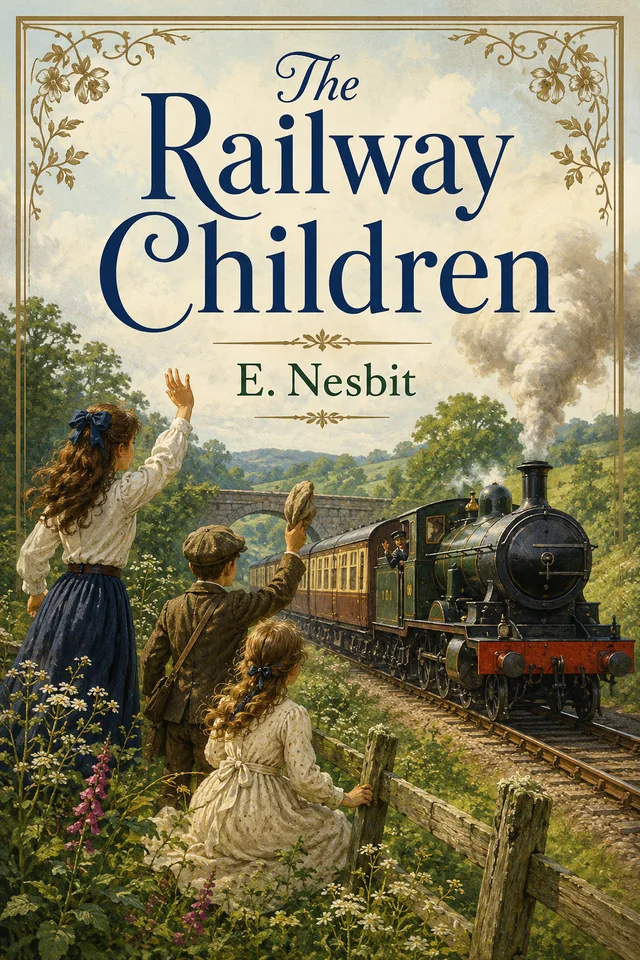
The Railway Children
Édition BooksWhale en anglais par E. Nesbit
A warm children’s classic of family loss, railway life, bravery, and generosity.
- Aperçu
- Extrait du texte préparé
- Formats
- Lecteur en ligne, EPUB, PDF
- Accès
- Claim Bibliothèque
Introduction du livre
The Railway Children
The Railway Children tells of three children whose family life changes suddenly and whose adventures near the railway reveal kindness, courage, and hope. E. Nesbit’s novel remains a classic of English children’s literature.
Édition BooksWhale
Préparation de cette édition
Cette édition repose sur un texte du domaine public et a été préparée par BooksWhale pour la lecture numérique.
Base du domaine public
Pourquoi cette édition peut être partagée
E. Nesbit died in 1924, and The Railway Children was first published in 1906. These dates support the public-domain basis for this English original-language edition.
Lire l'aperçu
Extrait du texte préparé
Aperçu sélectionné depuis le texte de lecture préparé.
Chapitre d'aperçuFull textLire l'aperçu
The Railway Children
By E. Nesbit
To my dear son Paul Bland, behind whose knowledge of railways my ignorance confidently shelters.
Chapitre d'aperçuChapter I. The beginning of things.Aperçu
They were not railway children to begin with. I don't suppose they had ever thought about railways except as a means of getting to Maskelyne and Cook's, the Pantomime, Zoological Gardens, and Madame Tussaud's. They were just ordinary suburban children, and they lived with their Father and Mother in an ordinary red-brick-fronted villa, with coloured glass in the front door, a tiled passage that was called a hall, a bath-room with hot and cold water, electric bells, French windows, and a good deal of white paint, and 'every modern convenience', as the house-agents say.
There were three of them. Roberta was the eldest. Of course, Mothers never have favourites, but if their Mother HAD had a favourite, it might have been Roberta. Next came Peter, who wished to be an Engineer when he grew up; and the youngest was Phyllis, who meant extremely well.
Mother did not spend all her time in paying dull calls to dull ladies, and sitting dully at home waiting for dull ladies to pay calls to her. She was almost always there, ready to play with the children, and read to them, and help them to do their home-lessons. Besides this she used to write stories for them while they were at school, and read them aloud after tea, and she always made up funny pieces of poetry for their birthdays and for other great occasions, such as the christening of the new kittens, or the refurnishing of the doll's house, or the time when they were getting over the mumps.
These three lucky children always had everything they needed: pretty clothes, good fires, a lovely nursery with heaps of toys, and a Mother Goose wall-paper. They had a kind and merry nursemaid, and a dog who was called James, and who was their very own. They also had a Father who was just perfect--never cross, never unjust, and always ready for a game--at least, if at any time he was NOT ready, he always had an excellent reason for it, and explained the reason to the children so interestingly and funnily that they felt sure he couldn't help himself.
You will think that they ought to have been very happy. And so they were, but they did not know HOW happy till the pretty life in the Red Villa was over and done with, and they had to live a very different life indeed.
The dreadful change came quite suddenly.
Peter had a birthday--his tenth. Among his other presents was a model engine more perfect than you could ever have dreamed of. The other presents were full of charm, but the Engine was fuller of charm than any of the others were.
Its charm lasted in its full perfection for exactly three days. Then, owing either to Peter's inexperience or Phyllis's good intentions, which had been rather pressing, or to some other cause, the Engine suddenly went off with a bang. James was so frightened that he went out and did not come back all day. All the Noah's Ark people who were in the tender were broken to bits, but nothing else was hurt except the poor little engine and the feelings of Peter. The others said he cried over it--but of course boys of ten do not cry, however terrible the tragedies may be which darken their lot. He said that his eyes were red because he had a cold. This turned out to be true, though Peter did not know it was when he said it, the next day he had to go to bed and stay there. Mother began to be afraid that he might be sickening for measles, when suddenly he sat up in bed and said:
“I hate gruel--I hate barley water--I hate bread and milk. I want to get up and have something REAL to eat.”
“What would you like?” Mother asked.
Chapitre d'aperçuChapter II. Peter's coal-mine.Aperçu
“What fun!” said Mother, in the dark, feeling for the matches on the table. “How frightened the poor mice were--I don't believe they were rats at all.”
She struck a match and relighted the candle and everyone looked at each other by its winky, blinky light.
“Well,” she said, “you've often wanted something to happen and now it has. This is quite an adventure, isn't it? I told Mrs. Viney to get us some bread and butter, and meat and things, and to have supper ready. I suppose she's laid it in the dining-room. So let's go and see.”
The dining-room opened out of the kitchen. It looked much darker than the kitchen when they went in with the one candle. Because the kitchen was whitewashed, but the dining-room was dark wood from floor to ceiling, and across the ceiling there were heavy black beams. There was a muddled maze of dusty furniture--the breakfast-room furniture from the old home where they had lived all their lives. It seemed a very long time ago, and a very long way off.
There was the table certainly, and there were chairs, but there was no supper.
“Let's look in the other rooms,” said Mother; and they looked. And in each room was the same kind of blundering half-arrangement of furniture, and fire-irons and crockery, and all sorts of odd things on the floor, but there was nothing to eat; even in the pantry there were only a rusty cake-tin and a broken plate with whitening mixed in it.
“What a horrid old woman!” said Mother; “she's just walked off with the money and not got us anything to eat at all.”
“Then shan't we have any supper at all?” asked Phyllis, dismayed, stepping back on to a soap-dish that cracked responsively.
“Oh, yes,” said Mother, “only it'll mean unpacking one of those big cases that we put in the cellar. Phil, do mind where you're walking to, there's a dear. Peter, hold the light.”
The cellar door opened out of the kitchen. There were five wooden steps leading down. It wasn't a proper cellar at all, the children thought, because its ceiling went up as high as the kitchen's. A bacon-rack hung under its ceiling. There was wood in it, and coal. Also the big cases.
Peter held the candle, all on one side, while Mother tried to open the great packing-case. It was very securely nailed down.
“Where's the hammer?” asked Peter.
“That's just it,” said Mother. “I'm afraid it's inside the box. But there's a coal-shovel--and there's the kitchen poker.”
And with these she tried to get the case open.
“Let me do it,” said Peter, thinking he could do it better himself. Everyone thinks this when he sees another person stirring a fire, or opening a box, or untying a knot in a bit of string.
“You'll hurt your hands, Mammy,” said Roberta; “let me.”
“I wish Father was here,” said Phyllis; “he'd get it open in two shakes. What are you kicking me for, Bobbie?”
“I wasn't,” said Roberta.
Just then the first of the long nails in the packing-case began to come out with a scrunch. Then a lath was raised and then another, till all four stood up with the long nails in them shining fiercely like iron teeth in the candle-light.
“Hooray!” said Mother; “here are some candles--the very first thing! You girls go and light them. You'll find some saucers and things. Just drop a little candle-grease in the saucer and stick the candle upright in it.”
“How many shall we light?”
“As many as ever you like,” said Mother, gaily. “The great thing is to be cheerful. Nobody can be cheerful in the dark except owls and dormice.”
So the girls lighted candles. The head of the first match flew off and stuck to Phyllis's finger; but, as Roberta said, it was only a little burn, and she might have had to be a Roman martyr and be burned whole if she had happened to live in the days when those things were fashionable.
Table des matières
Dans cette édition
- 01Full text
- 02Chapter I. The beginning of things.
- 03Chapter II. Peter's coal-mine.
- 04Chapter III. The old gentleman.
- 05Chapter IV. The engine-burglar.
- 06Chapter V. Prisoners and captives.
- 07Chapter VI. Saviours of the train.
- 08Chapter VII. For valour.
- 09Chapter VIII. The amateur firemen.
- 10Chapter IX. The pride of Perks.
- 11Chapter X. The terrible secret.
- 12Chapter XI. The hound in the red jersey.
- 13Chapter XII. What Bobbie brought home.
- 14Chapter XIII. The hound's grandfather.
- 15Chapter XIV. The End.
Disponibilité linguistique
Autres langues
Aucune autre édition linguistique n'est encore publiée. Cette section les reliera lorsqu'elles seront disponibles.
Demander une autre langue