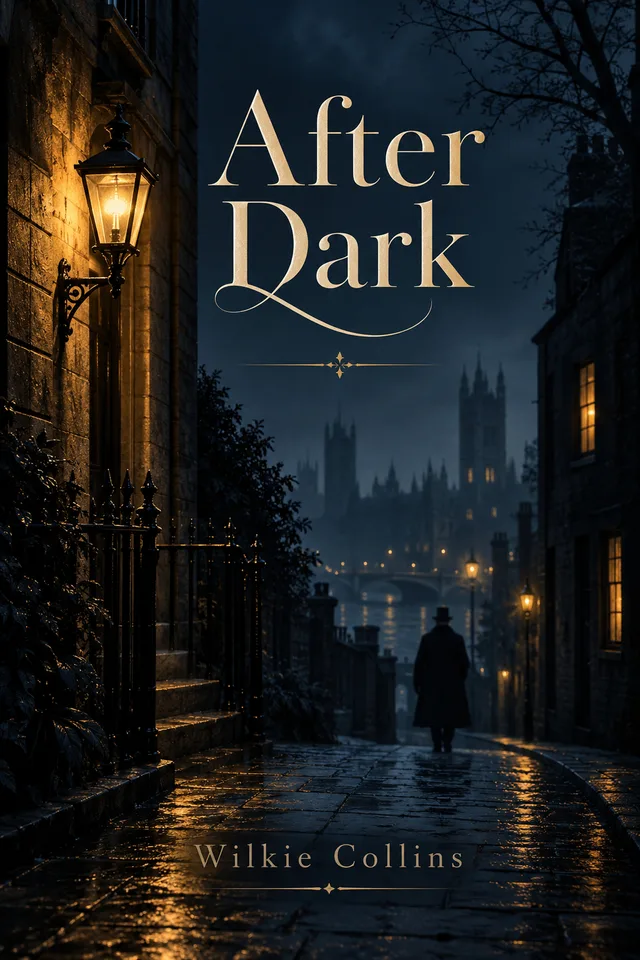
inglese Edizione
Letteratura
After Dark
Edizione BooksWhale in inglese di Wilkie Collins
A collection of linked tales where a night of storytelling becomes a portrait of fear, chance, and urban life.
- Anteprima
- Estratto dal testo preparato
- Formati
- Lettore online, EPUB, PDF
- Accesso
- Claim Libreria
Introduzione al libro
After Dark
Wilkie Collins frames several suspenseful stories with a narrator moving through darkness, illness, secrecy, and coincidence. The result combines Victorian sensation, moral uncertainty, and the pleasure of a carefully staged fireside tale.
Edizione BooksWhale
Come è stata preparata
Questa edizione si basa su un testo di pubblico dominio ed è stata preparata da BooksWhale per la lettura digitale.
Base di pubblico dominio
Perché può essere condivisa
Wilkie Collins died in 1889 and After Dark was first published in 1856. This edition uses the public-domain English original-language text.
Leggi anteprima
Estratto dal testo preparato
Anteprima selezionata dal testo preparato per la lettura.
Capitolo in anteprimaFull textLeggi anteprima
After Dark
Wilkie Collins
By Wilkie Collins
Capitolo in anteprimaPREFACE TO “AFTER DARK.”Anteprima
I have taken some pains to string together the various stories contained in this Volume on a single thread of interest, which, so far as I know, has at least the merit of not having been used before.
The pages entitled “Leah’s Diary” are, however, intended to fulfill another purpose besides that of serving as the frame-work for my collection of tales. In this part of the book, and subsequently in the Prologues to the stories, it has been my object to give the reader one more glimpse at that artist-life which circumstances have afforded me peculiar opportunities of studying, and which I have already tried to represent, under another aspect, in my fiction, “Hide-and-Seek.” This time I wish to ask some sympathy for the joys and sorrows of a poor traveling portrait-painter--presented from his wife’s point of view in “Leah’s Diary,” and supposed to be briefly and simply narrated by himself in the Prologues to the stories. I have purposely kept these two portions of the book within certain limits; only giving, in the one case, as much as the wife might naturally write in her diary at intervals of household leisure; and, in the other, as much as a modest and sensible man would be likely to say about himself and about the characters he met with in his wanderings. If I have been so fortunate as to make my idea intelligible by this brief and simple mode of treatment, and if I have, at the same time, achieved the necessary object of gathering several separate stories together as neatly-fitting parts of one complete whole, I shall have succeeded in a design which I have for some time past been very anxious creditably to fulfill.
Of the tales themselves, taken individually, I have only to say, by way of necessary explanation, that “The Lady of Glenwith Grange” is now offered to the reader for the first time; and that the other stories have appeared in the columns of _Household Words_. My best thanks are due to Mr. Charles Dickens for his kindness in allowing me to set them in their present frame-work.
I must also gratefully acknowledge an obligation of another kind to the accomplished artist, Mr. W. S. Herrick, to whom I am indebted for the curious and interesting facts on which the tales of “The Terribly Strange Bed” and “The Yellow Mask” are founded.
Although the statement may appear somewhat superfluous to those who know me, it may not be out of place to add, in conclusion, that these stories are entirely of my own imagining, constructing, and writing. The fact that the events of some of my tales occur on foreign ground, and are acted out by foreign personages, appears to have suggested in some quarters the inference that the stories themselves might be of foreign origin. Let me, once for all, assure any readers who may honor me with their attention, that in this, and in all other cases, they may depend on the genuineness of my literary offspring. The little children of my brain may be weakly enough, and may be sadly in want of a helping hand to aid them in their first attempts at walking on the stage of this great world; but, at any rate, they are not borrowed children. The members of my own literary family are indeed increasing so fast as to render the very idea of borrowing quite out of the question, and to suggest serious apprehension that I may not have done adding to the large book-population, on my own sole responsibility, even yet.
AFTER DARK.
LEAVES FROM LEAH’S DIARY.
16th February, 1827.--The doctor has just called for the third time to examine my husband’s eyes. Thank God, there is no fear at present of my poor William losing his sight, provided he can be prevailed on to attend rigidly to the medical instructions for preserving it. These instructions, which forbid him to exercise his profession for the next six months at least, are, in our case, very hard to follow. They will but too probably sentence us to poverty, perhaps to actual want; but they must be borne resignedly, and even thankfully, seeing that my husband’s forced cessation from work will save him from the dreadful affliction of loss of sight. I think I can answer for my own cheerfulness and endurance, now that we know the worst. Can I answer for our children also? Surely I can, when there are only two of them. It is a sad confession to make, but now, for the first time since my marriage, I feel thankful that we have no more.
Capitolo in anteprimabook of all your stories. You shall repeat them, and I will write themAnteprima
down from your dictation. Our manuscript shall be printed; we will sell the book to the public, and so support ourselves honorably in adversity, by doing the best we can to interest and amuse others.”
While I was saying all this--I suppose in a very excitable manner--my husband looked, as our young sailor-friend would phrase it, quite _taken aback._ “You were always quick at contriving, Leah,” he said; “but how in the world came you to think of this plan?”
“I thought of it while you were telling them the gambling-house adventure downstairs,” I answered.
“It is an ingenious idea, and a bold idea,” he went on, thoughtfully. “But it is one thing to tell a story to a circle of friends, and another thing to put it into a printed form for an audience of strangers. Consider, my dear, that we are neither of us used to what is called writing for the press.”
“Very true,” said I, “but nobody is used to it when they first begin, and yet plenty of people have tried the hazardous literary experiment successfully. Besides, in our case, we have the materials ready to our hands; surely we can succeed in shaping them presentably if we aim at nothing but the simple truth.”
“Who is to do the eloquent descriptions and the striking reflections, and all that part of it?” said William, perplexedly shaking his head.
“Nobody!” I replied. “The eloquent descriptions and the striking reflections are just the parts of a story-book that people never read. Whatever we do, let us not, if we can possibly help it, write so much as a single sentence that can be conveniently skipped. Come! come!” I continued, seeing him begin to shake his head again; “no more objections, William, I am too certain of the success of my plan to endure them. If you still doubt, let us refer the new project to a competent arbitrator. The doctor is coming to see you to-morrow. I will tell him all that I have told you; and if you will promise on your side, I will engage on mine to be guided entirely by his opinion.”
William smiled, and readily gave the promise. This was all I wanted to send me to bed in the best spirits. For, of course, I should never have thought of mentioning the doctor as an arbitrator, if I had not known beforehand that he was sure to be on my side.
6th.--The arbitrator has shown that he deserved my confidence in him. He ranked himself entirely on my side before I had half done explaining to him what my new project really was. As to my husband’s doubts and difficulties, the dear good man would not so much as hear them mentioned. “No objections,” he cried, gayly; “set to work, Mr. Kerby, and make your fortune. I always said your wife was worth her weight in gold--and here she is now, all ready to get into the bookseller’s scales and prove it. Set to work! set to work!”
“With all my heart,” said William, beginning at last to catch the infection of our enthusiasm. “But when my part of the work and my wife’s has been completed, what are we to do with the produce of our labor?”
“Leave that to me,” answered the doctor. “Finish your book and send it to my house; I will show it at once to the editor of our country newspaper. He has plenty of literary friends in London, and he will be just the man to help you. By-the-by,” added the doctor, addressing me, “you think of everything, Mrs. Kerby; pray have you thought of a name yet for the new book?”
At that question it was my turn to be “taken aback.” The idea of naming the book had never once entered my head.
“A good title is of vast importance,” said the doctor, knitting his brows thoughtfully. “We must all think about that. What shall it be? eh, Mrs. Kerby, what shall it be?”
Indice
In questa edizione
- 01Full text
- 02PREFACE TO “AFTER DARK.”
- 03book of all your stories. You shall repeat them, and I will write them
- 04“MEM. 5 ALONG. 4 ACROSS.”
- 05“MEM. 5 ALONG. 4 ACROSS.”
- 06PART FIRST.
- 07CHAPTER I.
- 08CHAPTER II.
- 09PART SECOND.
- 10CHAPTER I.
- 11CHAPTER II.
- 12Section. You forget that servants and masters are equal now. I am not
- 13CHAPTER III.
- 14CHAPTER IV.
- 15CHAPTER V.
- 16PART THIRD.
- 17CHAPTER 1.
- 18CHAPTER II.
- 19CHAPTER III.
- 20THE NUN’S STORY OF GABRIEL’S MARRIAGE
- 21CHAPTER I.
- 22CHAPTER II.
- 23CHAPTER III.
- 24CHAPTER IV.
- 25CHAPTER V.
- 26book that the head had been bending over, and flung it contemptuously
- 27PART FIRST.
- 28CHAPTER I.
- 29CHAPTER II.
- 30CHAPTER III.
- 31PART SECOND.
- 32CHAPTER I.
- 33CHAPTER II.
- 34CHAPTER III.
- 35“NANINA.”
- 36PART THIRD.
- 37CHAPTER I.
- 38CHAPTER II.
- 39CHAPTER III.
- 40CHAPTER IV.
- 41CHAPTER V.
- 42CHAPTER VI.
- 43part not to give you a chance of getting at the wax mask till I have
- 44CHAPTER VII.
- 45CHAPTER VIII.
- 46book that has been like an old friend to me--once when I had written the
- 47book as published already; pray oblige me by looking upon the book as
Disponibilità lingue
Altre lingue
Altre edizioni linguistiche non sono ancora pubblicate. Qui appariranno quando disponibili.
Richiedi un'altra lingua